


 Francais
 Deutsch
 Italiano
Refine Your Search
2nd-Rangers-D-Day stock footage and images
- Showing 787 to 792 of 13613 results more
more Hide
Hide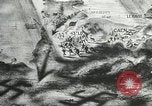
U.S.troops advance to Saint Lo in operation Cobra. U.S. 3rd Army advancing rapidly into Rennes, France, in World War II
Map showing path of Allied advance after D-day invasion in World War 2. German Marshal Rommel with staff. German artillery and armor firing. American heavy artillery, armor, and infantry advancing toward St. Lo in operation Cobra. Lieutenant General Omar Bradley, Lieutenant General Lesley James McNair, and Major General J. Lawton Collins, walking near the battle front. U.S. Army Air forces B-26 bombers dropping bombs at the front lines.(General McNair was killed by friendly bombers on July 25th in these operations.) U.S. infantry entering Saint Lo. House to house fighting and German soldiers taken prisoner.U.S.Sherman tanks firing point blank at houses and buildings.Large number of German prisoners being marched under guard with their hands over their heads. A wounded Allied officer being helped into a vehicle. Women and children refugees walking and in horse drawn wagons.French woman sorts through rubble trying to salvage some belongings. African American tank crewmen of the 761st Tank Battalion, operating with the U.S. 3rd Army, seen relaxing against a stone wall; cleaning their tank guns; and driving their Sherman tanks at high speed along dirt roads.General George Patton, Commander of the 3rd Army, looking through binoculars. French civilians waving enthusiastically as American armor drives through their villages. American forces arriving in Rennes, France, greeted by huge crowds and church bells ringing.
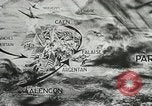
Allied forces closing in on German forces at Falaise, France, during World War II
Animated map depicts Allied and polish troops advancing toward Falaise, and American forces advancing toward Argentan, France, during World War 2. German forces stringing communications wire in the battle area. Allied forces setting up heavy field artillery. British Typhoon aircraft being armed and taking off. U.S. Army Air Forces Martin Marauder B-26 aircraft flying low overhead. U.S. and British soldiers in fox holes waiting with weapons at the ready. Close-up of African-American soldier's face. Suddenly, all artillery begins firing. A U.S. P-38 strafing and a P-47 aircraft dropping a bomb. U.S. artillery gun with "comment-Charlie" written on its barrel. Formation of British Avro 679 Manchester bombers in D-Day stripes. Allied pilot at controls in cockpit of bomber. Formation of U.S. Martin B-26 bombers in flight. Pilot in cockpit. Formation of British Hawker Typhoon aircraft. They peel off and two are seen firing rockets. American artillerymen firing heavy guns. British infantry pinned down on a roadside and firing mortars from foxholes. American troops firing mortars. German troops running to surrender. German soldiers surrendering under a white flag. Allied gun camera footage of a vehicle being strafed on a road. Several U.S. P-51 fighter aircraft with striped wing invasion paint roaring overhead. More surrendering German soldiers running forward. A U.S. B-26 bomber on bomb run with view of bombardier inside. Smoke and explosion scenes present throughout the footage.
U.S. soldiers in England, install wire cutters on U.S. jeeps before shipping them to France, during World War II.
U.S. soldiers of the 87th Chemical Battalion (mortar) make field modifications by installing wire cutters on army jeeps, at the D-Day Marshalling Area Camp in Shiphay, Torquay, (Devon) England during World War 2. U.S. soldier paints an angle iron vertical post (wire cutter) fastened on bumper of a jeep. He pastes U.S. flag on the windshield and writes OK in chalk on the front bumper. Line of modified jeeps travel along road after completing check ups. Soldiers use hack saws to cut pieces of metal and hand drills to put holes in bumpers where angle iron wire cutters will be fastened. They use files to take sharp edges off the angle irons. A soldier slips washers and bolts on an angle iron and tightens them with an adjustable wrench. (Note: These angle iron vertical rods, mounted on a vehicle front bumper, were meant to protect jeep occupants by catching and cutting wires that might be strung across roads to injure or kill unprotected drivers of open vehicles, such as Jeeps.)
U.S. Army airborne infantry training before and after World War II
U.S. Airborne forces in World War 2. U.S. Army Air Forces C-47 aircraft, painted in invasion stripes, take off as darkness falls, on June 5, 1944 (night before D-Day) and assemble in large formation headed toward France. Airborne troops seated inside cabin of a C-47. Some smoke cigarettes. One has "Rocky" stenciled on his helmet. One smokes a cigar. An officer stands in doorway of plane and then jumps, followed by his "stick" of troopers. View from ground of parachutes filling the sky overhead. Momentary view of troopers on the ground in Normandy. German troops, taken prisoners of war, marching in a town under guard, with their hands on their heads. Scene changes to post war training of U.S. Army airborne troops. They are seen practicing how to hit the ground. They practice use of static lines in wooden mockups of aircraft; and jump from towers, and engage in actual airborne exercises, at Fort Benning, Georgia. View of war materiel being airdropped from rear of an aircraft. Special parachutes being used to drop jeeps and artillery pieces.
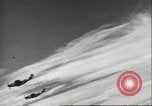
United States 8th Fighter Command P-51 gun camera footage showing German aircraft destroyed during World War II.
Activities of U.S. Army Air Corps 8th Fighter Command in Europe during World War 2. Gun camera footage showing P-51s downing German aircraft. German pilot bailing out in one scene. Brief view of a P-51 in D-Day paint stripes.
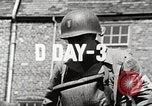
U.S. troops are ferried from Weymouth England, to transport ships in preparation for Normandy invasion in World War II
U.S. army troops board LCVPs (Landing Craft, Vehicle, Personnel) at pier in Weymouth, England, to be ferried out to transport ships anchored offshore, in preparation for the D-Day invasion of Normandy, France, during World War 2. Several large Landing Craft Infantry are seen tied up at the docks, including LCI(L) numbers 84 and 49. Views of Higgins Boats (LCVPs) heading out. Markings on one identify it as belonging to the Attack Transport ship USS Charles Carroll (APA-28). The Higgins Boats come alongside the USS Charles Carroll and troops of the U.S. 29th Infantry Division board her.
CRITICALPAST.COM: About Us | Contact Us | FAQs - How to Order | License Agreement | My Account | My Lightboxes | Shopping Cart | Advanced Search | Featured Collections | Website Terms & Conditions | Privacy Policy ©2026 CriticalPast LLC.
License Agreement |
Terms & Conditions |
Privacy Policy
©2026 CriticalPast LLC.