


 Francais
 Deutsch
 Italiano
Refine Your Search
2nd-Rangers-D-Day stock footage and images
- Showing 811 to 816 of 13613 results more
more Hide
Hide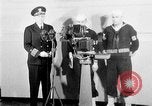
The Norden bomb sight is revealed to the U.S. public for the first time during World War II
The making of a public information film about the Norden bomb sight, during World War 2. Opening scene shows a Norden bomb sight on a pedestal, at the Museum of Science and Industry, in Radio City, Manhattan, New York City. It is flanked by U.S. Navy Captain, Irving Entwhistle and Shore Patrolman, Boatswain's Mate 2nd Class. Orville T. Payne. Another shore patrolman stands behind the bomb sight. The trio waits to begin. Then Captain Entwhistle begins to speak about the significance of the bomb sight to the war effort. The filming is interrupted and takes up again, focusing solely on Captain Entwhistle, as he continues to talk about the bomb sight, but is quickly interrupted, again, by the film director (heard, but not seen). The captain begins, repeating his scripted talk again. Scene shifts to Captain Entwhistle, now standing with hands on the bomb sight. He describes its operation as he maneuvers the sight. He notes the bomb sight's ability to take over control of the bomber's course to the precise drop point. Entwhistle, then looks up and comments: "Is that enough?" He then continues with his talk, but is interrupted, again. Next, Entwhistle picks up again, repeating part of his talk, while the camera pans over the bomb sight. Captain Entwhistle, states that, the instrument "is an automatic pilot, as well as a sight." He rotates the sight various ways for the camera, and asks: "'Want some more?" Scene changes, now showing Harold Barth, President of the Norden company, standing with Captain Entwhistle, who rotates the sight around on its pedestal, while chatting with him. (Microphones do not pick up the conversation.) Mr. Barth leans forward and peers through the sight. Next, in a closeup, the Captain manipulates the sight, while talking to Barth (sound not recorded). Mr. Barth and Captain Entwhistle, take turns looking through the sight. Closeup of the Captain looking through the sight, and manipulating its controls.
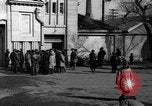
American advisors in China during World War II. Scenes of war-damaged and abandoned industrial sites and buildings
A group of Chinese Nationalist (KMT) and several American soldiers are gathered in the courtyard of a building in an industrial area of China during the 2nd Sino-Japanese War (World War 2). After conversing, they disperse and camera pans across surrounding compound that looks like it could house soldiers or workers. Another view of the American and Chinese soldiers conversing. Views of industrial buildings with smoke stacks. Corpse of a dead person lying on the ground near damaged building. View through hole in brick side of the building. Interior is strewn with debris.More views of damaged buildings in low-walled compound.
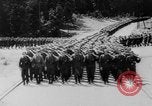
German coastal defenses against Allied invasion of Normandy and the battle of Villars Bocage, France, in World War II
A brief promotional scene of large columns of German Army soldiers, in class A uniforms, marching 9-abreast with shouldered rifles. A map of the English Channel with key cities shown along the French Coast. View from shore, of Allied invasion forces off the coast of Normandy, in World War 2. German soldier runs to an Atlantic Wall coastal defense gun, which then fires toward the invasion fleet. View of obstacles placed in surf at the beach. German coastal guns fire at Allied beachhead and ships offshore. Allied ship burning. German gunner seen inside the gun emplacement. Large explosion in water near shore. Destroyed invasion force equipment on the beach. abandoned Allied landing craft with numerous Army vehicles on board. Complete new sequence showing aftermath of the battle of Villers-Bocage, France. Destroyed Allied military equipment lines a road there, including many British Morris army trucks. One destroyed armored vehicle bears insignia of U.S. 2nd Armored Division, with names Betty, Joyce, and Sadie written on it. A German soldier walks past an American M3 halftrack with its right wheel jacked up and jerry cans stored on its side. A line of knocked out British armored trucks. An Allied soldier's shoe and flattened steel helmet. Sign at roadside reads: Villars, Bocage. Knocked out M3 Stuart light tank. Destroyed British Cromwell tanks on streets of the town of Villers-Bocage A British helmet on the ground in midst of debris near destroyed tank treads.
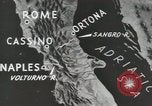
Canadian 1st Infantry Division troops engage German 1st Paratchute Division in battle for Ortona Italy, during World War II
Allied campaign in Italy during World War 2. A map depicts crossing of the Sangro Valley by the Allied Army and attack on the town of Ortona. Troops of the Canadian 1st Infantry Division, 2nd Infantry Brigade, enter the town of Ortona and fight against the elements of the German 1st Parachute Division, defending the town. Artillery being fired. Soldiers fighting in the streets. Damaged and destroyed buildings in the town after the German have been driven out after a bitter battle..
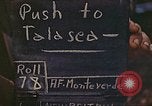
Elements of 1st Marine Division occupy Bitokara Mission compound in the Talasea District of New Britain during World War II
View of The German Roman Catholic church at the Bitokara Mission compound in the Talasea District of New Britain during World War 2. U.S. Marines of the 2nd Battalion, 5th Regiment, 1st Marine Division are seen strolling near a large building with wraparound porch, and relaxing near rough buildings that appear to be serving as their temporary quarters. Several marines walk in the interior of the mission church building. Altar and rows of bench seats are seen. Another view of the mission compound. A column of armed marines walks into the compound.

Various views of OSS airlift operations behind Japanese lines in Burma during World War II
Montage of scenes illustrating Office of Strategic Services (OSS) airlift activities in Burma during World War II. C-47 with number 26 on its tail seen on landing roll at an airfield. A C-47 (serial number: 41-19476) with number 33 on its tail. Men in khaki are loading supplies in the aircraft and several wearing parachutes board the aircraft. View of a C-47 with number 42 on its tail taking off from well established airport. A man with parachute stands in open cargo door of the aircraft during takeoff. (This segment of film is reversed.) A C-47, tail number 31 is seen cruising in flight. View from inside an airplane cruising over fog filled valleys and then later over jagged mountains. View of C-47 number 31 from cabin of another C-47. View of passengers inside C-47 cabin. A fighter escort of Two USAAF P-51s passes close to the C-47. Inside a C-47, crew members prepare supplies and then airdrop them behind enemy lines. View from below of supplies being dropped from a C-47. Views of airdrops from inside and outside C-47 aircraft. Commandos including indigenous personnel,parachute from C-47s. Views from camera strapped to leg of one paratrooper. View from ground of a parachutist descending. (Note: C-47 serial number: 41-19476 was assigned to the 10th Air Force, 443rd Troop Carrier Group in Burma, during world War 2, and was lost on on a mission, January 18, 1944, piloted by Ferde A. Larsen, of the 2nd Troop Carrier Squadron.)
CRITICALPAST.COM: About Us | Contact Us | FAQs - How to Order | License Agreement | My Account | My Lightboxes | Shopping Cart | Advanced Search | Featured Collections | Website Terms & Conditions | Privacy Policy ©2026 CriticalPast LLC.
License Agreement |
Terms & Conditions |
Privacy Policy
©2026 CriticalPast LLC.