


 Francais
 Deutsch
 Italiano
Refine Your Search
2nd-Rangers-D-Day stock footage and images
- Showing 8179 to 8184 of 13612 results more
more Hide
Hide
Imperial Japanese Army (IJA) soldiers commit war atrocities and murder during World War II
Atrocities committed by Imperial Japanese Army (IJA) soldiers in China and other parts of Asia during World War II. War workers in offices, factories, and mills shift their attention to the narrator. Smoke rises from factory smokestacks and chimneys. American workers manufacture war materiel in factories. Factory workers shovel coal to the furnace. Japanese soldiers abuse elderly Chinese women. A Japanese soldier toss an infant before striking with a bayonet midair. A Chinese woman watches with shock. IJA troops drag and bury Chinese civilians alive. IJA troops burn cities and shoot victims at close range. Soldiers place the remains of dead Chinese men, women, and children in truck. Japanese soldiers torture and kill Chinese civilians and are depicted killing American Prisoners of War (POW). Aerial views of San Francisco, Chicago, Pittsburgh, and New York. A dead Japanese soldier with flies covering his face. A newly built M4 Sherman tank moves inside a factory. Body of a Japanese soldier wearing round glasses. Dead Japanese soldiers seen with repeating American wartime propaganda message that every piece of wartime production "kills a Jap." Tanks, trucks, planes, shells, guns, and artillery are manufactured in United States factories and plants during World War II. Americans urged to take war jobs to help win World War 2.
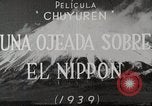
Japanese radio facilities in Tokyo Japan; live studio orchestra playing and broadcasting to South America before World War II.
Radio facilities and broadcasts in Japan before World War 2. Japanese radio facilities in Tokyo. Broadcasting to South America. Radio towers and radio facilities in Tokyo, Japan. Building of Radio Broadcast Center. A Japanese radio announcer speaking in Spanish. Flag of Japan on the building. Interior of the building. A Japanese conductor walks to podium and prepares to conduct orchestra. Musical instruments or in-studio orchestra play. Animated map of Latin America and South America. Sign on the animated map. Animated map describes radio broadcast in Mexico and South America. Animated map of Japan shows Tokyo.
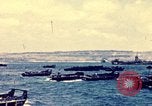
Amphibious assault in Operation Gunto of the Okinawa campaign during World War II
A flotilla of American Higgins boat landing craft head for the shore of Gunto, Okinawa during World War 2. Some Landing Craft Infantry (LCIs) are also seen. Landing Craft Large, LCI (L) number 326 is seen in the background. View from a Higgins boat landing craft of several LCI(L)s ahead. Silhouette of a Transport Ship is seen in waters close to Okinawa. An undentified white boat is behind it in the sunlight. Beyond that,nearer the shore, is the white hospital ship, USS Comfort (II) (AH-6).
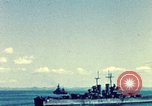
United States warships shell Okinawa, Japan, during World War II
U.S. Naval Task Force of warships bombarding Okinawa in World War 2. Light cruiser USS St. Louis, CL-49, in foreground in the background is the battleship USS Texas, BB-35 shelling Okinawa. Heavy cruiser USS Wichita, CA-45, using signal light communications. Foreground the stern of the USS St. Louis, USS Texas in background. LCI 370 (Landing Craft Infantry) approaches from the right with the USS Texas in the background. On right, the USS St. Louis has turned to port and is shelling Okinawa, a destroyer in the middle, and the USS Texas on left. Close up of the USS St. Louis's stern as she shells Okinawa. Close up of three gun turrent firing. USS Texas in close shelling a hillside Japanese strong point on Okinawa. Shell hits the top of a hill and beach. Explosions due to the shelling. Smoke rises from coastline of Okinawa. Smoke rises from hill on Okinawa and shells hit around base of hill.
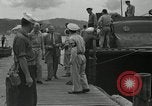
Soldiers watch a show of Jack Benny and party aboard a ship in the Pacific.
USO Show of Jack Benny and party in the Pacific Ocean theater during World War 2. American entertainer, Jack Benny walks along dock with guards. Jack Benny & party walk along dock. Men on tree watch show. Crowd of sailors and soldiers seated on lawn watches show. People talk.
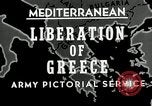
Celebration of liberation from German forces, and enthusiastic welcome of Prime Minister George Papandreou and British Armored unit in Athens Greece.
Liberation of Athens Greece during World War 2: Animated map of Athens, Greece. German forces end more than 3 years of occupation by withdrawing from the capital of Athens at end of October 1944, as British Allied forces near the city. Scenes of a ceremony by German troops before leaving, and then German army forces in trucks and armored vehicles leaving the city. Celebration: Greek boys ring bells and smile on departure of German forces. British troops dock in Greece and march into Athens. They are joined by partisan greek soldiers such as those from the ELAS and EAM. Close-up view of ELAS and EAM (National Liberation Front) Greek soldiers in uniform. Workers carry boxes of water. Narrator states that half of Greeks are for victims of malaria or tuberculosis. Boxes of water displayed. Shows the return of Prime Minister George Papandreou on October 18, 1944. Large crowd welcomes and cheers the Prime Minister George Papandreou and display banners for liberating their country. Prime Minister Papandreou puts the wreath on grave of unknown soldiers. British Lt. General Ronald Scobie salutes. General Scobie and Prime Minister Papandreou honor the two unknown soldiers. British Armored unit receive enthusiastic welcome. Sign of 'The Greek People Welcome EAM', and 'Welcome Great Allies KKE'. Greek people welcome the National Liberation Front (EAM) and Communist Party of Greece (KKE). Citizens buy food with inflated currency. Inflation causes citizens to hand over large amounts of currency for small purchases like bread and basic produce.
CRITICALPAST.COM: About Us | Contact Us | FAQs - How to Order | License Agreement | My Account | My Lightboxes | Shopping Cart | Advanced Search | Featured Collections | Website Terms & Conditions | Privacy Policy ©2026 CriticalPast LLC.
License Agreement |
Terms & Conditions |
Privacy Policy
©2026 CriticalPast LLC.