


 Francais
 Deutsch
 Italiano
Refine Your Search
2nd-Rangers-D-Day stock footage and images
- Showing 871 to 876 of 13613 results more
more Hide
Hide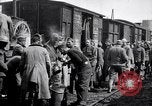
U.S. 1st Division troops (AEF) in Picardy, France, during World War I
U.S. 2nd Field Signal Battalion troops (AEF) getting their food in a chow line at an Army field kitchen alongside rail cars at Maron, France, during World War 1. They step aside as a steam locomotive arrives on the track next to them. Some soldiers sit on railroad equipment as they eat their meal. Several others cook over their own fire. Change of scene shows German prisoners of war being marched to the rear, and through a town near Catigny. A few are wounded, but ambulatory. One is carried on a litter, by his comrades.
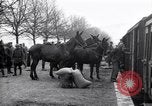
U.S. First Division troops load military supplies aboard a train in France during World War I
Mules, of the U.S. Army 2nd Field Signal Battalion, stand on a railroad platform, waiting to be loaded aboard a train, in France, during World War 1. Soldiers tending them stand nearby. Sacks of food sit on the platform. Soldiers coax a mule across a ramp into a train car. In another scene, 1st Division troops load war materiel aboard open cars of a train. A group of soldiers works to roll a French 75 artillery piece up a ramp onto the train. Another large group works to roll a heavily laden wagon up on to the train. (WWI. WW1)
A 1942-1943 film report to the American public about the progress of World War II in Europe and the Pacific.
Opening slate at start of film reads: "1942--1943 The Turn of the Tide." A column of British armor enters Bengazi, Libya, led by several troops in tankettes. Next seen are a Lee Medium Tank, M3 followed by an infantry tank, a jeep, another infantry tank and another Lee M3 Medium tank. Closeup of local people greeting the troops with upraised hands giving the "V" for victory sign. Another Lee M3 tank passes close by the camera. Black smoke is rising in the background. Scene changes to a half sunken ship near another burning in the harbor. Another view of this from further away above port buildings. Closeup of three smiling British soldiers leaning over a cartoon on a tank, of Winston Churchill (As a bulldog smoking a cigar and wearing a cap with the word "Victory" written on it). A crumpled captured flag with swastika on it. British Field Marshal Bernard Montgomery stands atop a vehicle (unseen) and looks through binoculars. Below, a column of British supply vehicles is making its way along a path in the desert. Two tanks coming toward the camera through sand. Animated map shows Nazi territory being threatened by the Allies from the Mediterranean, the USSR, and the English Channel. Views of Soviet infantry advancing against German forces in the snow of winter on the eastern front. Soviet troops firing updated 76-mm divisional gun model 1902 hidden in woods. Shells exploding in snow-covered field as Soviet BT series tanks advance. Various Soviet artillery firing from fixed gun batteries and from woods. A shell striking in distance. Fallen German soldiers lying on snowy field. Makeshift battlefield crosses marking graves of fallen German soldiers. German steel helmets lined up in the snow. A sign, posted on a birch tree, lists the names and birth dates of 16 German soldiers from the 3rd Panzer Division (3Pz-Pi-BH.39) buried at this site on November 28, 1941. Scene shifts to Joseph Stalin addressing Soviet troops in Red Square, Moscow, Russia. All the soldiers in formation seem to be singing (unheard). Film switches to animated map again. This time delineating the Eastern front being pressed by the USSR, and showing area of the 2nd Soviet winter offensive in 1943. Change of scene from Europe to the War in Asia, against Japan, shows General Douglas MacArthur after arriving by a B-17 bomber at a Pacific island American base. He ascends a steep hill in a jungle area, accompanied by other officers. Closeup of MacArthur. American infantry moving in single file in New Guinea, as a field piece fires a round in the direction they are headed. U.S. artillerymen load shells into a 105mm howitzer gun. A fire burns as mop-up operations begin on New Guinea. An Australian soldier is seen firing a Bren gun in jungles. Other Australian soldiers fire a mortar that explodes, raising earth and dust. More views of shells exploding near Allied soldier advancing. A soldier with fixed bayonet makes a fake charge toward the camera. Views of Japanese prisoners of war guarded in an outdoor compound. Japanese dead soldiers on Guadalcanal. An animated map shows new battle lines in the Pacific, closing in on Japan, with pressure from China, the USSR, and the Pacific islands being captured by the U.S. Arrows are added showing new pressure from American naval fleets and from British and American bombers out of Australia and captured islands.

Innovative new British vehicles move on land, water, and snow; the "Stalwart" and the "Gadabout" are shown.
The British unveil a vehicle called the Stalwart that can navigate the toughest terrain as well as move in water. The vehicle is a huge six wheel drive military transport with individually sprung drive wheels to give it traction in all situations. It is for military or farm use. The vehicle is shown moving on varied terrain areas with ease. It moves in deep water operating like a partially submerged boat and then boards a ship at sea by floating up to its opened ramp and driving up onto the ship. Showing another British vehicle innovation, men stand near a "Gadabout" car in a snow covered area. It has twin engines -- a motor in the front and the rear. Each engine has an independent gear lever. Driver is shown engaging 2nd gear lever to use additional engine in helping it move in the snow.
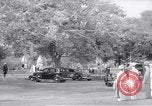
Viceroy reviews rally of Bombay Civil Defense Organizations and Red Cross workers in Bombay, India.
Viceroy Victor Hope, 2nd Marquess of Linlithgow, reviews rally of the Bombay Civil Defense Organizations in Bombay, India. British Viceroy's car arrives. He comes out of his car and officers greet him. Guards of the Civil Defense Organizations stand in formation. Buildings and trees in the background. Ambulances parked on the ground. Viceroy inspects a line of Red Cross and ARP workers. He greets a Red Cross worker.

Abyssinian Border disputes and the beginning of the Second Italo-Ethiopian War
Start of the 2nd Italo-Ethiopian War (Second Italo-Abyssinian War).Map shows Red Sea, Arabian peninsula, and Africa, and highlighting Ethiopia and its capital, Addis Ababa, along with Djibouti and the regions of Erythree (Eritrea) and Somalie Italienne (Italian Somaliland). Following border controversies, Narrator states the matter came to a head when Italian and Ethiopian elements clashed at Welwel oasis (aka Walwal, or Ual-Ual).on November 26, and again, on December 4, 1934. Views of League of Nations council reviewing the situation. (They later concluded, on October 7, 1935, that Italy violated Article 12 of the League Covenant, by its invasion on October 3rd.) Crowds are seen demonstrating in Ethiopia. Italian forces are seen embarked on a ship as part of Italy's force buildup. Italian forces, including armor and infantry, are seen in their wholesale invasion from Eritrea, into Ethiopia, on October 3, 1935. With war declared, Ethopian troops muster in areas of the Capital, Addis Ababa. Ethopian tribesmen are seen answering the call to arms
CRITICALPAST.COM: About Us | Contact Us | FAQs - How to Order | License Agreement | My Account | My Lightboxes | Shopping Cart | Advanced Search | Featured Collections | Website Terms & Conditions | Privacy Policy ©2026 CriticalPast LLC.
License Agreement |
Terms & Conditions |
Privacy Policy
©2026 CriticalPast LLC.