


 Francais
 Deutsch
 Italiano
Refine Your Search
2nd-Rangers-D-Day stock footage and images
- Showing 8875 to 8880 of 13613 results more
more Hide
Hide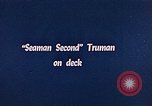
President Harry S. Truman of United States on deck of USS Augusta, on his visit to Berlin, after World War II.
President Harry S. Truman, in shirt and tie, without his jacket, and wearing a sailors hat, strolls along the deck of the heavy cruiser, USS Augusta(CA-31) as she makes way in the Atlantic headed toward Europe, following the end of World War 2. A member of his party points out something of interest on the deck. The Augusta test firing her 5 inch guns. Turret 3 main battery 8 inch 55 caliber guns fire one salvo. Views of bow waves and ship's wake astern, as the Augusta and accompanying ships proceed at 27 knots.
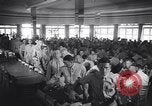
Organization of the United States Army and its divisions responsible for coordination during combat missions.
Organization of the United States Army in World War 2. Men stitch uniforms of soldiers at a factory. Animated flowchart showing various levels of service and departments in the U.S. Army. Secretary of War is the Supreme Commander followed by Chief of Staff and a Deputy Chief. Ground, Air forces and Supply services. Procurement of ammunitions and equipment is directly looked after by Secretary of War. Trucks for supply for army. Soldiers during combat missions. Task Force, Defense Command and Theater command aligns the forces during such missions. Sailors on a navy ship.
Training, staffing and Organization of Army Air Forces of the United States Army in World War II.
Organization of the United States Army during World War 2. Process of forming a unit of Army Air Forces. Aviators during a march. Animated map shows its organization under Commanding General, Chief of Staff, 27 combat groups and 1750 planes. Planes at a base. Map shows Fighter Air Command, Bombers, Air Support and Air Service Commands. Line of new U.S. Army Air Force Airmen in civilian clothing as each of the new recruits raises their right hand to take an oath of service as they join the Army. Map shows flying training schools and technical training schools. Training imparted in 36 weeks to the aviation cadets. Cadets fly in formation. Fighter planes and bombers flying. Navigators, Gunners, Bomb crew, Tech training command, Engineers of planes trained. Fighter planes manufactured. (World War II period).
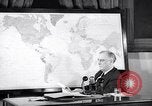
United States President Franklin Roosevelt addresses nation and shows the channels of American ships, in Washington DC.
United States President Franklin Delano Roosevelt addresses the nation from White House in Washington DC during World War 2. Sitting at his desk he points to a map of globe behind his desk. He demonstrates lines of travel of American ships. He points towards North Atlantic, Indian Ocean and Pacific Ocean. He shows various harbors and naval bases at waterfronts of the United States.
Scenes of warfare using American technology, including submarines, aircraft bombing of London, atomic bomb use in Japan
Training regarding relief and rebuilding works in Germany and Japan by United States Army, after World War II. Narrator discussing adoption of American inventions during the war that were used against America and allies. Sketch of an early American submarine design, followed by view of German U-boats operating under sea, firing torpedoes and target ship is destroyed. Footage of Wright brothers with an early Wright Brothers airplane invention, as they prepare it for a flight. This is followed by a view of London burning after aerial blitz raids by German aircraft during World War 2. View of atomic bomb explosion over Japanese city of Nagasaki and mushroom cloud seen from the air. Also view of Trinity blast in New Mexico - the first U.S. atomic test. The atomic cloud rises high and vast in the sky. Narrator warning against the perils of a third world war.
Orientation film for U.S. Occupational Forces in Japan. Militaristic Japan in past wars. Converting Japan into Peaceful Nation
Segment of orientation film for American troops occupying Japan after World War 2. First scene shows Japanese troops marching shouldering rifles with fixed bayonets. Viewed from more distance they are seen marching past the Japanese Imperial Palace on a hill in the background. Slate is superimposed over the scene reading: "Created to Rule the Whole Earth." Japanese soldiers rising from trenches to charge their enemy. Shells bursting all around them. Views of some huge explosions. Dead Chinese woman and child lying in rubble. Japanese soldier holding Rising Sun flag, charging past building. More dead women and children. Japanese troops advancing against wooden houses. Dead soldier lying on ground, with pistol held in his upraised hand. Japanese troops advancing past burning rural dwellings. Dead Chinese civilians in wreckage. Japanese troops holding Japanese flags celebrate a battlefield victory. Views of wounded Allied soldiers being transported on litters by American soldiers, interwoven with views of Japanese troops celebrating. Japanese civilians celebrating en masse. View of a human brain superimposed over scenes of celebrating Japanese soldiers and people. A slate superimposed at this point reading: "This is Japan's Last War." Views of Japanese workers busy in war production plants and factories, with Japanese war production workers building armament, war planes, and tanks; Japanese military officers walking in full dress uniforms ; Japanese warships; and Mitsubishi Ki-21 bombers in formation ("Type 97 Heavy Bombers") . All these views of war machinery are symbolically ended by intervening views of explosions. View of crashed Japanese warplane. Several American soldiers are seen among many Japanese people. Several American soldiers check identification of a Japanese man. U.S. soldiers standing guard in a roadway, as many Japanese stand in background. American soldier searching an unarmed Japanese soldier. Two American soldiers use a phrase book as they ask directions from a Japanese woman and her daughter. Japanese youth clapping hands and holding a homemade American flag. U.S. military officers accepting Chrysanthemum flowers from girls in traditional Japanese attire. A U.S. soldier reads a comic book to a Japanese boy. Other American GIs talk with a Japanese soldier. American troops in a chow line at a dining hall. U.S. soldiers with Japanese children at the Great Buddha of Kamakura at the Kotoku-in Temple in Kamakura, Kanagawa Prefecture, Japan. American soldier riding a bucking bronco in a Western Rodeo put on by U.S. forces. U.S. soldier and Japanese police sentries standing side by side.
CRITICALPAST.COM: About Us | Contact Us | FAQs - How to Order | License Agreement | My Account | My Lightboxes | Shopping Cart | Advanced Search | Featured Collections | Website Terms & Conditions | Privacy Policy ©2026 CriticalPast LLC.
License Agreement |
Terms & Conditions |
Privacy Policy
©2026 CriticalPast LLC.