


 Francais
 Deutsch
 Italiano
Refine Your Search
2nd-Rangers-D-Day stock footage and images
- Showing 9367 to 9372 of 13613 results more
more Hide
Hide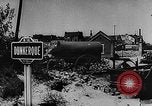
Allied evacuation from Dunkirk, France, during World War II.
Evacuation of Allied Troops at Dunkirk, France, during World War 2. Opening scene shows black smoke rising from beach area. Sign reads "Dunkerque". A German Henschel He 126 aircraft rolls over and dives toward Dunkirk. A formation of British Spitfire aircraft are seen, providing air cover over the beach during the Allied evacuation. They have dogfight with a German Fockwulf FW 190 fighter and engage a Heinkel He-111 bomber, and down a German Dornier Do 17 bomber. Allied antiaircraft guns firing from the beach area down a Henschel He 126 aircraft. Contrails in the air from dog fighting airplanes. Gunners fire from open cockpit airplanes. An Allied airplane is downed and crashes in an explosion. German Ju 87 (Stuka) dive bombers dive on targets. View from cockpit of one aiming for a transport ship. The plane pulls out and releases a bomb that explodes in the water next to the ship. View from distance of bombs exploding on a ship. British ships and boats of all kinds being employed to evacuate Allied forces. Soldiers being helped to board them, including some wounded on stretchers. Survivors from bombed ship make way in lifeboats. More smoke on the horizon from bombed ships. A wrecked British Spitfire on the beach. A crashed German Messerschmitt Bf 109 on the beach. A crashed German Heinkel He 111 bomber, inland. View of bomb damage in City of Dunkirk. Roadsides littered with abandoned Allied vehicles and equipment. A dead Allied soldier lying next to a truck. Abandoned antiaircraft guns and variety of military equipment left on the beach.

United States engineers make warplanes at Chanute Field, Illinois.
United States engineers at Chanute Field, Illinois. Engineers and war production workers building and assembling aircraft engines and airplanes inside an aircraft factory, early in World War 2, before America's entry into the war. Americans build equipment to aid allies and prepare for defense as war accelerates in Europe during World War II. Banks of spark plugs being tested, men assembling engines and propellers for airplanes. Man testing gear for lowering landing wheels on aircraft.
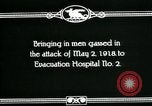
Soldiers affected by a poisonous gas are brought to Evacuation Hospital and advanced field hospital at Vesle Front, France.
A United States Army training film about defense against chemical warfare. U.S. soldiers affected by a poisonous gas in World War I are brought to Evacuation Hospital number 2 after an attack in 1918. United States troops put wounded soldiers on army trucks. Wounded soldiers at the advanced field hospital of the Fourth Division at Vesle Front, France in August 1918. (World War 1. World War I. WWI.)
German prisoner, Otto Richard Struller, is transferred by jeep from Béverce near Malmedy, Belgium during World War II.
A U.S. Military policeman leans against his jeep in front of a small building in Béverce near Malmedy, Belgium during World War 2. Two German prisoners emerge from the building escorted by an armed American soldier. A military photographer passes to the left, in front of them, as two American military policemen escort another German prisoner (Otto Richard Struller) from the building. They each hold one of his arms. The prisoner is bareheaded. They pause and pose for a photographer (unseen). Closeup of the prisoner with MPs at his sides. Camera zooms in on prisoner, Struller. The MPs direct him to a waiting jeep. They all get in and drive away. Closeup of the jeep passing the camera. It drives away along a muddy road, past an overturned vehicle. (Note: The principal prisoner in this film, is Otto Richard Struller, a ballet dancer, who during the war served as a corporal with Panzerbrigade 150 unit Stielau/Stab solar, where he masqueraded as an American soldier behind the lines. He was executed, as a spy, on January 13, 1945 at the Palace of Justice in Huy, Belgium)

On 8 December, 1944, U.S. soldiers test a new type rocket launcher at Viareggio, Italy, during World War II
U.S. soldiers insert charges into rockets and then load them into a multi-barrel rocket launcher mounted on a 37mm gun carriage, set up on the shore at Viareggio, Italy in World War 2. They load the 4.5 mm rockets into the firing tubes. Next the rockets are seen being fired by a soldier from a remote position. (Ordnance and Artillery Sections of the U.S. 5th Army developed this rocket launcher.)
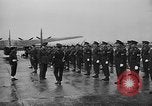
Various Allied Generals assume new commands in Italy during December, 1944, World War II.
On 12 December, 1944, at an airport in Naples, Italy, British General Sir Henry Nathan Wilson inspects an honor guard of American Military Policemen in formation. (Narrator states he is en route to replace the late Field Marshal Sir John Dill, in Washington, DC, USA) A contingent of British troops is also present as part of the honor guard, on the wet airport tarmac. (Narrator states that Wilson will head the British Joint Staff Mission and be personal military representative for Prime Minister Winston Churchill.) He approaches a line of U.S. military officers who salute him. Closeup of General Wilson With U.S. Army Air Forces Lieutenant General Ira C. Eaker, next to U.S. Vice Admiral Kent Hewitt. Also with them (back to camera) is British Admiral Sir John Henry Dacres Cunningham, Commander-in-Chief for the Mediterranean Fleet. Next, General Wilson and his party are seen boarding a British Avro York four-engine Heavy Transport aircraft. View from the ground, of the aircraft cockpit and the engines running as it taxis out for takeoff. Change of scene shows troops gathered in open air battlefield environment. General Mark Clark, now Commander-in-Chief of the Allied 15th Army Group, decorates some members of the 5th Army, as General Lucian King Truscott Jr. (new 5th Army Commander) stands by his side. General Clark says farewell to members of the 5th Army and shakes hands with many of them. (World War II; WW II; World War 2; World War Two)
CRITICALPAST.COM: About Us | Contact Us | FAQs - How to Order | License Agreement | My Account | My Lightboxes | Shopping Cart | Advanced Search | Featured Collections | Website Terms & Conditions | Privacy Policy ©2026 CriticalPast LLC.
License Agreement |
Terms & Conditions |
Privacy Policy
©2026 CriticalPast LLC.