


 Francais
 Deutsch
 Italiano
Refine Your Search
2nd-Rangers-D-Day stock footage and images
- Showing 9529 to 9534 of 13612 results more
more Hide
Hide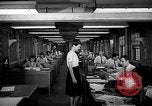
Work at an accounts department in an administration building in Oak Ridge, Tennessee.
An accounting department at an administration building in Oak Ridge, Tennessee, created during Manhattan Project effort to build the atomic bomb in World War 2. A man gives papers to a woman. She goes away. People work at a desk. Mr. Frank B. Elackston, the Chief Accountant, dictates to his secretary at his desk. Engineers work in a drafting room in the Engineering Section. Two men work at a drafting desk. A soldier hand prints a name on a blueprint at a desk.
Radar for establishing contact with the moon reflects rays back on the earth from the moon in United States.
U.S. Army radar equipment used to contact the moon. Steel structure of a radar. Men work at controls. Moon in the background of the radar. Animation shows distance of moon and earth being 238000 miles. Radar beam reaches to the earth in 2.4 seconds. Radar rays go to moon and comes back to earth after reflecting. Readings of radar shows signals. Picture of the surface of the moon. Narrator says, "no longer beyond men's dreaming is the possibility of reusable airplane-like space ships to commute between the two planets (the earth and the moon)" as animation shows an aircraft space ship flying from the earth to the moon (foreshadowing the NASA Space Shuttle program).

In the North Sea German bombers target warships escorting British and French troops leaving Namsos, Norway.
Evacuation of British forces during Namsos Campaign of World War 2. Views of German aircraft in flight and explosions from German Luftwaffe bombing in Namsos Norway region. Mountainous terrain near Namsos, Norway. British Lieutenant General Adrian Carton de Wiart, wearing eye patch, standing beside another British officer. Views inside a hospital in Namsos, where British and French medical personnel assist wounded British and French soldiers. A French soldier in a hospital bed shows his damaged helmet. A bomb blast on the ground. A British and French navy escort convoy begins its return to Scapa Flow from Namsos, Norway with British and French troops aboard. View of calm pre-dawn before the transport convoy is detected by German forces. Then a blast near a ship in the North Sea as German aircraft begin to attack the ships. British soldiers on the ship deck sit and watch as British ships battle against German airplanes. Anti aircraft guns fired from the warships. German aircraft drop bombs near a ship. The German aircraft in low flight. Scenes of British Navy and French Navy sailors firing anti-aircraft guns. Navy seamen look at the planes. Anti aircraft guns are fired. Fired empty shells on the deck of the ship. The ship underway with troops.

Cincinnati Reds beat Detroit Tigers to win the 1940 World Series
The Cincinnati Reds defeat the Detroit Tigers in game 7 of the 1940 World Series to capture that year's major league baseball title. Shot of crowd at Crosley Field in Cincinnati Ohio watching the game. In second inning, the Tigers' Hank Greenberg (#5) is tagged out by the Reds' second baseman Eddie Joost in a rundown between second and third base, ending a Tiger scoring threat. Crowd cheers. In seventh inning, Tigers pitcher Bobo Newsom (#12) gives up a fly ball to Reds shortstop Billy Myers, allowing Jimmy Ripple to score what would prove to be the winning run in the 2-1 Reds victory. Hundreds of fans rush onto the field and celebrate with at the end of the game.

Floating dry docks for repairs in the Pacific Ocean with USS Cleveland, CL-55, during World War II.
Floating dry docks for repairs shown in the Pacific Ocean. Panels of dry dock carried in a ship. U.S. Navy Floating dry dock in the Pacific Ocean during World War 2. A U.S. Naval officer salutes. Sailors salute as U.S. flag is hoisted at the dock. At time 00:33 to 1:00 light cruiser, USS Cleveland, CL-55, arrives at floating dry dock and is raised out of the water. A fleet oiler(AO)is shown raised out of the water in the floating dry dock.
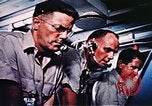
Detonation of liquid thermonuclear device MIKE, the first hydrogen bomb, at Enewetak Atoll, Marshall Islands.
Full-scale thermonuclear test of ultracold liquid deuterium, codenamed Ivy MIKE at Enewetak Atoll in the Pacific Proving Ground in the Marshall Islands (sometimes spelled Eniwetok or Eniewetok). (Left to right) Chief engineering and firing commander, Stan Burris -- later the leader of the Strategic Ballistic Missile development, including Polaris and later editions; retired as CEO of Rockwell Aerospace -- military firing and security commander, Colonel Richard Lunger, and ultracold refrigeration engineering commander for thermonuclear liquid fuel state monitoring, Robert Gibney. The intense nuclear radiation ignited the atmosphere around the device, creating a fireball 4.2 miles across. A remote firing control was created, using a televison tower beam signal to safely trigger the detonation from the USS Estes, approximately 35 miles south/southeast of the detonation. White hot device remnant specks are visible throughout the surface of the fireball. Shockwave from Operation Ivy Mike explosion is seen spreading across the water, then a white mushroom cloud spreading above. View of crew on ship deck observing blast. Device yield: 10.4 megatons.
CRITICALPAST.COM: About Us | Contact Us | FAQs - How to Order | License Agreement | My Account | My Lightboxes | Shopping Cart | Advanced Search | Featured Collections | Website Terms & Conditions | Privacy Policy ©2026 CriticalPast LLC.
License Agreement |
Terms & Conditions |
Privacy Policy
©2026 CriticalPast LLC.