


 Francais
 Deutsch
 Italiano
Refine Your Search
2nd-Rangers-D-Day stock footage and images
- Showing 9895 to 9900 of 13612 results more
more Hide
Hide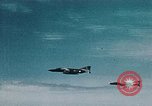
The battle of Khe Sanh in the Vietnam War.
Film begins showing two U.S. Air Force McDonald Douglas F4 Phantom jet fighters in flight. Narrator says American intelligence reports on January 29, 1968, of a 4th North Vietnamese Regular Army Division in the Khe Sanh area, bringing total enemy strength to about 40 thousand regular troops. View of photo interpreter rolling large wet film taken by Air Force surveillance aircraft. Map of Hue, area of South Vietnam, showing disposition of American forces in the region. American Marine Colonel David E Lownds, Commander of Khe Sanh garrison, describes North Vietnamese offensives against some American held positions. Views of North Vietnamese attacks being repelled by artillery and air strikes as well as organic infantry weapons like the A1 millimeter mortars, 3.5 rockets, and M79 machine guns. U.S. aircraft drop munitions on enemy positions. Infantry firing guns mounted on vehicles. An F4 Phantom drops napalm that creates a swath of fire. Closeup of North Vietnamese newspaper warns that the Americans face a defeat comparable to that of the French at Dienbienphu. American newspapers express concerns about the fate of the Marine Garrison at Khe Sanh. U.S. Army General William Westmoreland, Commander of U.S. troops in Vietnam, is seen and heard expressing confidence that American forces would win the battle of Khe Sanh. American troops listen as he speaks. Marines in briefings and in combat, including African American Marines. American artillerymen load and fire a 175 mm field gun at Camp Carrol, and a location called the Rock pile with a network of trenches. Inside that base, are seen Ontos M50A1 multi barrel anti-tank tracked vehicles armed with 105 mm recoiless rifles. A marine fires a 4.2 inch mortar, and another fires a recoiless rifle. Marines firing a 155mm howitzer. Scene shifts to deck of an aircraft carrier. View of Navy F4J phantom fighter aircraft being launched from the USS Ticonderoga (CVA 14) (Note: this may be an anachronism. Reportedly, the F4J was not operating from aircraft carriers in the Vietnam until after 1968). F-4 Phantom fighters taking off from an Air Force base. Aerial view of a U.S. Air Force B-52 bomber dropping conventional bombs on North Vietnamese targets. View from the air of bombs exploding on the ground over battlefield terrain. A C-130 transport plane dropping supplies to U.S. marines on the ground. View from below of the parachutes descending with supplies. Closeup of C-130 dropping mail from above. More views of parachute drops from C-130 aircraft to Khe Sanh. C-123 transport landing at a Marine base and a C-130 taking off. Another C-123 landing. Another having load delivered by low level extraction. Marines on the ground at Khe sanh opening packages of supplies and using a tractor to transport large boxes. On February 13, Marines suffered casualties when a platoon was ambushed just outside the base perimeter. View of Marine on a litter. Heavy black smoke rises at the base from shelling by North Vietnamese artillery. A C-123 aircraft takes off with dense black smoke in the background. Another napalm attack by a U.S plane creates a large conflagration. View from above of a B-52 dropping bombs only yards outside the Khe Sanh perimeter. Marines patrolling close in the base. More views of B-52s bombing North Vietnamese targets. View of nighttime bombing operations. A Marine plotting enemy movements on a plexiglass chart. Marines manning machine guns as enemy rockets and mortars continue to pound the garrison. Officers are seen in CINCPAC Command center. Continued U.S. bombardment and air strikes appear to prevent massing of enemy forces for an assault. Marines controlling hills in the area. A UH-1 Iroquois (Huey) helicopter flying low over the base. During a lull in battle Marines fill sand bags, maintain their weapons, play cards, and keep occupies as they sit and wait. Some play basketball with an outdoor improvised backboard and net. Some marines select books from a library. A marine plays a guitar as some others listen. Closeups of Marines in trenches including white and African American Marines. Marines doing their wash and having a meal of C rations. Marines preparing their own combinations of ingredients into meals being cooked over open fires. Views of many marines eating the various mixes of C-rations they called "casseroles." Marines in trucks pursuing retreating elements of North Vietnamese on Highway 9 that had been opened by Marine engineers. U.S. Army First Air Cavalry reinforcements arrive in operation Pegasus. Marine engineers working to restore bridges and roads needing repairs. Soldiers detecting and neutralizing mines. Bell UH-1 helicopters ferry troops. Captured enemy arms and ammunition. Surrendered North Vietnamese soldier prisoners of war marched under guard.
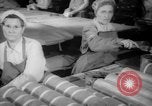
Elderly men do bench work and master mechanist instructs woman to use metal lathe in Douglas Aircraft Factory.
War production workers during World War 2. Two women work on installation for fuel and oil lines in Douglas Aircraft Factory, Long Beach, California. Old men do bench work. They work with various instruments and equipment. Master mechanist instructs a young woman in use of a metal lathe.
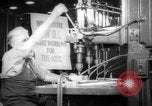
Women workers work at upholstering department and welding in Douglas Aircraft Factory, Long Beach, California.
Old man works on multiple-bit drill press in Douglas Aircraft Factory, Long Beach, California, during World War 2. Old men work on grinders. Both elderly women and young women war production workers in upholstering department. Women war workers wear protective helmets and shields and serve as welders. They weld parts in the aircraft factory to aid the war effort.
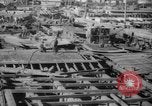
Deck plates, after mast and midship deck houses weighing 75 tons hoisted aboard ship in ways in Kaiser Shipyards, Richmond.
Shell assembly at Kaiser Shipyards in Richmond, California during World War 2. Women riveters at work. Deck plates hoisted aboard Liberty ship in ways. Welders and burners on fore peak assembly. Hoisting after mast on ship in ways. Large crane hoisting and setting in place LIberty Ship midship deck house weighing 75 tons.
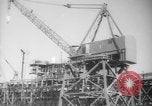
Welders work on bow peak and men work on after peak in Kaiser Shipyards, Richmond.
Liberty ship construction in World War 2. Midship deck houses weighing 75 tons hoists on board ship in ways at Kaiser Shipyards in Richmond, California. Welders work on bow peak. Men work on after peak. Deck house rose aboard ship by large crane.
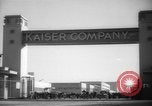
Views of Kaiser Shipyards, Richmond, California, where Liberty ships are being constructed during World War II.
Construction of Liberty Ships during World War 2. Sign over entrance to the Kaiser Shipyards in Richmond, California, one of the U.S. shipyards where Liberty ships were being constructed. Change of shift in Kaiser Company shows huge numbers of workers leaving at end of their shift . Words on large building read 'Machine Shop'. Traffic passes on road in yard. Views from high vantage point of buildings and ships under construction. Crane and moving parts at dusk. Welders at work on several ships. Cranes against evening sky.
CRITICALPAST.COM: About Us | Contact Us | FAQs - How to Order | License Agreement | My Account | My Lightboxes | Shopping Cart | Advanced Search | Featured Collections | Website Terms & Conditions | Privacy Policy ©2026 CriticalPast LLC.
License Agreement |
Terms & Conditions |
Privacy Policy
©2026 CriticalPast LLC.