


 Francais
 Deutsch
 Italiano
Refine Your Search
2nd-Rangers-D-Day stock footage and images
- Showing 10309 to 10314 of 13612 results more
more Hide
Hide
A farmer talks about inability to produce enough foods to feed soldiers and populace without rationing in the United States.
Rationing during World War 2 in the United States. A dramatization: A farmer works at a machine. The farmer gets up and climbs up a hilly terrain. He looks down. He gets into a horse cart. He plows a field. He works in the field. He drives a tractor. He bends his head on the steering wheel as he gets tired. Production of grains, vegetables and fruits. The farmer talks about the inability of U.S. farms to produce enough food to feed soldiers, Navy seamen, Allies and U.S. population without rationing. A ration book for equal share in food. Close up view of hands of person on ration book, showing cover with title 'War Ration Book Two" and views of pages of ration stamps.
American farmers increase production of agricultural products needed during World War II
Film opens with series of animated maps of the United States, showing the States that are the typical sources of agricultural products, including wheat, corn, dairy products, beef cattle, cotton, flax, lumber, and fruits and vegetables. A woman in overalls places fresh cut corn from a truck on to a conveyor. Farmers pitch hay from trucks. Momentary glimpse of a warehouse on a waterway, with a railroad train running to it, and a large cargo ship docked beside it. A federal official briefs a group of farm state officials and farm families, about the need for increased agricultural production, during World War 2. Closeups of persons in the audience. Scene shifts to window of a modest wooden home with anchor symbol two blue stars displayed for family members in military service. Closeup of the two blue stars in the window. With many men gone in military service, women and youth fill the labor gaps. A women at the wheel of a piece of farm equipment. A boy picking fruit from a tree. View of a large vacant lot in a city being used for numerous "Victory Gardens." A girl digging with a spade in one of the gardens. Other gardeners conversing in the background. A woman storing mason jars of preserved fruits and vegetables on a shelf in her home. Farmers performing maintenance and repairs on farm machinery. Momentary view of farmers loading crates of foods onto an open truck. Women placing vegetables into cans at a factory. Cattle moving into a pen. Men loading bales of cotton onto a river boat. A large freighter being loaded at a port. A farmer treating the soil with something dispensed from a spreader behind his tractor. A farmer harvesting corn by machinery. Three dead pigs, on the ground, (victims of disease.) Cattle foraging close to one another in a pasture. Insects attacking crops as there is a shortage of insecticides during the war. Severe weather causing crop losses is seen. A farmer harvesting with a combine. A document is shown labeled PL 147 77th Congress (the Steagall Bill). (Narrator states it guaranteed prices of 90 percent of parity for war needed crops.) Brochures for alternate crops that farmers might consider because foreign supplies were cut off. A farmer removes an envelope from his mail box. (Narrator alludes to government supplied crop loans and dairy feed payments.) Corn being piled up. Pigs at feeding troughs. Men loading crates of food onto a truck. fresh cut logs rolling into a river. Complete change of scene to Piazzale Loreto, in, Milan, Italy, 1945, where Benito Mussolini and other fascist leaders are seen hanging upside down following their deaths at the hands of crowds. Adolf Hitler and Marshal Hermann Goering at Berteschgaden. Japanese Emperor Hirohito astride a white horse leading some of his senior military officers as they review assembled troops.
Lieutenant Hamilton calls OSS cadets' names and gives instructions during their training in the United States.
Military training of OSS cadets provided by the Office of Strategic Services in the United States, for agents who are assigned a military cover during World War 2. The OSS cadets get off a truck. Lieutenant Hamilton calls out the cadets' names. The cadets come and stand in one row. Lieutenant Hamilton gives them instructions. The cadets turn back and go away. They enter a building. They attend a lecture given by Lieutenant Hamilton.
OSS Cadets learn about marksmanship, hand-to-hand combat and first aid during their training in the United States.
Military training of OSS agents being assigned a military cover during World War 2. OSS Cadets in training by the Office of Strategic Services in the United States. The cadets march and drill as a sergeant teaches them. The cadets stand with rifles.They learn marksmanship, tactical field work and hand-to-hand combat. Soldiers attend a class to learn first aid for battle and non battle injuries via demonstrations, charts and training films.
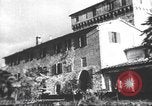
Parachutists of Cayuga Team jump from U.S. C-47 Skytrain aircraft in flight over Italy during World War II.
U.S. OSS (Office of Strategic Services) Operational Group's assistance in helping to organize and coordinate anti-fascist, partisan activities in Italy during Cayuga Mission of World War 2. Operations Officer Albert Materazzi briefs the men of Operational Group (Cayuga Team) at OG (Operational Group) headquarters in Ciano, Italy. Cayuga Team members study the terrain in which they have to operate. Pilots who will fly in the Cayuga Team members are briefed. Cayuga Team members with their paratrooper packs board U.S. Army Air Force C-47 Skytrain transport aircraft. The C-47s taxi on an airfield. Aerial view of Italian terrain. Parachutists of Cayuga Team jump from C-47s in flight.
U.S. Army Air Force C-47 Skytrain transports drop parachute supplies for Cayuga Team members and Italian partisans in Italy.
U.S. OSS (Office of Strategic Services) Operational Group's assistance in helping to organize and coordinate partisan, anti-fascist activities in Italy during Cayuga Mission of World War 2. A U.S. radio operator receives a radio message at Operational Group headquarters after Cayuga Team (OSS Operational Group members) are parachuted in a drop zone. An officer takes a look at the message detailing requirement of equipment needed for the mission. The material is loaded in waiting U.S. Army Air Forces C-47 Skytrain transport airplanes. The C-47s warm up before taking off. They taxi and take off from an airstrip. Formations of C-47s. Parachute supplies are dropped in drop zones in mountainous terrain.
CRITICALPAST.COM: About Us | Contact Us | FAQs - How to Order | License Agreement | My Account | My Lightboxes | Shopping Cart | Advanced Search | Featured Collections | Website Terms & Conditions | Privacy Policy ©2026 CriticalPast LLC.
License Agreement |
Terms & Conditions |
Privacy Policy
©2026 CriticalPast LLC.