


 Francais
 Deutsch
 Italiano
Refine Your Search
2nd-Rangers-D-Day stock footage and images
- Showing 10375 to 10380 of 13612 results more
more Hide
Hide
Prime Minister Mussolini of Italy declares war on France and the UK in World War II.
Slate announces "Fall of France." in World War 2. Next, huge crowd of enthusiastic people is seen jamming the Piazza Venezia in Rome. Prime Minister Benito Mussolini ("II Duce," the Leader) of Italy is seen on the balcony of the Palazzo Venezia, overlooking the Piazza. View from behind him as he waves to the crowd. Closeup of Mussolini announcing that Italy will consider herself at war with Great Britain and France effective 11 June 1940. Another view of the crowd, from the Palace balcony. Scene shifts abruptly to fires burning in a town in France and scenes of death and destruction in France from invading Axis forces. French soldiers and police assist a French civilian lying on the ground near a path in a bucolic setting in France. Several Frenchmen on bicycles ride along the path, behind them. More scenes of fires and destruction. A civilian being carried on a stretcher, accompanied by a nurse in white. A French boy walks next to the stretcher bearers. A French woman holding a baby with look of anguish on her face. Closeup of young boy and girl children among French civilians fleeing bombing. The boy is asleep on a burlap sack, with a woman's arm over him. The girl simply looks wide-eyed at the camera. A French civilian woman and a child, lying together on a stretcher on the ground. Glimpse of a person's hand lying open on the ground.

Italy faces defeat in World War II as King Victor Emanuel III dismisses Benito Mussolini as Prime Minister
Benito Mussolini’s dismissal as Prime Minister of Italy following major military defeats during World War 2. Past events show a large number of people gathered at the Piazza Venezia (Piazza Venezia, 00187 Rome Italy) in Rome, Italy. Italian Prime Minister Benito Mussolini delivers a speech from his balcony at the Palazzo Venezia (Piazza Venezia, 3, Rome, Laz. 00186). A damaged building in Italy after the defeat. People on the roof of a building as they hoist the flag of the Kingdom of Italy. German Chancellor Adolf Hitler confers with other leaders. People gathered at the Victor Emmanuel II Monument (Altare della Patria Piazza Venezia, 00186 Roma RM, Italy), also known as the Altar of the Fatherland, in Rome. Mussolini delivers a speech. A procession arrives with the Royal Carriage of King Victor Emanuel III of Italy. Marshal Pietro Badoglio shake hands with supporters after his appointment as Prime Minister by King Victor Emmanuel III. Cheering crowds gathered in Via del Corso street. People gathered at the Piazza Venezia.
The Countess of Halifax launches USS Natoma Bay (CVE-62) escort carrier in Vancouver, Washington, United States.
A US Navy Escort Carrier carrier being launched from Kaiser Shipyard of Vancouver, Washington, in the United States during World War 2. The ship USS Natoma Bay (CVE–62), a Casablanca class escort carrier, is ready to be launched. Sponsor at the launch is Dorothy Evelyn Augusta Wood (née Onslow), Countess of Halifax, (Wife of 1st Earl of Halifax who was the United Kingdom's Ambassador to the United States; and she was daughter of 4th Earl of Onslow). The Countess of Halifax hits a bottle of champagne against the ship hull and it slides down the ways. The escort carrier gets underway at sea.
U.S. soldiers depart army after getting points needed for discharge at Fort McPherson in East Point, Georgia.
First U.S. soldiers discharged from U.S. Army at a separation center toward end of World War 2. The soldiers exit a bus and enter a army facility at Fort McPherson in East Point, Georgia. They confirm their earned service points after 5 years of service, and and prepare to leave. Sergeant Ronald Stroud with 132 service points hands over papers to an officer as he leaves the army. He returns his uniform and gear to quartermasters. Stroud being given a pay check worth 1400 dollars. (World War II period).
Horse racing resumes as 30,000 people turn out at Narragansett Park in Rhode Island.
Horse racing resumes in the United States after the end of World War II in Europe. Men work to redecorate the stands at a racing park. Horses go for their paces at the track. 30,000 people turn out at Narragansett Park, Rhode Island to watch a horse race. Crowd entering racetrack stands. People lined up to purchase $2 place and show tickets at betting windows. The horse race begins. People cheer. Horses on the track. The race comes to a thrilling finish.
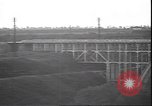
Highway viaduct with center section bombed out during World War II, Northern Italy
A dramatic roadway viaduct somewhere in Northern Italy. It is of steel and concrete construction with integral arches, and soars above a deep valley in which a river flows. The center portion of the bridge is gone, due to Allied bombing in World War 2. Camera pans over the viaduct from surrounding high terrain. (May be associated with a river named Olio, or perhaps, Oglio.)
CRITICALPAST.COM: About Us | Contact Us | FAQs - How to Order | License Agreement | My Account | My Lightboxes | Shopping Cart | Advanced Search | Featured Collections | Website Terms & Conditions | Privacy Policy ©2026 CriticalPast LLC.
License Agreement |
Terms & Conditions |
Privacy Policy
©2026 CriticalPast LLC.