


 Francais
 Deutsch
 Italiano
Refine Your Search
2nd-Rangers-D-Day stock footage and images
- Showing 10573 to 10578 of 13612 results more
more Hide
Hide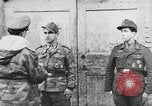
German troops are decorated by a German officer and troops advance in Italy during World War II.
German troops in Italy during World War 2. A German General decorates German soldiers with Iron Cross. German paratroopers battle enemy in a burning village. Artillery is fired at American forces. Tanks advance on a battlefield.
Hungarian schoolboys are interviewed by American soldiers of U.S. 11th Armored Division at Freyung, Germany in World War II
American soldiers interviewing prisoners at the U.S. 11th Armored Division Prisoner of War enclosure in Freyung, Germany near the end of World War 2. An American Army Sergeant questions a young man with help of another Sergeant, interpreter, who speaks to him in German. The boy identifies himself as being Hungarian from the Royal Hungarian High School. The boy tells them he learned marching drill, but had no weapons training. He had been enrolled four years, and had never been engaged in combat with Americans. He states his age as 14 years. Scene shifts to another interview with a younger boy soldier. The interpreter asks if he speaks German. The boy says no, he is Hungarian. Nevertheless, with some difficulty, they determine that he too is from the Hungarian military school. When asked about his military training, the boy answers by demonstrating, standing at attention, saluting, and simple close order drill actions. They determine that he is in the third year of school. The film director calls for a cut at this point. They resume asking if he ever fought against Americans. He has difficulty understanding but eventually says no. The boy is 12 years old.
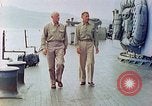
U.S. Admiral Chester W. Nimitz and U.S. Fleet Admiral Ernest King aboard a cruiser off the coast of Saipan, Mariana Islands, in World War II..
U.S. Navy Admirals aboard a cruiser off the coast after the invasion of Saipan, Mariana Islands during World War 2. U.S. Fleet Admiral Chester W. Nimitz and Admiral Raymond Spruance with U.S. Fleet. Admiral Ernest King aboard the USS Indianapolis (CA-35) anchored. Ships of U.S. Task Force in the background. Navy Hospital Ship USS Relief (AH-1) lying off-shore.
Allied Logistics supply operations commencing at Arromanches-les-Bains, France, following the Nornandy invasion of World War II
Allied logistics supply operations getting started at Arromanches-les-Bains, France, following the Normandy invasion in World War 2. A large Landing Craft Infantry LCI(L) number 153 is seen beached, along with many other landing craft. Various other ships are seen along with cranes and equipment along the beach. Field ambulances move along the beach road. Camera focuses on LCI(L) number 642. Some larger ships are offshore. Trucks move along the road, and soldiers and Coast Guardsmen are seen.

U.S. 8th Air Force activities at RAF Station Chelveston, England, in World War II
U.S. 8th Air Force B-17 Flying Fortress bombers in England during World War 2. Interiors of an operations building shows an operations officer making a call on a phone. Displayed on a board is a chart of the airfield, RAF Chelveston (USAAF Station 105) in Northamptonshire, England. Airmen inside the operations building measure distances on a large wall map. A tower operator fires a flash signal gun. British and American airmen stand on an observation platform and watch B-17s overhead, while several aircrew members sit in the grass below. A British airman on the platform holds a very pistol.
B-17s of the U.S. 91st Bomb Group, returning to their base at RAF Bassingbourn, England in World War II
B-17s of the U.S. 91st Bombardment Group, returning to their home base at RAF Station Bassingbourn following a bombing mission,in World War 2. B-17, tail number 41-24617, named "Southern Comfort," taxiing on outboard engines, only, after landing with a large chunk of its rudder shot away. Crew members and other airmen gather around the battle-damaged aircraft. Closeups of the damage to its rudder. Dim views of the B-17, "Memphis Belle," tail number 41-24485, with skin missing from wing exposing its internal ribs. It also has holes in its rudder and its nose. Closeup of a B-17 engine stained by fire-fighting foam. Other views of battle damage to a B-17.
CRITICALPAST.COM: About Us | Contact Us | FAQs - How to Order | License Agreement | My Account | My Lightboxes | Shopping Cart | Advanced Search | Featured Collections | Website Terms & Conditions | Privacy Policy ©2026 CriticalPast LLC.
License Agreement |
Terms & Conditions |
Privacy Policy
©2026 CriticalPast LLC.