


 Francais
 Deutsch
 Italiano
Refine Your Search
2nd-Rangers-D-Day stock footage and images
- Showing 10831 to 10836 of 13612 results more
more Hide
Hide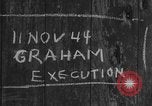
German spy Josef Wende is executed by U.S. Military Police firing squad in Toul, France, during World War II.
Execution of a spy in Toul, France, during World War 2. A slate reads Graham (presumbly cameraman) Execution. Military Policemen (MPs) lead a single spy, Josef Wende, to the execution location in the farmyard of a farmhouse in Toul, France. A Catholic Priest in black accompanies the MPs. At the execution point, a Lieutenant Colonel and two other officers stand with the Priest as he speaks with the prisoner. The Priest offers prayers for the German spy, who was a Pole drafted in the German Army and caught behind American lines posing as a Polish slave laborer. The face of Wende is covered using a cloth. The MPs tie the legs of the spy. The firing squad fires at Wende from a distance. The body of Wende leans forward and falls to the ground after it is hit. Afterwards The Lieutenant Colonel returns with a medical corpsman who checks bullet wounds on prisoner's chest and checks for a pulse. MPs pick up the dead body of the spy, cover it with a white sheet and carry it on a stretcher. The Priest prays as MPs pass carrying the body. (Note: Reportedly, Lt. Col. Elbert L. Nelson, Headquarters Third Army, was assigned to head a contingent of several soldiers to witness this and another execution at Toul, on November 11, 1944. He is likely the Lieutenant Colonel seen in this sequence.)
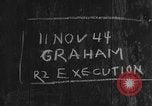
German spy Stephan Kortas is executed by Military Policemen and is carried away covered in white sheet in Toul France.
Execution of German spy Stephan Kortas in Toul, France during World War 2. A soldier's uniform near a tree. A box lies near the tree. U.S. Military Policemen (MPs) walk across the items. Military Policemen (MPs) bring German spy Stephan Kortas to the execution point. From Poland, Kortas was drafted in the German Army and sent behind American lines posing as a Polish slave laborer, where he was caught by U.S. Army forces. A clergyman offers prayers for Kortas. The face of the spy is covered using a cloth. The MPs tie the legs and hands of the spy. Firing squad fires at Stephan Kortas from a distance. Kortas' body leans forward and falls to the ground. The marks of gun shots on the chest of the German spy. MPs pick up the dead body, cover it with a white sheet and carry it on a stretcher.
German planes bomb Paris on June 3, 1940, during World War II
Film begins showing nighttime scene of fires burning from German bombing of Paris in the World War 2 German invasion and Battle of France. In daylight, firemen are seen directing streams of water on smoking remains of buildings. Camera pans across numerous destroyed buildings and debris. One notable undamaged structure is the the Sacre Coeur Cathedral and its tall bell tower, on lÎle-de-France. Citizens are gather discussing the situation. One mostly destroyed building has "Les Soeurs de St. Vincent Paul," written on its side. It is headquarters of the Daughters of Charity of Saint Vincent de Paul (Catholic order) on 140 rue du Bac. A woman of the order, wearing their signature cornette, is seen conversing with a police officer. A Nun of the order works with several women (not in habit) to save some tables. More views of the destruction including one showing water gushing from a burst underground water main. Camera pans over more scenes of destruction. Inside of a badly damaged church. Women distributing snacks to children. A sign reading: "Milice Francaise," (a local Militia) where food and drinks are being given to many people.
A soldier inspects dead bodies of Nazi atrocity victims in World War II in a wooded area of Landsberg, Germany.
Wooded forest area, site of Nazi atrocities in World War 2: U.S. Army soldiers walk in woods and examine bodies of Jewish concentration camp victims near Landsberg Germany. The bodies lie on the ground close together. Some victims are wearing prison uniform pieces.
German Atlantic Wall coastal defenses. German forces enter the Crimean Peninsula in World War II.
In opening scene, German Field Marshal Erwin Rommel is giving a "pep talk" to senior officers assembled at the Northern part of the German "Atlantic Wall" defenses in Scandinavia, during World War 2. A German sentry is seen in front of a large coastal fortification bearing the name "Skagerrak." Camera focuses on the barrel of a huge coastal gun. Closeup of the sentry. Troops travel on a small gauge railway carrying canisters of propellant and shells to a unique heavy coastal gun installed , near Kristiansand, Norway, overlooking the Skagerak Strait. (The gun is a 28 cm SK C/34 naval gun, similar to those installed on some battleships. But this one was appropriated from an abandoned German Army super-tank project.) An alarm bell sounds in the fort and soldiers respond. Next, huge coastal gun shells are seen being moved on conveyors to the gun. A team of gun operators recite preparation steps out loud as they adjust range, bearing, and other parameters before firing the weapon. Gunners load a shell into the gun breech, followed by several propellant charges. The breech lowers inside the fort as the gun barrel is raised to desired elevation. The gun is fired. More commands are spoken aloud and another round is fired. Glimpse from outside of gun flash at night. Complete change of scene shows a map of Crimean Peninsula. Anti-aircraft guns are shown at coastal areas. A quad-barreled FlaKvierling 38 gun is seen. German forces entering the Crimea. Infantry walk in and others, ride in open trucks.One soldier mans a light gun mounted on the back of a 6-wheeled truck. German soldiers posted on roads directing incoming traffic of trucks carrying troops. Closeups of German soldiers riding in open trucks. A trio of German Army officers watches the incoming troops. Local refugees carry their belongings as they flee from battle fronts.
Theater performances in Berlin, Germany in 1941, during World War II
Women chorus line or chorus girl dancers perform as part of a stage production in Berlin, Germany, 1941, during World War 2. Scene shifts to a concert hall, where a German General and other officers are in front row seats applauding the conductor who is treated as a maestro. He speaks to them from the orchestra pit. Closeup of the maestro as he begins conducting the orchestra, presumably accompanying actors/singers on stage (unseen). Glimpse of audience reveals many German military officers and civilian men and women. After the performance, the maestro escorts a woman and a man onto the stage, which is set for the just concluded performance. The maestro bows slightly. The next scene is still onstage and a civilian man joins the two performers just seen along with a young military officer in a white uniform (possibly a Kriegsmarine officer). Another woman joins them. She also greets the maestro. A large basket of flowers sits in their midst. Finally the young Kriegsmarine officer shakes hands with the maestro..
CRITICALPAST.COM: About Us | Contact Us | FAQs - How to Order | License Agreement | My Account | My Lightboxes | Shopping Cart | Advanced Search | Featured Collections | Website Terms & Conditions | Privacy Policy ©2026 CriticalPast LLC.
License Agreement |
Terms & Conditions |
Privacy Policy
©2026 CriticalPast LLC.