


 Francais
 Deutsch
 Italiano
Refine Your Search
2nd-Rangers-D-Day stock footage and images
- Showing 1081 to 1086 of 13612 results more
more Hide
Hide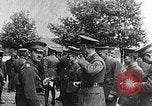
Allied military forces maintain order in Upper Silesia, following the third Silesian uprising.
Group of British Army officers relax while stationed in Oppeln (Opole), Upper Silesia, with other Allied forces as peacekeepers after the third Silesian uprising following the post World War 1 plebiscite. Several Italian Army officers pose for the camera. A unit of French Army bicyclist troops walks their bicycles as they leave a military post at Malapanerstrasse (Ozimska Street). French bicycle troops on their bicycles, riding along a rough road, causing several to fall, at side of the road. Several armed men patrol rail bridge, at Sczepanowitz (Szczepanowice) where one span had been destroyed by the Polish Konrad Wawelberg Destruction Group, on May 2nd. View of the bridge in state of partial reconstruction. A French Bicycle soldier and another armed man accompany a soldier operating a small rail car on the line. In the final scenes, behind the men riding the railway handcar, silhouettes of building spires can be seen on the horizon, in the distance, in Old Town Opole (now in Poland). Among these may be the Piat tower, the Town Hall, and the cathedral.
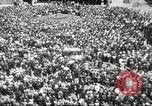
The Soviet Union is placed on a total war footing in June 1941, as the Fascist axis powers invade in Operation Barbarossa.
Soviet Union mobilizes in wake of the Operation Barbarossa, invasion by Germany and its allies in World War 2. At beginning, the film shows a large crowd of Soviet citizens gathered as they learn about the invasion on June 22, 1941, Camera pans over the crowd and shows many closeups of individuals and groups. Brief view of Joseph Stalin broadcasting to the Soviet people on June 22nd, saying, "This war is not an ordinary war. It is a war of the entire Russian people, not only to eliminate the danger hanging over our head, but to aid all people groaning under the yoke of Fascism." High speed printers produce news reports for distribution across the land. Views of men on horseback leaving a rural village to answer the call for recruits to defend the nation. Views of conscripts being marched in formation on a city street, under direction of a Soviet officer. Film emphasizes the roll of women in the war effort, showing women pasting patriotic posters on a wall. A cadre of uniformed women soldiers is seen marching along a city street past spectators. A large group of many kinds of Soviet citizens walking together, including men, women, and youths. A boy works, checking a newly manufactured rifle, in an arms factory. Boys digging with pickaxes alongside older miners in a coal mine. Women in an army unit wearing full uniforms including bed rolls. A Soviet army unit containing both men and women. A woman operating a lathe in a war plant machine shop. An old man seen along with women harvesting grain by hand, on a farm. A steam locomotive moving on a rail road. A woman at the helm of a ship. Women operating farm equipment. Soviet soldiers removing usable metal objects from a dwelling to use in the war effort. Women and children gleaning remains in a farm field. Cattle being driven to prevent their capture by the enemy. An old man with an old fashioned rifle, tanding watch over rural fields, on the lookout for German airplanes.
Parents of Japanese-American soldiers who died serving in the U.S. army are awarded Purple Heart medals.
Parents of American soldiers of Japanese ancestry receiving awards in the United States, during World War 2. Parents of the Japanese-American soldiers seated at the ceremony. They are receiving Purple Heart medals for the soldiers who died while serving in the U.S. army. Narrator mentions "60 from Hawaii alone gave their lives." (The soldiers were likely from the 100th Infantry or 442nd Regimental Combat Team).
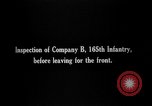
U.S. 165th Infantry soldiers are inspected, issued clothing, and paid, in France during World War I.
Officers inspect troops from Company B, 165th Infantry Regiment (42nd Infantry, Rainbow Division) in France during World War 1. The soldiers are lined up in front of their pup tents, in a field. Captain K. C. Siebert, Lieutenant R. Doris and Lieutenant F. W. Carter inspect strong dugouts of Company A, in a hillside just behind the front lines, at Chasseurs, France. Officers walk out of the passageway of an adjoining heavy stone structure (Headquarters?). Scene shifts to U.S. Machine gun battalions firing French Hotchkiss M1914 heavy machine guns. At each position, one soldier feeds a strip of 8mm Lebel cartridge ammunition while the other fires the weapon. Slate states that the firing is toward a German town 2,800 meters away. Men of a machine gun company are seen lined up to receive issues of personal clothing from Quartermaster. Soldiers of the 165th Infantry receiving pay from paymasters at an outdoor table near a hillside dugout. One counts out a soldier's pay and another annotates a pay ledger.
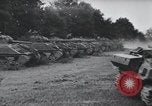
British tanks battles and British troops dig in for night in France during World War II.
British tank battles in France during World War 2. Tanks parked in a line near Caen. Camouflaged tanks. British soldiers being briefed. A soldier on a tank. British tanks advance. The tanks cross railroad tracks, pass through woods. Sherman crab flail tank from British C squadron, 22nd Dragoons. The tanks advance in the wooded region. A truck drives in the wooded region. Infantry follow tanks as they advance. A soldier digs in for the night. Soldiers seated in the dugout look into the plan. Two soldiers seated look into the plan and one of them smokes a cigarette.
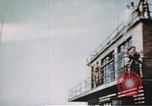
U.S. 351st Bomb Group B-17s take off on mission to Germany, from their base at RAF Polebrook, England, in World War II
Flare is fired from control tower and B-17s of the U.S. 351st Bomb Group begin taking off from their base at RAF Station Polebrook, England, on a mission to Germany during World War 2. The B-17 aircraft fly off in formation. View inside one B-17, as crew goes on oxygen, as they climb through 10 thousand feet. Sky filled with formations of B-17s. U.S. P-47 fighter escort aircraft of the U.S. 487th Fighter Squadron (352nd Fighter Group) at RAF Station Bodney, take off to accompany the B-17s part way. Gunners inside a B-17 are alerted to German fighters at 3 O'clock low. They are identified as the American P-47 escorts. Squadron of U.S. P-47s seen in flight. B-17s and escorts pass over the enemy coastline. They being to encounter flak which can be seen as Black clouds.
CRITICALPAST.COM: About Us | Contact Us | FAQs - How to Order | License Agreement | My Account | My Lightboxes | Shopping Cart | Advanced Search | Featured Collections | Website Terms & Conditions | Privacy Policy ©2026 CriticalPast LLC.
License Agreement |
Terms & Conditions |
Privacy Policy
©2026 CriticalPast LLC.