


 Francais
 Deutsch
 Italiano
Refine Your Search
2nd-Rangers-D-Day stock footage and images
- Showing 10975 to 10980 of 13612 results more
more Hide
Hide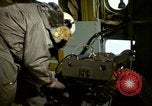
AC-119K Stinger gunship, of the 1st Special Operations Wing, Lockbourne AFB, firing guns during live fire training flight.
Cabin of USAF AC-119K Stinger gunship of the 1st Special Operations Wing, Lockbourne Air Force Base, on live fire training mission. Gunner adjusts Vulcan M61A1 20mm cannon aboard AC-119K. He sights and fires the cannon. Spent shells tumble down chute (including several unspent with light blue noses). View of GAU-2/A 7.62 minigun firing. Spent rounds dropping into container under the gun. Brief view of tracers streaming toward the ground.
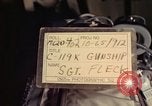
Airman removes muzzle covers from guns and inspects jet pod of AC-119K gunship aircraft at Lockbourne Air Force Base
Airman of the U.S. 1st Special Operations Wing, Lockbourne Air Force Base, performs visual .inspection of AC-119K Stinger gunship. He removes muzzle covers from the GAU-2/A miniguns and 20mm M61A1 cannons. He inspects the left J-85 jet engine pod.The airman picks up the muzzle covers and walks away. A C-130 is parked on the ramp in the background.

Alice Davison, wife of Assistant Secretary of Navy for Air, christens the USS Essex (CV-9), and ship is launched from Virginia.
The U.S. Navy USS Essex (CV-9) aircraft carrier being launched from the Northrop Grumman Shipbuilding in Newport News, Virginia, during World War 2. The newly constructed USS Essex (CV-9) aircraft carrier in the Northrop Grumman Shipbuilding yards. Flags of the United States on the ship. People watch the ship as it is ready for launch. Alice Trubee Davison, wife of the Assistant Secretary of the Navy for Air Artemus L. Gates, with others christens the USS Essex (CV-9). USS Essex (CV-9) aircraft carrier being launched from the Newport News yards. The ship at sea.
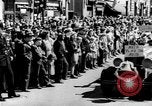
School children and civilians participate in a war time "jalopy parade" to encourage donations of junk cars and other scrap metal in Decatur, Illinois.
Scenes of a a "jalopy and general salvage parade" in an American city during World War 2, to support the war effort. Parade floats that use scrap materials simulate the finished products of war like vehicles and airplanes. Civil Air Patrol airplanes fly over the parade route reminding citizens of the need for scrap metal in manufacturing and producing airplanes for war. Narrator describes need for inclusion of many needed scrap materials in the parade such as tin cans, silk, nylons, fats, greases, etc. and that "jalopies make jeeps." Narrator, on behalf of the United States War Production Board, gives specific instructions of how to hold such a parade in any town in the United States and encourages viewers to hold such parades in their towns all over America to help the home-front war effort. The parade heads down main streets of Decatur, Illinois, with many shops and buildings seen along the route. People stand on roadside to watch the parade. Cars driven at the parade. School children ride on cars, many bearing wartime victory slogans. Man works on a vehicle carried on a truck. A float decorated with papers. School children march. A man pushes a trolley. Girls ride bicycles. Officers address parade attendees as livestock is auctioned off to raise funds for the war effort. Junk yard cars that are candidates for scrap recycling are seen in the backyards of houses. Clip concludes with a message from Mr. Eugene Dunne, District Chief, Scrap Processors Branch, War Production Board, Chicago. Mr. Dunne encourages viewers to hold jalopy parades like the one seen in Decatur, Illinois.
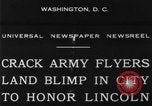
U.S. Army aviators land an airship at the Lincoln Memorial to place a wreath honoring Lincoln's Birthday
A U.S. Army blimp is seen approaching the Lincoln Memorial (2 Lincoln Memorial Cir NW, Washington, DC 20002, United States), at low altitude. The Washington Monument is in the background. The view shifts to inside the open gondola of the blimp, with the reflecting pool below, and the Lincoln Memorial and Potomac River in the background, dead ahead. Pilots at the controls wear helmets, goggles, and parachutes. The airship descends slowly over the reflecting pool, and then rises slightly above the Lincoln Memorial. The scene shifts to view from the ground, as the blimp descends to land on nearby partly snow-covered field. U.S. Army and airship number C-41 are stenciled on the blimp. Sequence shifts to the airship cockpit again, viewing over the pilots' heads, as the blimp nears the ground. Several automobiles are parked at the curb, and a few dozen spectators stand watching the airship from below. The pilot, in right seat, stands up and signals to Army men on the ground, while the pilot in the left seat controls the airship's flight path. As they land, Army ground crewmen take hold of lines from the blimp, and the pilots climb out carrying a large floral wreath. Closeup of the pilots unloading the wreath, with the Lincoln Memorial in the background. Airship model identification TC-6 or TC-8 seen stenciled on the side of the gondola. The airship's engine and propeller are clearly visible in the open gondola. The aviators step to the ground and carry the wreath across the grass, and around to the front steps of the Memorial Building. The reflecting pool and Washington Monument are seen in the background. Pilot of the airship, U.S. Army Captain, William J. Flood, and his copilot (unknown) pose with the wreath, on the top step of the Lincoln Memorial.
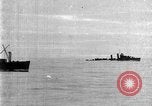
Men with life jackets on deck and Brooklyn class Cruiser,Destroyer underway in the North Atlantic Ocean
A convoy of Allied ships underway in the North Atlantic Ocean during World War 2. Transport and U.S. Navy Destroyer underway. Men with life jackets on deck. Transport and destroyer zig zagging. Brooklyn class Cruiser underway. Troops lean on rail of transport underway. Transport and destroyer silhouetted against sun. Cruiser underway.
CRITICALPAST.COM: About Us | Contact Us | FAQs - How to Order | License Agreement | My Account | My Lightboxes | Shopping Cart | Advanced Search | Featured Collections | Website Terms & Conditions | Privacy Policy ©2026 CriticalPast LLC.
License Agreement |
Terms & Conditions |
Privacy Policy
©2026 CriticalPast LLC.