


 Francais
 Deutsch
 Italiano
Refine Your Search
2nd-Rangers-D-Day stock footage and images
- Showing 11101 to 11106 of 13612 results more
more Hide
Hide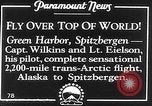
Captain Wilkins and Lt. Eielson stand near an aircraft in Spitsbergen, Svalbard after completing a trans-Arctic flight.
The history of famous airplanes. Australian polar explorer Captain Sir George Hubert Wilkins and American aviator Lieutenant Carl Benjamin Eielson in Spitsbergen, Svalbard after completing a 2,200 mile trans-Arctic flight from Alaska to Spitszbergen. Captain Wilkins in a civilian dress. An aircraft being moved out of the area. 'Detroit news, Arctic expedition' written on the side of the airplane. Captain Wilkins and Lt Eielson check over the airplane prior to a take off. Men dressed in civilian garb. The aircraft starts to taxi across the field. It is a Lockheed Vega aircraft. Animated world map shows the start of the Wilkins flight on April 15th from Point Barrow in Alaska and traces the route of the flight to Spitsbergen. The time of the flight was 20 hours, 20 minutes. They land at Green Bay in Spitsbergen.
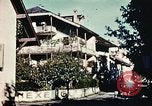
American flyers who escaped from Swiss internment during World War II
view of a building in Annecy, France, during World War 2. Flags of Britain, Soviet Union, United States, and Poland displayed together. A busy street with many bicyclists. A truck driving on a road carrying a group of American flyers who have escaped internment in Switzerland. The flyers, in civilian clothes, smile and wave at the camera from the back of the truck. Change of scene to front view of the truck arriving at Annecy airfield. some flyers are riding on the fenders and running boards of the truck. view of German prisoners of war clearing stones from a field near the airfield runway. A C-47 transport aircraft landing on the field, in background. The German POWs pose for the camera. Cyclists on a dirt road near the airfield, pause to watch a C-47 taking off. Children on bicycles wave to the camera. View again, of German prisoners clearing stones from the field. Local children looking to the sky for airplanes.
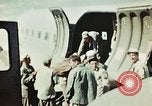
U.S. wounded soldiers transported to North Africa by air evacuation during World War II.
Wounded American soldiers arriving in North Africa, after being evacuated by air from combat zones, during World War 2. U.S. soldiers in fatigues, offload wounded troops, on litters from a U.S. C-47 air evacuation aircraft, and place them into an Army ambulance that drives away. The unloading soldiers wait for another ambulance. Several airmen sit in a jeep with a woman in a blue flight outfit, wearing a headscarf. They are facing away from the camera and watching patients being transferred. The tail of the C-47 can be seen in the background. It displays the tail code "N." Numerous closeups of wounded being moved on stretchers from the aircraft to ambulances.
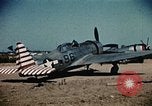
U.S. Army Air Forces 86th Fighter Group P-47s operating at Poretta Airfield, Corsica, during World War II.
P-47s of the 86th Fighter Group, distinguished by their bright red and white striped enpennages, are seen in operation at the Poretta Airfield, Casamozza, Corsica, during World War 2. Several P-47s (with razor back canopies) are seen parked on the field. One P-47 takes off and another lands.
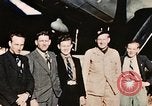
U.S. airmen who escaped internment in Switzerland pose at Annecy airfield, France, during World War II
American fliers who escaped internment in Switzerland, pose in front of a C-47 aircraft at Annecy Airfield in World War 2. They wear clothes provided by sympathetic civilians, and kid about the way they fit. They are accompanied by a Free-French Commandant (equivalent to U.S. rank of Major) who wears rank insignia on shoulders of his uniform and the Cross of Lorraine and rank insignia on his black beret.
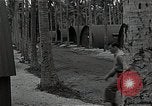
A mess and a hospital in Espiritu Santo, Vanuatu during World War II.
Quonset huts in Espiritu Santo, Vanuatu during World War 2 A row of Quonset huts and palm trees in an area. A sign board reads: 'Mess Hours'. A truck moves past on a road. A sign on a palm tree reads: 'US Naval Base Hospital No. 3'. The front of a Quonset hut shows an officer and enlisted men entering. Another sign reads: 'U.S. Naval Base Hospital No 3 Administration Office'. A painted bomb on the steps of the U.S. Navy Quonset hut.
CRITICALPAST.COM: About Us | Contact Us | FAQs - How to Order | License Agreement | My Account | My Lightboxes | Shopping Cart | Advanced Search | Featured Collections | Website Terms & Conditions | Privacy Policy ©2026 CriticalPast LLC.
License Agreement |
Terms & Conditions |
Privacy Policy
©2026 CriticalPast LLC.