


 Francais
 Deutsch
 Italiano
Refine Your Search
2nd-Rangers-D-Day stock footage and images
- Showing 11119 to 11124 of 13612 results more
more Hide
Hide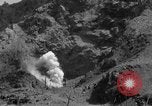
U.S. 503rd Parachute Infantry Regiment paratroopers jump from C-47s during the U.S. return to Corregidor, Philippine Islands, in World War II.
Footage taken from the ground as paratroopers of the 503rd Parachute Infantry Regiment jump from C-47 aircraft over Japanese-held Philippine island fortress of Corregidor, in World War 2. White smoke issues from the ground, providing a drop target for C-47 transport aircraft approaching in trail formation. The first wave of paratroopers are seen jumping, with chutes opening. But they appear to be dropping high hill, making their relative height over the ground very small and leaving little chute opening time (even though the aircraft are maintaining a constant preplanned altitude during the run). A U.S. soldier is seen walking past the camera. Then parachutes are seen descending and dotting the landscape. Ruins of fortress buildings are in the background. C-47s continue flying in background. View from th ground of paratroopers descending directly overhead and landing in dangerously uneven rocky terrain. Two trooper bend over another who has been injured during the drop. Their chutes are still billowing. Closeup of an injured trooper being assisted by another. Troopers spilling chutes, gathering their gear and beginning to assemble. More C-47s flying overhead and more chutes seen descending. Some are dark colored. A trooper hitting hard on rocky ground. Several troopers sitting on the ground as one pulls on the risers of a chute to spill the air.
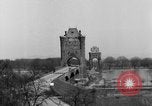
Destroyed Nibelungen Bridge over the Rhine River in Worms, Germany during World War II.
U.S. Army 4th Armored Division in vicinity of Worms, Germany during World war 2. View of the approach and towers of the Nibelungen Bridge over the Rhine River. The center spans have been destroyed. Closeup in shadow of the tower, where body of a fallen soldier lies on the concrete. View from roadway, of dropped bridge spans in river below. Closeup of the first fallen span with river flowing past. Two U.S. soldiers in shadows of the bridge. One looking through binoculars.
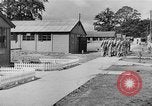
Combat Exhaustion patients receive military training at a center after the completion of treatment in the United States.
Reenactment of combat exhaustion treatment for U.S. soldiers from World War 2 combat. Patients receive military training at a training center after the completion of treatment. The patients march during the training. Rehabilitated patients pitch tents and drill. The patients receive training of sensible occupation therapy project, constructive and field projects, sports for physical coordination and team spirit. (Note: Clips deals with treatment for Combat Exahaustion, also later termed Post-traumatic Stress Disorder or PTSD)
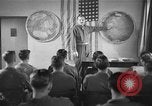
U.S. Army officers discuss treatment for combat exhaustion cases among World War II Army soldiers
Reenactment dealing with treatment for World War 2 combat exhaustion cases among U.S. soldiers. Army personnel receive training to know the reasons for exhaustion and the methods to rehabilitate the soldiers. The flag of the United States on a wall. U.S. Army officers seated at a table. The army personnel and an officer are in discussion about combat exhaustion. Personnel receive answers of their questions in the discussion. (Note: Clips deals with treatment for Combat Exahaustion, also later termed Post-traumatic Stress Disorder or PTSD)
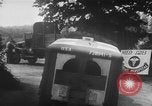
U.S. Army medic staff screen incoming patients before treatment, separating physical injury cases from combat exhaustion cases
Reenactment of treatment for combat exhaustion cases among World War 2 U.S. soldiers. A vehicle of a medical unit arrives at a field hospital carrying a combat exahusted soldier at an aid station. Medical personnel soldiers carry the agitated, traumatized soldier from the vehicle to the tent of the aid station while he yells. Soldiers lay the traumatized soldier on a stretcher. They give medicine to him. They carry his stretcher away. They give soup to another soldier. An exhausted soldier comes into the tent for treatment. He takes off his bag. A medic asks the soldier his problem. He suggests that he take rest and eat food. The medic gives him medicine. The soldier picks his bags and move out with the medics who are holding a blanket and soup for the soldier. Another exhausted soldier arrives for treatment. A Red Cross soldier examines his hand. The injured soldier goes to sleep. (Note: Clips deals with treatment for Combat Exahaustion, also later termed Post-traumatic Stress Disorder or PTSD)
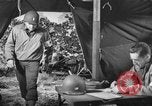
A U.S. Army psychiatric officer tries to detect signs of combat exhaustion and advises ways to prevent them
Reenactment of handling and treatment for U.S. Army World War 2 soldiers suffering combat exhaustion. A soldier gives answers to a psychiatric officer. The psychiatric officer tries to detect signs of combat exhaustion (modern equivalent Post Traumatic Stress Disorder or PTSD) like lack of physical coordination, slowing mental processes, excessive reaction off noise and inability to rest. Soldiers adjust position of artillery. The soldiers are directed to take proper meals and get sound sleep to prevent combat exhaustion and fight stress.
CRITICALPAST.COM: About Us | Contact Us | FAQs - How to Order | License Agreement | My Account | My Lightboxes | Shopping Cart | Advanced Search | Featured Collections | Website Terms & Conditions | Privacy Policy ©2026 CriticalPast LLC.
License Agreement |
Terms & Conditions |
Privacy Policy
©2026 CriticalPast LLC.