


 Francais
 Deutsch
 Italiano
Refine Your Search
2nd-Rangers-D-Day stock footage and images
- Showing 11293 to 11298 of 13612 results more
more Hide
Hide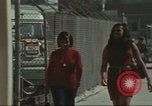
16mm motion picture film, quad videotape, and records at the American Forces Radio and Television Station in Los Angeles, California.
American Forces Radio and Television Station facility in Los Angeles, California. Women walks on sidewalk in Los Angeles. Women enter AFRTS building in Los Angeles. Man in 16mm film library packs 16mm motion picture films into boxes. Officer runs a kinescope machine to record video onto 16mm motion picture film. Officer operates 2" quad videotape recorder to record television program. African-American man packs record albums into boxes and tapes box shut.
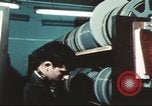
Operation of an American Forces Radio and Television Station.
Work of members at a American Forces Radio and Television Station in the United States. A man examine 16mm motion picture film before a program telecast. Station technicians playback 2-inch Quad reel-to-reel videotapes. Closeup of a monitor displaying a sports event. Closeup of waveform monitor. Men undertake technical maintenance of the television broadcast station. Transmitter is adjusted by one technician. A maintenance man examines a transmission dish.
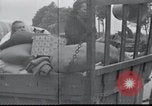
German tanks advance along a road in Marquion, France, and refugees flee, during World War II.
Germany invades France, during World War II. German troops invade French town of Marquion, in the Pas-de-Calais department in the Hauts-de-France region. Horse-drawn carriages loaded with French refugee families and belongings move along a road. Street signs on road number 15 point toward Sauchy-Lestrée 2 km away, and Avrincourt, 12 km away. A chalk drawn arrow points toward Arras. French families evacuate using bicycles, baby carriages, and wagons. German troops arrive on motorcycles. Numerous German Pz.I, Pz.II, Pz.III and Pz.IV tanks pass through the village. Smoke rises from a burning building.
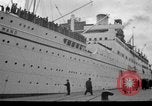
Jewish refugees disembark from ocean liner SS Conte Biancomano in Shanghai, China after arriving from Nazi Germany in 1938
Arrival of European Jews in Shanghai, China. Jewish refugees aboard ship SS Conte Biancomano at a port in Shanghai, fleeing deteriorating conditions in Germany leading up to World War 2. The refugees are processed by reception officials at a desk on deck, as they disembark. Some appear to travel by smaller boat to another location. The Japanese Cruiser Idzumo is at dock in front of the Japanese Consulate. Scenes of the travelers with their belongings on the Bund. They walk up a steel ramp to the back of an open truck and representatives, of the International Settlement organization,drive them to their next location. They stand in line at a food stand. A group looks at a map, together. Another group learns basic English words of "please" and "thank you." Group at table practices writing. The men and women have fun by going down a slide in what appears to be a school playground.

U.S. forces capture Tarawa, Gilbert Islands, from Japanese forces. Sea Bees repair captured airfield. during World War II.
The Battle of Tarawa between U.S. and Japanese forces during World War 2. U.S. Task Force ships head for Tarawa in the Gilbert Islands. U.S. officers confer aboard a ship. A stick points out the location of Tarawa on a map of the Pacific Ocean. U.S. soldiers bow their heads in prayers aboard the ship. U.S. naval guns are fired at coastal targets. U.S. Marines in landing crafts head for Tarawa. Smoke rises from artillery shell attacks on the island. The Marines use hand grenades to destroy Japanese pillboxes and machine gun nests. Reinforcements arrive and U.S. Marines advance inland after heavy fighting. Abandoned coastal artillery guns and dead Japanese soldiers on the island. The island after the battle. Forced Korean laborers on the island. A U.S. medic giving first aid to a Korean laborer. U.S. Navy CBs (Construction Battalion) make repairs and construct an airstrip on Tarawa.

Marshal Josip Broz Tito at his mountain headquarters near Drvar, Bosnia.Yugoslavia. Tito's troops training in Italy during World War II
Note: This film was shown during World War 2 and edited for security reasons. Accordingly, some narrated statements are incorrect or misleading, and should be disregarded. Film opens showing a sentry posted at Yugoslav Partisan Leader Marshal Josip Broz Tito's mountain headquarters in Drvar, Western Bosnia, Yugoslavia. Marshal Tito steps from his headquarters to a lower porch where he stands with American OSS Officer, American Army Major Linn M. Farish, American Liaison to the Partisans, and British Brigadier General Fitzroy Maclean, Winston Churchill's special envoy to the Yugoslav leader. (For security reasons, they are identified as war correspondents.) Scene shifts to the town of Drvar that has experienced several periods of German occupation. Local people go about their daily activities and some pose for the camera. Women are seen salvaging silk from Allied parachutes, that they have spread out on the ground. It will be used as bandages for their Partisan army. View from above of a number of Partisan fighters gathering before the camera. One, a woman with dark hair wearing a black coat, is identified by the narrator, as a 21-year old Montenegrin who left school to join the Partisans. Closeup of that woman conversing with uniformed women soldiers. Next, a loose column of Partisan fighters is seen marching slowly through the town of Drvar. Scene shifts to a large formation of marching Yugoslav Partisan soldiers, who are training in Italy. They are seen standing if formation in a field, under Marshal Tito's command. He orders their officers forward and exchanges salutes with them. Marshal Tito then inspects the ranks. Women soldiers are seen conversing with Tito. He converses with his Chief of Staff, General Koča Popović. Closeup of a smiling woman Partisan fighter. Closeup of a soldier with a notable white moustache. Closeup of two uniformed women with Red Cross armbands. The Partisan soldiers marching across the field with shouldered arms. Film closes with closeup of Marshal Tito in front of his headquarters.
CRITICALPAST.COM: About Us | Contact Us | FAQs - How to Order | License Agreement | My Account | My Lightboxes | Shopping Cart | Advanced Search | Featured Collections | Website Terms & Conditions | Privacy Policy ©2026 CriticalPast LLC.
License Agreement |
Terms & Conditions |
Privacy Policy
©2026 CriticalPast LLC.