


 Francais
 Deutsch
 Italiano
Refine Your Search
2nd-Rangers-D-Day stock footage and images
- Showing 11377 to 11382 of 13612 results more
more Hide
Hide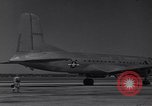
Cargo being loaded by winch in side door and jeep being loaded by elevator in a C-74 aircraft at Wright Field, Dayton, Ohio
U.S. Air Force C-74 Globemaster cargo aircraft at Wright Field in Dayton, Ohio. A C-74 Globemaster parked at Wright Field. Several ground crew stand in wheel well under No.3 engine of the aircraft. A ground crewman works on the tail of the C-74 aircraft, which displays the identification number: 265402 . No. 2 engine and open side door of the aircraft. A loadmaster stands in the open doorway with cable winch control in his hand. Man on ground secures cargo which loadmaster then raises with electrical winch .A jeep being loaded using platform elevator at underside of the C-74 Globemaster. Cargo hold of the aircraft with jeep being lifted up by elevator. Loadmaster secures elevator platform and then closes bottom cargo doors. Jeep is driven several feet forward inside the cargo compartment.
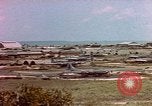
U.S. Army Air Force B-29 Superfortress bomber airplanes parked at airfield Isley Field, Saipan, during World War II
U.S. Army Air Force (USAAF) aircraft at Isley Field, Saipan, Mariana Islands, during World War 2. U.S. Army Air Force B-29 Superfortress bomber aircraft parked on aprons at airfield in Guam. Tail Code "A" of the 497th Bomb Group (73rd Bomb Wing) can be seen on one of the B-29s. A formation of USAAF P-51 Mustang fighter aircraft, in flight. U.S. airmen pull through propeller on number 4 engine of a B-29 to assure against hydraulic lock before starting the engine. B-29 parked next to this one displays "Square M" tail code of the 19th Bomb Group (314th Bomb Wing) stationed on Guam.
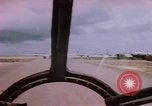
A U.S. Army Air Forces B-29 Superfortress bomber takes off from Isley Field, Saipan in the, Marianas Islands during World War II.
View from nose canopy of a U.S. Army Air Forces B-29 bomber, as it taxis behind another at Isley Field, Saipan, during World War 2. Next, the B-29 is on the active runway, accelerating for takeoff.
Lord of Admiralty Churchill speaks to Britain's stronger position during World War II, during a speech in London.
A speech by British Lord of the Admiralty Winston Churchill in London, England during World War 2. He states that Britain is in stronger position than it was at the start of the war. He says that fate of Holland, Belgium, Czechoslovakia, Poland and Austria will be decided by the victory of Britain and French Republic.
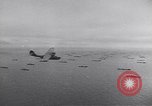
U.S. Engineers work to construct supply routes throughout the world during World War II.
PBY Catalina aircraft seen inflight above an Allied convoy of ships at sea. Closeup of British flag displayed at stern of one ship. A destroyer escort in the convoy. U.S. Army engineers creating a road in an area of wilderness. A steam shovel empties its bucket into a truck. A surveyor taking readings with a transit. Two graders moving side-by side as they level a new road A tractor pulling a drum compactor. A vehicle drives on a mountainside road built by Army engineers. Snow covered mountains seen in background. Animated map showing far flung places where military supplies had to be delivered during World War 2. An open Army truck carrying American troops on Guadalcanal in the Pacific. U.S. soldiers walking on a pier at Attu in the Aleutian Islands of Alaska. American soldiers arriving at a pier in Accra, Gold Coast. Soldiers hold the American flag on a hilltop in Casablanca, French Morocco. Chinese Generalissimo Chiang Kai-shek and Madame Chiang, in Chungking. American troops in foul weather gear neat tents in Kiska, the Aleutians. Troops offloading from a troop transport ship in Cairo, Egypt. Troops in Algiers, and in Sicily. Troops hitting the beach in an amphibious assault.
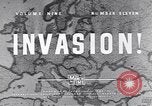
News media military analysts discuss the problems of Allies invading Europe to defeat Germany in World War II
Map of Europe and label "Invasion." Westbrook Van Voorhis leading a panel discussion about the problems arising from the Allied invasion of Europe in World War 2. He introduces panelists: Hanson Baldwin (military editor of the New York Times) Dewitt MacKenzie (Associated Press military analyst), and Paul Schubert (of Mutual Radio Network). He asks Mr. Baldwin about the importance of aerial bombing campaigns. Baldwin also stresses importance of a land invasion of Europe. Relief map of Europe highlighting major German cities. Asked about the merit of invading Italy on the way to Germany, Mr. Schubert cites the problem of the Alps and suggests other more effective invasion routes. Van Voorhis asks Mr. MacKenzie about best route into fortress Germany. He considers the criterion of ease of supply as most important, and suggests the Atlantic coast, near a good port and not far from England. Animated map shows this idea. When asked about this, Mr. Baldwin agrees completely, calling the conflict "a quartermaster's war." He adds, "The problem of victory is the problem of supply."
CRITICALPAST.COM: About Us | Contact Us | FAQs - How to Order | License Agreement | My Account | My Lightboxes | Shopping Cart | Advanced Search | Featured Collections | Website Terms & Conditions | Privacy Policy ©2026 CriticalPast LLC.
License Agreement |
Terms & Conditions |
Privacy Policy
©2026 CriticalPast LLC.