


 Francais
 Deutsch
 Italiano
Refine Your Search
2nd-Rangers-D-Day stock footage and images
- Showing 7 to 12 of 13614 results more
more Hide
Hide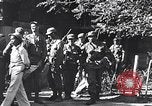
U.S. Rangers and Filipino guerrillas rescue Allied prisoners from Japanese prison camp in Philippines during World War II.
On January 30, 1945, 121 members of the 6th Ranger Battalion and 286 Filipino guerrillas are seen setting out on a 30 mile trek behind Japanese lines, to free Allied prisoners of war (POWs) and civilians from a Japanese camp near Cabanatuan City, in the Philippines, during World War 2. They stretch out in a long, informal column as they traverse low flat lands and ford a wide shallow river. The men carry weapons and supplies (some on their heads) as they move along, almost like a Safari. Scene shifts to rescued prisoner, Major Emil P. Reed, U.s. Army Medical Corps,26th Cavalry. He was the senior officer among prisoners at the Cabanatuan prison camp number 1. He recounts being told by the Japanese Commandant that commencing January 7th, they were free at their own risk, but also assured them they would not be molested by the Japanese if they stayed within their regular camp area. Sergeant Samuel E. Goldy, Signal Corps, also speaks a few words about that period when Japanese were departing. Next the camera records the Rangers and Filipino guerillas returning with the approximately 500 freed POWs. Some Filipino women and children watch them return. At one point, the cadre climb aboard army trucks and continue their journey in a convoy. The POWs climb down from their trucks at the 92nd Evacuation Hospital, in Guimba, Luzon. Some take pleasure is simply lying down on the grass at the site. Many gather around hospital staff handing out packages of treats, including cigarettes, candy and the like. A couple of them express pleasure as they smoke cigarettes. Two frail and injured are seen hobbling with canes. Some appear seriously malnourished. A group are seen trying on new clothes. A British prisoner, Sergeant Robert Bell, Manchester Regiment, British Army, speaks of his experience. He was taken prisoner in Singapore and sent to Thailand where he worked to build a railway for the Japanese. Many prisoners died there from disease and malnutrition. He was one of a small number who survived after being on a Japanese ship with other prisoners when it was sunk by American dive bombers. Sergeant Walter Ring, of San Roque, Luzon, is seated, relaxed on a chair, as he recounts his experiences. Two young Filipino boys sit on the grass at his feet. He reaches to one, whom he says is his son Louis and to the other, his son Sam. His captivity began on Bataan in 1942. Finally, after rest and rehabilitation, the former POWs are seen heading away from the battle fronts to be transported back to the U.S.A.
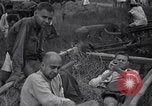
American Prisoners rescued from Japanese prison camp near Cabantuan City, during World War II, arrive at 92nd Evacuation Hospital
American prisoners rescued from the Japanese prison camp near Cabantuan City, Philippines, near the end of World War 2, are seen arriving at the 92nd Evacuation Hospital, in Guimba, Luzon. Opening scene shows some less able to walk, in a straw lined bamboo cart. Behind them Filipino youths are seen. Some former prisoners, who are stronger, walk amongst their rescuers and local Filipinos. (The rescue was accomplished by 121 members of the 6th Ranger Battalion and 286 Filipino guerrillas and Scouts.) Sequence contains many scenes of freed prisoners posing for the camera, smoking cigarettes, resting on the grass, and siting on log benches. One is carried from the porch of a building, on a stretcher. Several relax on rustic chairs. Closeups of some, including Colonel James Duckworth with his arm in a sling. One hobbles with help of a makeshift cane. Freed prisoners open packages containing cigarettes and treats. A full Colonel, in perfect uniform, and steel helmet (possibly commander of 75th Ranger Regiment) speaks with one of the 6th Battalion members. Freed prisoners relaxing and smoking cigarettes. Lieutenant Colonel Henry Mucci (with moustache) who accompanied the mission, conversing with Battalion members.
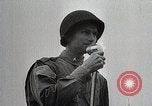
U.S. Paratroopers of 82nd and 101st Airborne divisions preparing to depart England the day before D-day in World War II
Film begins showing Brigadier General James M. Gavin, Commander of the Force A (parachute) contingent of the 82nd Airborne Division, standing on the hood of a jeep, at an airfield, to brief his paratroopers as they prepare for the D-Day invasion, during World War 2. A C-47 transport plane taxis behind the assembled group of troopers. Barbed wire is strung in the foreground. Paratroopers are issued French currency before departure. Some gamble with it using dice. Troops are seen playing volleyball on a field surrounded by trees. On an airfield, one trooper hits ground balls with a soft ball and several others field it. Some other troopers sit in grass next to the ramp, assembling wooden containers for airdrop. Two Army Air Forces mechanics fasten a tow bar on the nose wheel of a British-built Horsa Mk.II glider. They then tow it with a tug. View from above of Horsa gliders and C-47 tow airplanes, all in D-Day paint stripes, lined up on an airfield ramp. Paratrooper tent camp is viewed from above. Then, General Dwight D. Eisenhower and other senior officers are seen visiting paratroopers of the 101st Airborne Division, at the camp, on June 5, 1944, as they prepare to board their aircraft. Famous closeup of General Eisenhower speaking to a tall paratrooper who has his face camouflaged with grease paint.View looking down, as Eisenhower circulates among the troopers. Closeup of him conversing with another one directly.
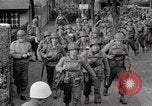
U.S. Army Rangers in Weymouth, England, prior to the D-Day invasion of France in World War II
Pre-invasion activities of United States Army Rangers in Weymouth, England during World War 2. The rangers walk past an American Red Cross tent, adjacent to Greenhill Gardens, Weymouth, where they receive coffee and doughnuts before sailing. A sign at the tent reads: "From the folks back home through the American Red Cross." A U.S. guard and a British guard patrol Weymouth Seafront, beside a gun emplacement on the esplanade in front of the Jubilee Clock Tower. An insignia on the ramp of Landing Ship Tank 357 (LST-357) reads '357' and shows a stork carrying a baby with the words 'We Deliver'. The ramp is raised.
Former U.S. prisoners rescued from Japanese prison at Cabanatuan, arrive at 92nd Evacuation Hospital, in World War II
U.S. prisoners of war, rescued by U.S. Army Rangers of the 6th Battalion, Alamo Scouts, and Filipino guerrillas, from Japanese prison camp at Cabanatuan, Philippines, during World War II. The rescued prisoners arrive at the 92nd Evacuation Hospital, at Guimba, Nueva Ecija, in ambulances and trucks. Soldiers and former prisoners gather outside the hospital buildings. Some of the freed prisoners rest on the ground outside the hospital buildings. The main building displays a sign reading: "Guimba East Central School, Academic Building No.2."
Allies, including U.S. Fifth Army, encounter heavy enemy resistance in amphibious assault at Salerno, Italy, in World War 2
Allied invasion at Salerno, Italy, during 2nd World War. Scenes of U.S. Sherman tanks, military vehicles and troops, moving easily through Sicily. Animated map depicts allied invasion routes from Bizerte, North Africa, to two points on opposite sides of Italy mainland. Convoys emerge from smoke screens in bay of Salerno, Italy. Allied warship creating heavy black smoke screen. Decks of LSTs crammed with trooops and vehicles. Allied warships bombard Salerno coastline. Commandos, Rangers and Seabees, in first assault wave are targets of German guns and dive bombers. Pontoon boat dropped from LST, with 35 Seabees aboard, strikes a mine, and is destroyed, setting off conflagration on the LST. Other LSTs (Landing Ship Tank) discharging vehicles to the beach over floating causeways, under enemy fire. Destroyed U.S. Sherman tanks, vehicles and a U.S. P-40 aircraft , litter the beach. A Seabee uses semaphore flags to direct an LST to beach area. Seabees build shelters for war materiel and dressing stations where allied wounded are treated. Seabees continue to unload supplies to beachhead. Brief view of Lieutenant General Mark Clark, 5th Army commander, on the beachhead. Allied casualties being tended. Stretcher bearers carry wounded. Allied troops advancing on roads in Italy. Admiral Moreell, chief of the U.S. Navy's Bureau of Yards and Docks, concludes narration of the Seabee documentary, from his office in Washington, DC
CRITICALPAST.COM: About Us | Contact Us | FAQs - How to Order | License Agreement | My Account | My Lightboxes | Shopping Cart | Advanced Search | Featured Collections | Website Terms & Conditions | Privacy Policy ©2026 CriticalPast LLC.
License Agreement |
Terms & Conditions |
Privacy Policy
©2026 CriticalPast LLC.