


 Francais
 Deutsch
 Italiano
Refine Your Search
2nd-Rangers-D-Day stock footage and images
- Showing 13441 to 13446 of 13614 results more
more Hide
Hide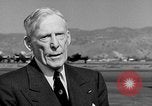
Former U.S. Army Lieutenants Lahm and Foulois recall their flights with Orville Wright in 1909
A film about the history of aviation in the United States. Retired Air Force Brigadier General, Frank Lahm talks about his first flight, as an Army Lieutenant, with Orville Wright on the Wright Flyer airplane, in July, 1909.Then, Retired Major GeneralBenjamin Foulois recalls how, as an Army Lieutenant, he flew the final cross-country and speed test flight from Fort Myer to Alexandria , Virginia, and back, again, with Orville Wright on 30th July, 1909. Film then shows that event, on July 30, 1909. Lt. Benjamin D. Foulois is seen climbing aboard the Wright Flyer airplane to accompany Orville Wright on the final cross-country and speed test required by the U.S. Army before it would purchase any aircraft. View of the Wright Flyer taking off with Wright and Foulois. Spectators watch in the background. View from another perspective of the aircraft taking off from Fort Myer, Virginia. View of the Wright Flyer being moved by several soldiers after landing back on the Fort Myer drill ground. (In his comments about this, Foulois notes that the flight set three world records: flying ten miles cross-country; attaining altitude of 600 feet, and speed of 42.5 miles per hour.)
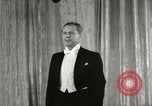
Host Walter Wanger speaks during the 13th Academy Awards at Biltmore Hotel in Los Angeles, California.
The 13th Academy Awards for motion picture movies at Biltmore Hotel in Los Angeles, California. American Hollywood film producer Walter Wanger welcomes United States President Franklin D Roosevelt for his six minute direct radio address to the attendees from the White House.
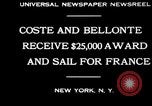
Colonel W.E. Easterwood presents a $25,000 prize to French aviators Coste and Bellontefor the first one-stop flight from Paris to New York to Dallas.
Film opens showing people assembled at a celebratory dinner, honoring French aviators, Captain Dieudonne Costes and Lieutenant Maurice Bellonte, who on September 1, 1930, flew their Breguet XIX aircraft,"Le Point d'Interrogation" (The Question Mark) non-stop from Paris to New York, and thence to Dallas Texas,landing at Love Field, Dallas, on September 4th,where they were greeted by 30,000 aviation enthusiasts. They are being honored by William Edward (Colonel) Easterwood, Jr., a Texas philanthropist and aviation enthusiast who had offered a $25,000 prize for the first one-stop flight from Paris to New York to Dallas,Texas. Colonel Easterwood delivers congratulatory remarks, and presents his check for the prize to the fliers. Closeup of the Easterwood check. Broadcast microphones are placed close to Colonel Easterwood and the fliers. Next, the fliers stand near the end of the event. Scene shifts completely to Costes and Bellonte with their aircraft, "The Question Mark, aboard a steamship, ready to sail back to France. Closup of the aircraft with large question mark painted on its side along with names of cities world-wide to which it had flown. Among these are: Hanoi; Calcutta; Karachi; Alepo; Athens; Rome; Paris; and New York. (Note: There is a display at the Frontiers of Flight Museum, Dallas Love Field, that includes the actual prize check as well as a panoramic picture of the "Question Mark" landing in Dallas, along with a plaque commemorating the event.)
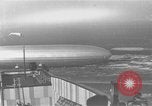
German rigid airship Graf Zeppelin approaches a mast in Lakehurst, New Jersey.
German rigid airship LZ 127 Graf Zeppelin is moored in Lakehurst, New Jersey. The nose of the airship. Full view of the airship. The tail of the airship. 'D-LZ 127' written on the airship. People in the foreground look at the Zeppelin. A mast in the background. The airship approaches the mast.
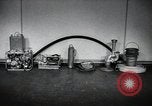
Working of a portable electric submersible pump used for removing water from a flooded ship compartment in the United States.
A training film depicts different types of portable pumping equipment, their capabilities, applications, limitations and workings used for removing water from flooded compartments of a ship in the United States. Portable pumping equipment on a ship include a D-500 pump, a portable electric submersible pump, eductors and buckets. The portable electric submersible pump is handled by two men. Animation depicts the working of the pump. A man connects a hose line to the pump. He puts the pump in a wire stainer basket. A man operates an overboard discharge connection. A man attaches the hose to the discharge connection. He closes the switch. The water comes out from the hose. Three men on the deck work with the pump. The limitations of the pump. Men attach a hose to the pump and put it in a basket. A flooded compartment and a pump put in the compartment to remove water.
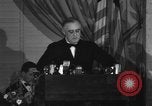
Roosevelt talks about dictators of Asia and Europe not doubting on Americas unanimity during a speech in the United States.
U.S. President Franklin D. Roosevelt gives a speech in the United States. He stands at a podium and speaks into a microphone. He talks about the needs of the nation. Officials and dignitaries seated in a hall. Men take pictures. Roosevelt speaks about dictators of Asia and Europe not doubting America's unanimity. He expresses his thoughts on the future. The Nazi elective system of the Government. He speaks about decisions taken by democracy. The end of compromises to be reached by the Americans.
CRITICALPAST.COM: About Us | Contact Us | FAQs - How to Order | License Agreement | My Account | My Lightboxes | Shopping Cart | Advanced Search | Featured Collections | Website Terms & Conditions | Privacy Policy ©2026 CriticalPast LLC.
License Agreement |
Terms & Conditions |
Privacy Policy
©2026 CriticalPast LLC.