


 Francais
 Deutsch
 Italiano
Refine Your Search
2nd-Rangers-D-Day stock footage and images
- Showing 1453 to 1458 of 13612 results more
more Hide
Hide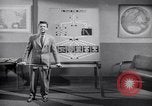
U.S. Army Public affairs film to explain idea of Universal Military Training (UMT) as a Plan for Peace, in 1947
The Universal Military Training Plan for Peace, 1947. A civilian spokesperson stands before a briefing chart entitled "Plan for Peace." He explains the concepts for the program, involving military training for young men immediately after they complete high school.He explains how young men would register and be screened, assigned, and trained under the program. Two college students discuss a requirement to join the Reserve Officer Training Corps (ROTC) under the program. Scene shifts to a U.S. Army officer talking with a civilian about the cost of World War 2. As scens of wartime military production are shown, Narrator interjects that "a full year of Universal Military Training will cost less than three days of war." Scene shifts to Separation Center, Fort Douglas, Utah. U.S. soldiers are seen mustering out. One holds his Honorable discharge certificate. View of marching German soldiers is inserted at this point. Contents of the U.S. Constitution are displayed in plain print, higlighting the part: "...provide for the common defense..." View of college students on a campus. Closeup of Dexter Gate at Harvard College, and three men walking through it into Harvard Yard. ROTC cadet talking with acquaintances about studying rockets. ROTC cadet talking with two middle aged men about unique sounds of airplanes. A B-17 bomber in flight. A C-119 (flying boxcar) aircraft in flight. A formation of B-17s viewed from above with clouds beneath. The XP-84 jet in flight. A V2 rocket being test fired at White Sands, New Mexico.
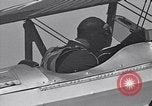
Aviator Charles Lindbergh talks to U.S. Navy officers aboard USS Saratoga, and takes off in a biplane fighter bomber.
Aviator Charles Lindbergh aboard USS Saratoga (CV-3) in the Pacific near the Panama Canal. Charles Lindbergh seen in a Boeing F3B-1 carrier based fighter bomber (BuNo A-7739) from Bombing Squadron VB-2B aboard the aircraft carrier USS Saratoga. Lindbergh visited the USS Saratoga on 8 February 1929. He was aboard for two days and while he was there he was invited to fly the new Boeing F3B-1. The VB-2B made him an honorary member of the squadron. U.S. Navy officers talk to Lindbergh on the deck of Saratoga, including Admiral Joseph Mason Reeves (aka "Bull" Reeves), A.P. Storrs, and W.V. Davis. Pilots pose for a photo with Lindbergh. Lindbergh seated in the aircraft. Squadron emblem of Felix the cat holding a spherical bomb is painted on side of plane. Plane takes off from the carrier deck. Lindbergh, U.S. Military and Navy officials aboard Saratoga talk to each other. Another naval ship can be seen in the sea. Bow of the aircraft carrier.
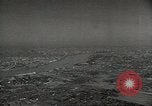
Japanese troops surrender Shanghai and South Korea in the Pacific Theater at end of World War II.
Aerial view passing over Shanghai at end of World War 2, just after VJ Day surrender of Japan. People in Shanghai celebrate the surrender of Japanese troops. Citizens sew and the hold up a American flag. Various allied citizens celebrate together with Shanghai residents. A building with flags of America and China in front of it, a large "V" for victory, and a picture of Chiang Kai Shek on the wall. In Seoul, U.S. soldiers march and Korean citizens cheer the end of World War 2. A surrender ceremony takes place at Governor's Palace. Japanese and Allied officers sign documents. Lt. General John Hodge signs documents accepting the Japanese surrender. In front of the Palace, the Japanese flag is lowered from a flag pole, and the American flag is raised as officers salute.
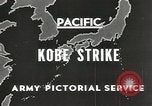
United States B-29 bombers drop incendiary bombs over Kobe, Japan
"Kobe strike" shows United States B-29 bomber aicraft dropping 3200 tons of incendiary bombs over industrial targets in Kobe, Japan during World War 2. Firebombing causes pillars of smoke to rise up. Narrator speaks of strikes on other Japanese cities also and relates statement by General Arnold that beginning July 1945, industrial Japan will be hit by bombs at the rate of 2 million tons per year, or 5480 tons per day, adding that "by the end of 1946, Japan will have ceased to exist as a bombing target."

New recruits enter training at the U.S. Great Lakes Naval Training Center during training during World War II.
A U.S. Navy training film titled 'You're Navy now' about the recruitment and training of sailors in U.S. Navy during World War 2. Opening scene shows a tram at the Inter-urban trolley station near the gate of the Great Lakes Naval Training Center, during World War 2. Arriving military recruits in civilian clothes step from the train cars as U.S. Navy sailors in uniform wait to board. A Petty Officer instructs the newcomers to follow him. A Petty Officer, second class, and his friend, stand on the trolley platform and comment about the new recruits, as they walk past. The recruits follow their guide into the center and walk across the campus. A Wave (woman sailor) in uniform is seen walking on another path. One recruit remarks: "Look at the lady sailor." On their way, the recruits see a contingent of sailors marching in formation. Scene shifts to the barracks where the new recruits are settling in. Interior parts of the barracks are labeled with naval terms, such as "passage way,"instead of hall. One recruit peeks inside door marked,"Crews Head." Recruits make the best of their first night in the barracks, trying to rest, playing cards, and thinking. The next day they are lined up outside a building. Next, inside that building they are instructed to prepare labels to ship their civilian belongings home. They disrobe for physical examination and walk up a stairway to be reviewed by doctors and dentists, who check their eyes, teeth, and vital signs (blood pressure). One stands up for a chest X-ray. View inside the Training Center hospital. Recruits seen donning new white uniforms, and later going "below,"in work uniforms.
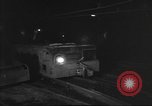
Westland Mine coal miners return to work after end of walkout of 400,000 miners called by United Mine Workers.
At start, the film shows coal miners riding on electric-powered open railway cars at the Westland Mine in Pennsylvania, owned by the Pittsburgh Coal Company. The miners wear hats with lights on them. A train of open hopper cars filled with coal is being pulled by the last railway car carrying miners. Scene changes to above ground where a string of minecarts filled with coal are emerging from the mine into a railroad yard. Closeup of large chunks of coal in the hopper cars. Another view of filled mine carts being pulled out of the mine. View of full-size open rail cars lined up underneath an overhanging wooden tipple discharging coal into them. Closeup from underneath the tipple showing coal dropping into full size open hopper cars. Next, a long train of full hopper cars are seen moving along a railroad track, being pushed by several electric-powered locomotives. They pass on tracks near other cars being loaded with coal. A miner writes: "Mon Dec 9," with chalk on a brick structure. (This is the day the miners returned to work, following announcement by United Mine Workers President John L. Lewis, on December 7, 1946, calling an end to a walkout of 400,000 coal miners that he had called on November 20). Two 2-8-2 Mikado steam locomotives owned by the Montour Railroad pull a long train of coal cars. View in background of duplex homes of the coal town in Westland, Pennsylvania. Next scene shows elevated view of city of Pittsburgh, Pennsylvania, from approximately Duquesne Heights area, with distant view of downtown buildings, and steel bridges over the three rivers area (Monongahela River, Ohio River, and Allegheny River). Next scene shows many industrial smoke stacks emitting smoke. Final scene shows a train of empty hopper cars returning to the coal mines.
CRITICALPAST.COM: About Us | Contact Us | FAQs - How to Order | License Agreement | My Account | My Lightboxes | Shopping Cart | Advanced Search | Featured Collections | Website Terms & Conditions | Privacy Policy ©2026 CriticalPast LLC.
License Agreement |
Terms & Conditions |
Privacy Policy
©2026 CriticalPast LLC.