


 Francais
 Deutsch
 Italiano
Refine Your Search
2nd-Rangers-D-Day stock footage and images
- Showing 1525 to 1530 of 13612 results more
more Hide
Hide
Syngman Rhee, General Hodge, General Shitkov, and other officials meet at Duck Soo Kong in Seoul, after World War II.
Early North Korean Propaganda film depicts post-World War 2 events in Korea. including the partition of North and South at the 38th parallel. Korean village and country side.Seagulls fly at seaside. Duck Soo Kong building in Nam Dai Moon in Seoul. Officers stand around a table as General Hodge ( United States), General Shitkov (Russia), Syngman Rhee of South Korea meet. Rhee addresses the meeting, Koreans enter YMCA building in Seoul. Shows Japanese flag and states that Syngman Rhee has traded one Imperial overlord for United States. Animated map of Korea shows division at 38th parallel and depicts Southern part being covered by the entangling web of American interference. Len Han Sa building in Seoul and the city as a whole. South Korean police depicted treating a man badly and taking his food away to highlight Syngman Rhee's strongman tactics.
U.S. Air Force Lieutenant General Lauris Norstad and Norwegian General Bjarne Øen arrive at Wiesbaden Air Force Base, West Germany, for Exercise Cirrus involving Allied Air Forces in Europe.
Exercise Cirrus, an air exercise for the Allied air forces in Central Europe, that ran concurrently , part of the time, with Exercise Jupiter, a three-day, French-directed war game involving Allied forces in Europe (principally Germany). A band and honor guard are seen prepared for the arrival of senior air commanders at Wiesbaden Air Force Base, West Germany, involved in Exercise Cirrus. Glimpse of C-47 aircraft lined up on the field. A United States Air Force C-54 transport aircraft taxis into the airfield ramp with engines one and four shut down. A North American T-6 Texan training aircraft is seen in the background. The C-54 circles to where a greeting committee of Allied Air Force officers is standing. Closeup of the aircraft door being opened and a rolling stairs being placed at the doorway. Inside of door displays insignia of States Air Forces Europe (USAFE). Exiting the aircraft is Lieutenant General Lauris Norstad, commander in chief, of USAFE, with headquarters at Wiesbaden, Germany. (On April 2, 1951 he assumed additional duty as commanding general of the Allied Air Forces in Central Europe under the Supreme Headquarters of the Allied Powers in Europe.) He is accompanied by General Bjarne Øen, Chief of the Norwegian Air Force. As they descend the stairs, they are greeted by a group of officers including: Major General Truman H Landan, Deputy Commanding Officer, USAFE ( United states Air force in Europe ), Lieutenant General Robert W Harper, Commander, U.S. Air Force Air Training Command, Colonel Rich, chief of Staff 12th Air Force and Colonel Roberts, Commanding Officer Wiesbaden Air Force Base. After mingling and conversing, Generals Norstad and Oen and their escorts exchange salutes with the color guard. A car arrives and Norstad and Oen step into it and and drive away.
Allied aircraft lay mines in Pacific Theater during World War II.
'Aerial mine laying blockades Japanese shipping' depicts Allied preparations and Operations of the 21st Bomber Command, for aerial dropping of mines in the Pacific ocean to thwart Japanese shipping in World War 2. . Rows of stacked bombs are shown in a munitions dump at Tinian Air Base in the Mariana Islands. Camera focuses on a 2000 pound MK25 mine. Men demonstrate hydrostatic safety devices on the mine, including an extender that holds the detonator away from the booster charge until sufficiently immersed, and a clock delay mechanism. MK 25 transported to B-29 aircraft named Flak Alley Sally. (This is B-29 Number 42-24878 of the 40th Bomb Squadron, 6th Bomb Group, 313th Bomb Wing.) Airmen attach a parachute to the end of the mine. Another inserts the detonator and its extender plus the timer device into the side of the mine. Soluble washers are then placed in arming device ports. Scene shifts to Army and Navy planners working with maps, dividers, and a Weems plotter to mark the target location and mine laying pattern. 313th Bombardment Wing Group Commanders are seen being briefed in a war room. Next, engines are seen starting on a B-29, that then takes off and is seen in flight.(Narrator notes that missions are flown at night, but this one is photographed in the day to show how it is done. View of B-29 cruising above clouds. View from inside the aircraft, of bomb bay slowly opening. View of the target area below. The parachute of a mine opens by a static line as it falls from the bomb bay. Scene shifts to water level closeup of a mine striking the water. ('Presumably a demonstration inserted here.) Final scene shows a Navy Grumman TBF/TBM Avenger torpedo bomber dropping a parachute equipped mine. in the same location.
Japanese Americans at relocation center in United States during World War II.
Relocation of Nisei people in United States during World War 2. Japanese Americans arrive at the Manzanar relocation center (internment camp). Family members exit a bus. A young boy looking unsure as he observes the camp. New internees undergo medical examination. They participate in Americanization classes. They train themselves in self government. Block leaders are presented citations at a meeting. Japanese-American children internees are looked after in day care centers as men and women go to work. Young boys and girls seated at a table. Internees at Manzanar working in an experimental laboratory house for extracting rubber from guayule shrubs to increase rubber production during the war. Japanese American internees working in cultivating the guayule shrub. View of a project at the Parker camp where internees were working to irrigate desert land. View of sugar beet fields where internees could work. View of Manzanar war relocation center with mountains behind. War time propaganda narrator promotes the relocation centers as "setting a standard for the rest of the world in the treatment of people who may have loyalties to an enemy nation. We are protecting ourselves without violating the principles of Christian decency."

Internees from Brussels at the Buchenwald concentration camp interviewed in Germany.
Internees at a concentration camp in Buchenwald, Germany. Jean Blume, leader of socialist national movement against occupation in Belgium, shares his experiences of the days spent as a prisoner at Breendonk concentration camp in Belgium. He expresses joy at being liberated by American Army from Buchenwald concentration camp. (Note: Jean Blume was a Resistance Leader during the Nazi occupation in World War 2. The Gestapo arrested him on January 19, 1943 and he was imprisoned in Breendonk. In May 1944, he and many others, were sent to Buchenwald. They were released on April 11, 1945.)
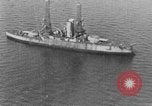
Bombing runs are conducted on practice target USS Alabama, BB-8, destroying the ship
USS Alabama (BB-8) serves as a bombing practice target and is destroyed by Phosphorus bombs in the Chesapeake Bay, off the coast of Maryland, United States. Views of the USS Alabama at sea. A U.S. Army DH-4 single-engine bi-plane bomber of the 1st Provisional Air Brigade is prepared for a bombing run. Army soldier inspecting bombs attached to bottom of plane. The bomber in flight toward the target. Bombs released from the bomber. Huge explosions from phosphorus bombs on the mast birds nest area of the USS Alabama. The ship is completely shrouded in white smoke. Subsequent bombing run on the ship days later. The ship is struck by 2,000 pound bombs and quickly tips sideways and sinks in shallow water. Close views of the wrecked ship with mast toppled and massive destruction on deck.
CRITICALPAST.COM: About Us | Contact Us | FAQs - How to Order | License Agreement | My Account | My Lightboxes | Shopping Cart | Advanced Search | Featured Collections | Website Terms & Conditions | Privacy Policy ©2026 CriticalPast LLC.
License Agreement |
Terms & Conditions |
Privacy Policy
©2026 CriticalPast LLC.