


 Francais
 Deutsch
 Italiano
Refine Your Search
2nd-Rangers-D-Day stock footage and images
- Showing 2737 to 2742 of 13612 results more
more Hide
Hide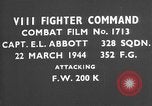
U.S. Army Air Forces attack German fighter aircraft Focke Wulf 200 Condor in the European Theater during World War II.
U.S. Army Air Forces VIII Fighter Command Operation in the European Theater during World War II. Gun camera footage from a P-51 fighter aircraft. An attack on a German Heinkel He 177 by Capt. E L Abbott from 328th Squadron, 352nd Fighter Group. The burning aircraft falls. Grasslands in background. (Note: The introductory slate erroneously identifies the target aircraft as a German 4-engine FW-200, when it is actually a twin engine HE-177.)

Georgy Zhukov inspects troops during unveiling of Soviet War Memorial and Russian Revolution anniversary celebrations in Berlin, Germany.
Unveiling of new Soviet War Memorial (Tiergarten) in Berlin Germany, during Russian Revolution anniversary celebrations (28th anniversary), in Berlin, Germany, soon after the end of World War II. Marshal of the Soviet Union Georgy Konstantinovich Zhukov inspects British, French, American and Russian units. Trees in the background. Zhukov and United States Army Major General James Maurice Gavin in a grandstand. A Russian officer speaks from the grandstand in front of the Soviet War Memorial (then also called Russian Victory Monument by Allied forces) on Charlottenburger-Chaussee. A Russian Army band plays. A statue of a Russian soldier atop the Victory Monument. Russian troops parade after unveiling of the Memorial. Honor company of United States Army 82nd Airborne Division marches past. Allied troops seen marching in formation on nearby streets of Berlin. Major General Gavin shakes hands with Soviet leader Marshal Zhukov. Officers place wreaths at the Soviet War Memorial. Russian artillery fires salute. Photographers take photographs. The officers salute in front of the War Memorial. Wreaths placed at the base of the Memorial.
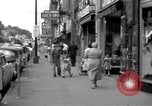
Views of a typical small town in the midwestern United States in the 1950s, Ottumwa, Iowa.
In a U.S. Army documentary, an Army Sergeant walks on sidewalks of a typical 1950 small town in the rural United States -- Ottumwa, Iowa. Civilians on streets of the city. Various shops and 1940s and 1950s era automobiles. People from various walks of life talk to the Sergeant. The Sergeant recalls the town's ancestors entering America. The Des Moines river is shown with a small boat anchored at the end of a dock and men and boys fishing. Statue of Native American Indian Chief atop the Courthouse Building, Chief Wapello, whose tribe camped in the spot of the town years prior. The entrance of the library. Still images and drawings from the library depicting the town. Pictures of houses, shops and other buildings. People on the streets of Ottumwa. The Ottumwa Daily Courier newspaper headline announcing U.S. participation in World War I, "War Becomes Actuality." Images of members from Ottumwa's own Company G, 42nd Rainbow Division in WWI, including soldiers Arthur Menge, Charles Orman, Marlow Work. Views of WWI battle scenes. Oscar Nelson is remembered for heroism. WWI soldiers returning to American towns. Private Charles Orman 40 years later in Ottumwa. He enters a barber shop. Art Menge is also seen in the Barber shop. Aerial view of the city with many bridges, plants, factories, and homes visible. Cars and pedestrians on streets, The Ottumwa Bank, the Airport with a plane parked in front of the terminal, the Railroad train station with people waiting as a large sleek silver passenger train pulls up and arrives. The Hoffmann Drug store, the Ottumwa Hotel, The Ottumwa Daily Courier newspaper building, the Glover Motor Company, the Union Bank, and the Sunnyslope Sanitorium. Various homes and neighborhoods and 1950s automobiles. Governor Herschel Loveless, an Ottumwa native, at home with his wife. The home on Davis Street of the Miss Universe contest winner Carol Morris, and views of Ms. Morris in the pageant and receiving the winners crown in 1956.
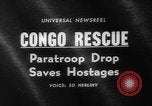
U.S. Air Force Aircraft transport 600 Belgian Para-Commando troopers, on rescue mission to Stanleville, Congo
View from behind the pilot in cockpit of a U.S.Air Force C-130 transport aircraft of the 322nd Air Division, U.S. Air Forces Europe, approaching Stanleyville, Congo, on a mercy mission to save lives of Belgian hostages held by Congolese rebels who threaten to kill them. View from tarmac on the airport, as Belgian paratroopers exit the aircraft while its engines are still running. They secure the airfield, unload supplies and ammunition, and start moving toward the center of Stanleyville. View from moving vehicle traveling along deserted street in Stanleyville. After hearing shots, the paratroopers come upon a courtyard where they find numerous Belgian dead. View of courtyard and bodies covered with cloth. Another dozen, or so, bodies are seen lying in another group. One dead seen lying in the roadway. Bullet-riddled car at side of road. Local Congolese residents (non-rebels) board trucks for transport to the airport. Hundreds of rescued Belgian people are gathered at the airport. A C-46 transport aircraft is parked in the background. A Belgian trooper walks past. Next, a view, again, from behind the pilot in a USAF C-130 aircraft, this time, approaching Leopoldville. Ground crewman guides the aircraft to a parking place on the Leopoldville airport ramp. Rescued people walk across the ramp. U.S. Air Force airmen carry body of a victim,on a stretcher, down the rear ramp of a C-130. Bodies of those killed, are laid out across the entrance of a hangar at the airport. Two U.S. Marines place American flags on the bodies of medical missionary, Dr. Paul Earle Carlson, and missionary, Phyllis Rine. More views of rescued persons walking with some belongings, across the tarmac and gathered around the open rear door of a C-130. Tail number of the C-130 is 40499. A USAF C-119 aircraft; a C-97 (of the Military Airlift Command); and a C-54 aircraft are parked in the background.
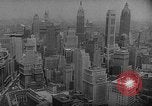
Pope Paul VI leads prayer at Saint Patrick's Cathedral and addresses the UN General Assembly meeting in New York.
Pope Paul VI becomes the first Roman Catholic Pontiff to visit the United States. Aerial view of buildings and skyscrapers of New York City skyline. Brief external view of Saint Patrick's Cathedral (5th Ave, New York, NY 10022, United States). Pope Paul VI leads a prayer during a mass at Saint Patrick's Cathedral. Aerial view of United Nations Building (405 East 42nd Street, New York, NY, 10017, USA). Pope Paul VI addresses the United Nations General Assembly in New York, calling the UN a man's last hope for peace.
U.S. soldiers operate M36B1 tank destroyers in Germany and Allied cargo arrives at the port of Rouen in France.
Activities in the European Theater of Operations during World War II. M36B1 tank destroyers in Germany. The tank destroyers advance through slush and mud. Soldiers of the 692nd Tank Destroyer Battalion attached to the U.S. Army 104th Infantry Division, seated on the tank destroyers. A 90mm gun is test fired. A soldier removes the barrel cover and fires the gun. Soldiers observe the impact. First United States Army soldiers instruct the 8th Infantry Division troops about the use of captured German guns. A soldier demonstrates the use of a captured German Panzerfaust, a recoilless anti- tank launcher. A tank is hit. Damage caused by the hit. France: The port of Rouen along the Seine River. Various ships arrive with cargo for the Allies battling at the Rhine. A LIberty and Victory ship arrives. The Marine Division of the Army Transportation Corps on board. Women soldiers at work. A soldier near an organizational chart on the ship.
CRITICALPAST.COM: About Us | Contact Us | FAQs - How to Order | License Agreement | My Account | My Lightboxes | Shopping Cart | Advanced Search | Featured Collections | Website Terms & Conditions | Privacy Policy ©2026 CriticalPast LLC.
License Agreement |
Terms & Conditions |
Privacy Policy
©2026 CriticalPast LLC.