


 Francais
 Deutsch
 Italiano
Refine Your Search
2nd-Rangers-D-Day stock footage and images
- Showing 2953 to 2958 of 13612 results more
more Hide
Hide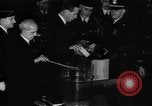
President Franklin D Roosevelt delivers a speech about the Selective Service System in Washington DC, United States.
Official and officers draw draft under Selective Service System at the Department of Labor auditorium in Washington DC, United States. President Franklin D Roosevelt delivers a speech on the occasion, during the lead up to America's involvement in World War 2. He reveals that 95 percent of the people registered under the Selective Service System are not required by the nation and will not be called to military service. He also encourages those new recruits selected for military service to answer the call for duty and defend the independence of the nation. He declares peace keeping as the main task of the United States Armed Forces, and speaks of the those called as members of a peace time army.
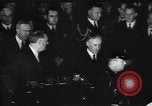
President Franklin D Roosevelt announces results of numbers drawn under the Selective Service System in Washington DC.
Officials draw drafts under Selective Service System at the Department of Labor auditorium in Washington DC, United States. Attorney General Robert H Jackson and Secretary of Navy, William Franklin Knox draw numbers and President Franklin D Roosevelt announces them, during United States initial build-up of military forces prior to the country's involvement in World War 2. A man writes down the numbers drawn on a draft board.
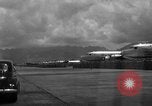
President Franklin D. Roosevelt at Hickam Field and at Alea Naval Hospital in Hawaii, during World War II
Rear view of a car in President Franklin Roosevelt's motorcade driving along the flight line at Hickam Field, Honolulu, Hawaii, during World War 2. Several C-54 aircraft are seen (Navy designation R5D). President's The President sits with Admiral Chester Nimitz, in the back seat of an open 1942 Packard convertible motorcar. (It displays private use "A" gas ration stamp, the most restrictive, on its windshield.) Medics carry a wounded soldier, on a litter,past the car, and the President shakes his hand. A new scene shows the President's VC-54C airplane (Sacred Cow) parked in front of the air base terminal building, which it topped by a sign reading: "Aloha Air Transport Command." Change of scene shows spectators filling the lower level and porch of a building at the U.S. Naval hospital, Alea Heights. Next the President's car is seen surrounded by hospital staff in formation to honor him. Nurses in white stand at attention on the ground, and a large formation of sailors stand at attention on a porch above.
General Patton in background as General Dwight D. Eisenhower addresses soldiers of United States 35th Infantry Division
U.S. General Dwight D. Eisenhower visits United States 35th Infantry Division troops in England during World War 2. General Eisenhower speaks into a microphone as he stand on a raised platform. Soldiers of United States 35th Infantry division listen to him. General Eisenhower speaks as General George S. Patton stands in the background. General Eisenhower with other officers. He along with an officer moves down the slope of a hill.
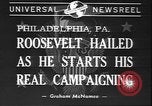
Franklin D. Roosevelt begins his election campaign in Philadelphia, Pennsylvania
Franklin D. Roosevelt begins his election campaign in Philadelphia, Pennsylvania. He delivers a speech at the convention hall. He addresses the prospect of war (early in World War 2) saying, "We are arming ourselves not for any foreign war. We are arming ourselves not for any purpose of conquest or intervention in foreign disputes. I repeat again that I stand on the Platform of our Party: 'We will not participate in foreign wars and we will not send our army, naval or air forces to fight in foreign lands outside of the Americas except in case of attack.'"
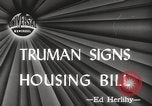
United States President Harry Truman signs housing bill in Washington D.C . that will help provide homes for the homeless.
United States President Harry S. Truman signs Housing Bill in Washington D.C., United States. President seated at desk as he signs the the Veterans Emergency Housing Act of 1946, during a housing shortage for veteran soldiers and their families after World War 2. Officials stand behind him at the White House. President Truman signs the bill that will help provide homes for the homeless. He speeds authorization of $250,000,000 for emergency homes.
CRITICALPAST.COM: About Us | Contact Us | FAQs - How to Order | License Agreement | My Account | My Lightboxes | Shopping Cart | Advanced Search | Featured Collections | Website Terms & Conditions | Privacy Policy ©2026 CriticalPast LLC.
License Agreement |
Terms & Conditions |
Privacy Policy
©2026 CriticalPast LLC.