


 Francais
 Deutsch
 Italiano
Refine Your Search
2nd-Rangers-D-Day stock footage and images
- Showing 3133 to 3138 of 13612 results more
more Hide
Hide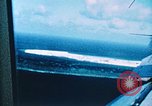
President Richard Nixon awaits the arrival of Apollo 11 astronauts aboard USS Hornet (CV-12) in the Pacific Ocean.
A splashdown point for Apollo 11 Command/Service Module (CSM) in the Pacific Ocean. Aerial views of a base with trailers and people gathered. The President's aircraft can be seen parked. USS Arlington (AGMR-2) underway. It is bristling with countless antennas and posts erected on the flight deck, and is providing communications support for the Apollo 11 recovery. Navy officers on the deck of USS Arlington. Sailors are lined up in a square formation surrounding center of deck. Astronaut Frank Borman, who commanded the Apollo 8 mission, is seen on deck. A U.S. Navy Sikorsky Sea King SH-3D helicopter hovering over USS Arlington. Aboard prime recovery ship USS Hornet (CVS-12), U.S. President Richard Nixon awaits the arrival of astronauts. The President stands in front of a Mobile Quarantine Unit, where NASA Associate Administrator for Manned Space Programs, George Mueller, explains the Biological Isolation Garment being modeled. Nixon feels the texture of the suit.
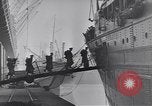
U.S. Army Service Forces transporting troops and supplies worldwide during World War II.
U.S. troops board a large troop transport ship via a gangplank. Troops on an intermediate deck of the ship. Some are sprawled out relaxing. View from above of more troops boarding a ship. Men and equipment on the pier below. American forces at various far flung places where the U.S. Army Services Forces facilitated their transport and logistic support. Fleeting glimpses of troops in: Ireland; Alaska; Trinidad; and South America. Troops jam the upper deck of a transport ship. Army Service Forces officers in a planning meeting. Naval officers on deck of a ship look through binoculars as U.S. Naval ships bombard the coast of Solomon Islands and landing craft carry marines in an amphibious assault. Next, a man is seen annotating a map of North Africa. Secret maps pertaining to Allied landings in Tunisia and Algeria. Animated map illustrates amphibious landings on North African coast, highlighting Casablanca, Oran, and Algeria. Landing craft carry troops and supplies that are piled up in the sand beach. Soldiers moving military supplies ashore, in fire brigade fashion. Soldiers working at desks in Offices of the Army Service Forces. Filing cabinet in background. Trucks on the move in remote locations. Supply ship being loaded at a terminal. Fuel drums and army vehicles a being loaded aboard ships. Officers seated at a conference table. Ordinary American enlisted soldiers in a griping session at an Army post in the United States. Camera pans over large formation of soldiers. Animated chart shows more than half of servicemen who are part of Army Service Forces (ASF), are unaware of that. Troops marching in review at a tropical location, where reviewing officers wear pith helmets. Chart illustrates lack of unit pride in ASF. Images of various ASF logos. Chart shows results of polling data from soldiers and service members. Signal Corps and Engineers elements of ASF have the greatest unit pride. But most think better of other branches of the Army. More troops marching, in steel helmets and carrying rifles with bayonets affixed. Troops marching overlaid by "50%" indicating that half don't believe their contributions to the war effort are significant. Troops lined up (for pay?). More charts expressing concern about low morale. A heavy gun firing. German paratroopers jumping from a formation of Junkers Ju 52 aircraft. Charts expressing prevailing U.S. troops view that Germany wouldn't be too hard to defeat. Chart showing lack of understanding about why the U.S. is fighting Germany. Image of President Franklin D. Roosevelt and Prime Minister Churchill seated in front of their key military officers at Casablanca Conference in World War 2. Chart shows U.S. soldiers believe that the greatest war effort is expended by the U.S. followed by Russia, with China and Britain providing little. Chart illustrates that only half U.S. troops want to get overseas and fight. Chart shows U.S. War Department films can correct this problem.
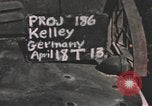
German Luftwaffe aircraft at captured airstrip, in Germany, near end of World War II
Undamaged German Luftwaffe aircraft, including Focke Wulf FW 190 D-9s, Ju-88C night fighter aircraft, and camouflaged Ju-88, parked in edge of woods beside a dirt runway, several weeks before the end of World War 2. Aircraft wreckage seen in one area of the airstrip
Contributions of African Americans in various fields in the United States.
(See also clip 65675078146 from different film transfer). Famous African American men and women citizens in the United States. Clip opens with of Booker T. Washington at Tuskegee University. Scene in a laboratory with African American scientist and inventor George Washington Carver, as an elderly man, working with another scientist in the laboratory. African American judge of New York city court. African American explorer Matthew Henson is seen looking at a globe (he was with Admiral Peary planting the American flag at the North Pole in 1909), and an unnamed African American surgeon at work in an operating room in New York. Next scene shows famous "father of the blues" musician and composer W.C. Handy (William Christoper Handy) smiling. Next is seen the financier and publisher of the Amsterdam News, Dr. C.B. Powell (Clilan Powell) greeting three uniformed African American women during a World War 2 war bond drive, and handing them a check (close up is shown) for 25,000 dollars, dated January 4, 1942, for the war bond drive. It is from the account of the Victory Mutual Life Insurance Company which Dr. Powell also owned. The check is signed by C.B Powell and Philip M.H. Savory (Dr. Savory was co-owner of the New York Amsterdam News). The next scene shows Elise Johnson McDougald, better known as Gertrude Elise Ayer, who was the first black full-time public school principal after the consolidation of New York City schools in 1898. She was also a noted woman writer during the Harlem Renaissance. She is seated in her office at her desk, likely in P.S. 119 in Harlem, since this is approximately year 1945 and she was at P.S 119 at that time. Her name plaque is visible on the front center of the desk. Principal Ayer smiles as a woman delivers a document to her. Next is seen the African American historian, author, and professor, Lawrence D. Reddick, serving in his role as the curator of the Schomburg Collection of African American Literature. In an art studio is seen the famous African American sculptor and painter Charles Alston, at work on a sculpture. Next scene shows the famous African American contralto singer, Marian Anderson, receiving a bouquet of flowers and smiling after a performance. This transitions to a view of African American orchestra conductor Dean Dixon leading an orchestra in a performance of Beethoven's 9th Symphony. Several views of different sections of the orchestra performing under Dixon's direction. Clip closes with brief shots of campuses of several historically black colleges and universities in the United States like Howard University, Hampton, Tuskegee, Fisk, Prairie View. An American college football game underway at the stadium of one of the colleges.

An officer briefs trainees at Motor torpedo boat squadron training center in the United States in World War II.
A U.S. Navy training film titled 'The PT's' about the role and importance of patrol boats during a war ( World War 2). A sign reads 'Motor torpedo boat squadron training center' in the United States. Trainees in a class room as U.S. Navy Lieutenant Commander John D. Bulkeley briefs them about the role of torpedo motor boats. The trainees listen to him carefully and take down notes. Patrol boats underway at sea. A gunner aboard a boat as an explosion occurs at sea.
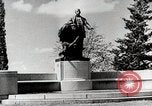
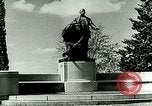
Achievements of African Americans in art, literature, music science, and medicine in the United States, in the late 1930s and 1940s.
A film about achievements of various African American men and women citizens in the United States. A statue of Booker T. Washington, founder of Tuskegee University in Alabama. View of African American scientist and inventor George Washington Carver, as an elderly man, working with another scientist in a laboratory. African American judge of New York city court. African American explorer Matthew Henson is seen looking at a globe (he was with Admiral Peary planting the American flag at the North Pole in 1909), and an unnamed African American surgeon at work in an operating room in New York. Next scene shows famous "father of the blues" musician and composer W.C. Handy (William Christoper Handy) smiling. Next is seen the financier and publisher of the Amsterdam News, Dr. C.B. Powell (Clilan Powell) greeting three uniformed African American women during a World War 2 war bond drive, and handing them a check (close up is shown) for 25,000 dollars, dated January 4, 1942, for the war bond drive. It is from the account of the Victory Mutual Life Insurance Company which Dr. Powell also owned. The check is signed by C.B Powell and Philip M.H. Savory (Dr. Savory was co-owner of the New York Amsterdam News). The next scene shows Elise Johnson McDougald, better known as Gertrude Elise Ayer, who was the first black full-time public school principal after the consolidation of New York City schools in 1898. She was also a noted woman writer during the Harlem Renaissance. She is seated in her office at her desk, likely in P.S. 119 in Harlem, since this is approximately year 1945 and she was at P.S 119 at that time. Her name plaque is visible on the front center of the desk. Principal Ayer smiles as a woman delivers a document to her. Next is seen the African American historian, author, and professor, Lawrence D. Reddick, serving in his role as the curator of the Schomburg Collection of African American Literature. In an art studio is seen the famous "Harlem Renaissance" African American sculptor and painter Charles Alston, at work on a sculpture. Next scene shows the famous African American contralto singer, Marian Anderson, receiving a bouquet of flowers and smiling after a performance. This transitions to a view of African American orchestra conductor Dean Dixon leading an orchestra in a performance of Beethoven's 9th Symphony. Several views of different sections of the orchestra performing under Dixon's direction. Clip closes with brief shots of campuses of several historically black colleges and universities in the United States like Howard University, Hampton, Tuskegee, Fisk, Prairie View. A football game underway in one of the colleges, and view on the field as quarterback throws a pass.
CRITICALPAST.COM: About Us | Contact Us | FAQs - How to Order | License Agreement | My Account | My Lightboxes | Shopping Cart | Advanced Search | Featured Collections | Website Terms & Conditions | Privacy Policy ©2026 CriticalPast LLC.
License Agreement |
Terms & Conditions |
Privacy Policy
©2026 CriticalPast LLC.