


 Francais
 Deutsch
 Italiano
Refine Your Search
2nd-Rangers-D-Day stock footage and images
- Showing 3265 to 3270 of 13612 results more
more Hide
Hide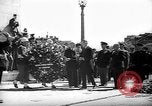
U.S. Ambassador to France Caffery at the Tomb of the Unknown Soldier in Paris and U.S. military cemetery in Suresnes in France.
Memorial Day in Paris, France. U.S. Ambassador to France Jefferson Caffery with officials. The ambassador lays a wreath at the Tomb of the Unknown Soldier. A guard helps the ambassador. The officer behind the ambassador salutes. The ambassador signs on a book. The wreath has a band across it which reads 'American Overseas Memorial Day Association'. U.S. military cemetery in Suresnes. American and French flags beside the graves. U.S. soldiers walk between the graves. U.S. troops march in the cemetery. Jefferson Caffery arrives with officials. U.S. Airborne Battalion marches in the cemetery. The soldiers stand at attention. They fire a volley over the cemetery. The Airborne Battalion stands in formation along a pathway. The officials review the troops. French and American troops march along a road during the parade. People on both sides of the road watch the parade. U.S. Ambassador Caffery and the officials salute. The Ambassador and the officials talking.
A large crowd gathers for the funeral of Gestapo official, Reinhard Heydrich in Prague
The funeral of German SS Officer and Gestapo official, Reinhard Heydrich in Prague-Libeň, Protectorate of Bohemia and Moravia (now Prague, Czech Republic). Exterior view of the Church of Our Lady before Týn. A large crowd gathers in Old Town Square for the funeral. Citizens stand and sit, crowded atop the Jan Hus Memorial. A man at a dais addresses the crowd. A Nazi logo in the background of the dais. Buildings in the background. Dignitaries attend the funeral.

Paul McCracken, an American economist, comments on the economic speech by U.S. President Nixon in the United States.
Discussion and analysis following U.S. President Nixon's speech on the economic crisis from the White House, United States. Reporter Bill Gill sits with Bob Clark, a White House correspondent, and economic advisor Paul McCracken. Both the reporters ask Paul McCracken to make a comment on the proposals of President Nixon dealing with the American economy (a speech later known as the "Nixon shock" speech). Paul McCracken speaks on the advantages of the 90 days wage-price freeze. He tells how to secure cost price level, how to control unemployment and inflation. He states the 90 days wage-price as the strongest economy program and how it will give foundation to more companies. He also speaks on dollar rate and foreign exchange and how to maintain its position, and the closing of the gold window.
Rescued inmates talks about their experiences at concentration camp # 3 in Linz, Austria towards the end of World War II.
Rescued inmates of the concentration camp # 3 talk about their experiences in Linz, Austria towards the end of World War II. The rescued assembled outside a wooden house. Those who were inside the house look outside through a window. The inmates are emaciated. An Italian talks about the adverse living conditions they faced at the concentration camp. He states that they had very little food, they slept 3 or 4 to a bed and there was no way to wash. He said he was also at Mauthausen for a time before being transferred. In total he had been in concentration camps for 8 months and considered himself very lucky to have lived. He said that in Linz there were 50 men in his quarters and each day 3 to 4 men died. He tells how he worked in a forced labor factory in Linz building tanks for the Germans, working 12 hours a day as a welder.
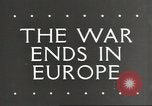
At the end of World War II in Europe, President Truman speaks and crowd celebrates in New York Times Square.
A film titled 'The war ends in Europe' shows American people celebrating the end of World War II in Europe following surrender by Germany. A crowd in New York Times Square celebrates Victory in Europe Day (V-E Day). People pray in a church. U.S. President Harry S Truman announces the German surrender.
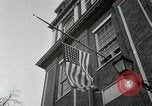
People casting their votes in an automatic voting machine and booths during the 1960 Presidential Election in the U.S.
The 1960 Presidential Election in the United States. The U.S. flag displayed on a building on the election day. Cars moving down a road. Boards displayed in front of banks and other business places declaring the day to be a legal holiday. People gathered outside schools and community halls. People voting through paper ballots. People waiting in a queue to vote using an automatic voting machine. Men and women reading a printed paper to choose the Presidential or the Vice Presidential candidates. A man inside a polling booth enters an area separated by a curtain and casts his vote in a polling machine. Men and women walking past officers seated at a table in the booth. People casting their votes in ballot boxes. A ballot box has 'Town Of Barnstable' written on it. A man turning a lever on the box. A woman placing a ballot paper in the box. 'State Election, Official Ballt, Barnstable' written on the ballot paper. The number on the box changes from 843 to 844. Another man placing a ballot paper in the box.
CRITICALPAST.COM: About Us | Contact Us | FAQs - How to Order | License Agreement | My Account | My Lightboxes | Shopping Cart | Advanced Search | Featured Collections | Website Terms & Conditions | Privacy Policy ©2026 CriticalPast LLC.
License Agreement |
Terms & Conditions |
Privacy Policy
©2026 CriticalPast LLC.