


 Francais
 Deutsch
 Italiano
Refine Your Search
2nd-Rangers-D-Day stock footage and images
- Showing 3469 to 3474 of 13612 results more
more Hide
Hide
President Lyndon B Johnson talks about Vietnam in his address at the John Hopkins University in Baltimore.
President Lyndon B Johnson gives a speech at the John Hopkins University (Baltimore, MD 21218, United States) in Baltimore. He talks about U.S. relations with South Vietnam, peace talks and proposes an aid program. He offers to hold diplomatic discussions to end the war in Vietnam. He states the need for an independent South Vietnam. “Such peace demands an independent South Viet-Nam—securely guaranteed and able to shape its own relationships to all others—free from outside interference—tied to no alliance—a military base for no other country.” President Johnson said. The President calls upon South East Asia nations for a co-operative economic drive, and asks the United Nations and nations like the Soviet Union to join in. “For our part I will ask the Congress to join in a billion-dollar American investment in this effort as soon as it is underway. And I would hope that all other industrialized countries, including the Soviet Union, will join in this effort to replace despair with hope, and terror with progress.” President Johnson said. Men working with heavy machinery in a South East Asian industrial plant. View of working men constructing a modern bridge in Vietnam. Vietnamese farmer threshing harvested rice. A doctor examines a Vietnamese man. The crowd applauds the President's speech. Views of Vietnamese people working on farms, in technical and scientific laboratories, and industrialization in Vietnam. A European or American professor teaches a Vietnamese student inside a laboratory. Vietnamese women working inside a textile factory. Vietnamese farmers carrying produce. President Johnson quotes from the book of Deuteronomy in the Bible. “We may well be living in the time foretold many years ago when it was said: “I call heaven and earth to record this day against you, that I have set before you life and death, blessing and cursing: therefore choose life, that both thou and thy seed may live.” Well, we will choose life. In so doing we will prevail over the enemies within man, and over the natural enemies of all mankind.” President Johnson concludes his speech.

Use of video, and the various Orbiting and Satellite Systems in Space Communications.
Space Communications and the related problems and developments. Animation: Use of video for Space Communications requires highly directive antennas for power economy. Depicts enlargement of capture area of antennas located at terrestrial reception points. Efficiency in signal processing of the receiving equipment increased, to reduce intrinsic noise by reducing temperature of components. A satellite in Earth's orbit for space and terrestrial communications. Explains the Passive Sattelite Relay System using reflecting spheres; Single Orbiting Active Satellite System using line of sight communication, ideal for weather forecasting and mapping; and the sophisticated active Day Period Cry Satellite Orbiting System equipped with transponders.
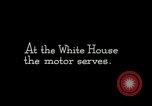
U.S. President Calvin Coolidge, First Lady Grace Coolidge and Senator Charles Curtis in a modern automobile at the White House.
Modern automobile in use by the President at the White House. March 4, 1925: U.S. President Calvin Coolidge, First Lady Grace Goodhue Coolidge and Senator Charles Curtis emerge from inside. Officers around them. The get into a car. The three prepare to leave for the Capitol building on Inauguration day.
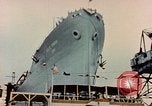
Launching, naming, and outfitting newly built Liberty Ships in Sausalito, California
A new ship, named "Bold Creek" is ready for a launch out of Sausalito California shipyards (or Richmond California). A ceremony takes place. A formation of crew members welcome guests by saluting them. The guests climb a platform and Christen the ship which slides down the ways into the water. Work commences immediately on another ship in the same place. Another ship is launched (number 22 on its bow). The yard launches 5 ships per day for two years. A ship is moved by a boat called a "sea mule." into a line of ships being outfitted. After being outfitted with everything for operation and living, a Liberty ship departs on its maiden voyage.

Movie depicts Idyllic life in American New England village, circa 1800
From movie "La Ciudad" (The City). Credited to Pare Lorentz. Opening credits text in Spanish. A reenactment of 18th Century life in American New England village. Reflections in water. Water gushing over an old water wheel at a mill. A sign over a structure reads 'Sias Farm 1791'. Old covered bridge spans river and waterfalls. Boys skinny dip swim naked in lake. Farmer drives a horse- drawn wagon on a path. Boy lying down in the wagon with head resting on a gunny sack next to a barrel of apples. Boy looks up at clouds overhead, daydreaming. Engraved granite milestone points to "Shirley" 3 miles and to "Shirley Village" 4 miles, the opposite way. Boy jumps off wagon as it enters village. Wagon stops at blacksmith shop, where farmer and blacksmith unload a damaged wheel as two boys and an old man watch.Blacksmith and farmer use hand-operated rollers to true-up broken iron strap from wheel. Old woman doing needle work. Young woman working on a loom. Man weaving a basket. Water wheel turning in water. View, inside mill, shows millstone, turning,as miller grinds corn. Farmers harvesting grain with scythes. White Wooden church with steeple.Graveyard with old gravestones.One reads: "Mary Day,died March 18, 1829,Aged 43." Blacksmith, at forge, repairing broken iron strap for wheel.

Myriad views of New York City. Subway and elevated train commuters. Skyscrapers, street and office scenes
Succession of views of Manhattan New York City skyscrapers on a busy work day. Commuters using subway and elevated trains. Trinity Church at foot of Wall Street, Manhattan, with pedestrians filling the sidewalks. A sea of commuters jamming a subway entrance, People stream through revolving doors. Large numbers of women typists at work in typing pools of offices. Skyscrapers views with pan shots from top to bottom of skyscraper building. Closeup view of lower half of train car or subway car moving by quickly. Children playing in the street near sign reading: "Danger, Congested Area."
CRITICALPAST.COM: About Us | Contact Us | FAQs - How to Order | License Agreement | My Account | My Lightboxes | Shopping Cart | Advanced Search | Featured Collections | Website Terms & Conditions | Privacy Policy ©2026 CriticalPast LLC.
License Agreement |
Terms & Conditions |
Privacy Policy
©2026 CriticalPast LLC.