


 Francais
 Deutsch
 Italiano
Refine Your Search
2nd-Rangers-D-Day stock footage and images
- Showing 3493 to 3498 of 13612 results more
more Hide
Hide
Film reenacts travels of American pioneers moving west by wagon trains and shows life in small town during winter.
Film reenacts events in lives of American pioneers migrating West via wagon trains in the early 19th Century. They are seen traveling in the day, and then resting for the night by a fire, where a family bows their heads as the father speaks a prayer of thanks for their progress. He ends the prayer with an “Amen.” Next, the wagon train sets out again, during the daylight. A series of illustrations shows scenes of a small town in the winter with snow on the ground. People are shown going about their ordinary activities, using horses and sleighs. Some are seen ice skating on a pond. Others are shown visiting relatives.
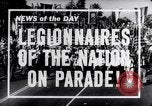
Legionaries on parade in Los Angeles, United States.
Views of night time and day time parade of vehicles and bands of the American Legion down a crowd-lined street. State delegations of Legionaries marching in the Los Angeles coliseum including the Iowa delegation and the New York delegation with former Air Service Captain Fiorello La Guardia leading the New York delegation. Ground and aerial views of large formations of B-17 and B-18 aircrafts in flight.
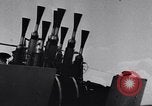
Scenes of routine activities aboard a British Naval warship at sea.
Antiaircraft guns mounted on British Naval ship at sea. Crewman instructing others about fire fighting. Crew members exercising emergency and damage control procedures. Views of interior Damage Control Headquarter, where crewmen refer to chart of the ship. A member of the medical staff lectures crewmen about first aid. Ship's doctor demonstrates precautions crew members can take for self-protection. Officers relaxing, off duty, singing and playing musical instruments. Sailors settling in hammocks for the night. Beginning of new day by swabbing decks.Views of engine room. (World War II period).
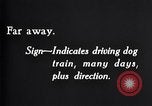
Sign for 'far away' in Indian sign language by General Hugh L. Scott, United States.
General Hugh L. Scott of Smithsonian Institute, seated on a chair demonstrates Indian sign language. General Scott demonstrates sign for 'far away', indicates driving, dog, train, many days and direction.
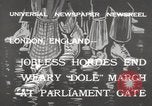
Unemployed people march on the roads to London, England.
Unemployed men and women from Scotland, Wales, Midlands and the South march to London during the Great Depression. Signs seen include, 'Scotland vs. London,' 'National Hunger March,' 'Revolutionary United Mineworkers of Scotland,' and 'We are Against Starvation.' Slate at head of film reads, 'Jobless Hordes End Weary Dole March at Parliament Gate.' Sign in background within village reads, 'The Castle Restaurant.' Research suggests this is the The Castle Restaurant on Norwich Road, Caister-on-Sea, Great Yarmouth Norfolk, NR30 5JN This section of film ends with views of Parliament Building and Clock Tower in London. (Background to the next section of film: In Ireland a so-called Outdoor Relief Strike, supported by the Falls and the Shankhill united, Catholics and Protestants, was launched by the unemployed of Belfast. On Oct 3, 1932, 60 thousand attended a torchlight meeting at the Customs House in Belfast Ireland, to protest relief levels. Sporadic looting and rioting ensued in the following days and more mass demonstrations were planned for Oct 11th.) Film picks up on Wednesday October 5, 1932 as the Royal Ulster Constabulary (RUC) attempt to maintain order. A series of street scenes is shown in which the RUC has begun patrolling. Officers are seen patrolling in Lancia armored car No. 105, with a machine gunner on top. Another Lancia armored car (No. 33) patrols near a park at the corner of Stage Street, Belfast. Boys are seen running across cobblestone streets where they have piled up stones for use in rioting. An RUC Crossly tender truck, carrying several police officers, drives along a Belfast street. View of an empty street where piles of stones and slates obstruct the roadway. Pedestrians appear to be going about their daily affairs as usual. (The primary mischief makers seem to be youths.) Final scene is that of a funeral. (In the course of the week's troubles, two of the rioters were shot dead by the RUC.) A horse-drawn hearse carries at least one. But behind it is a group of pallbearers also carrying a coffin. The street behind is filled with masses of mourners.
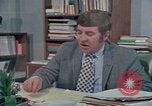
Paraprofessionals and volunteer instructors work with mentally disabled children and document results in Kansas, United States.
Research programs for mentally disabled in the United States. James E McLean, Director of Speech and Hearing Department, Parsons Research Center talks about more efficient research programs for the mentally disabled. Mentally disabled children at a table. Paraprofessionals stand nearby. The children play with games. A volunteer instructor refers to master scheduling board to see Debra's records. She takes out a file from a drawer. She works with Debra and documents the results. Cards with printed dots and tokens on the table. A boy prepares master scheduling board for the next day's work. Scores marked on Debra's chart.
CRITICALPAST.COM: About Us | Contact Us | FAQs - How to Order | License Agreement | My Account | My Lightboxes | Shopping Cart | Advanced Search | Featured Collections | Website Terms & Conditions | Privacy Policy ©2026 CriticalPast LLC.
License Agreement |
Terms & Conditions |
Privacy Policy
©2026 CriticalPast LLC.