


 Francais
 Deutsch
 Italiano
Refine Your Search
2nd-Rangers-D-Day stock footage and images
- Showing 3715 to 3720 of 13612 results more
more Hide
Hide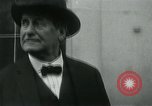
Montage of scenes with William Jennings Bryan
Some restrospective scenes with William Jennings Bryan, assembled after his sudden death in Dayton, Ohio, shortly after the celebtrated "Scopes" trial in 1925. Bryan speaking in front of a residence. (Slate notes he ran for Presidency three times, and was Secretary of State in cabinet of President Woodrow Wilson.) Bryan wearing a cloak and hat, walking on a rainy day, in a city. Automobiles parked at the curb in the background. He smiles, stops and removes his hat to pose for the camera. Next, a closeup of Bryan, bareheaded. Scene shifts to New York City, in 1924, where Bryan stands with his brother, Charles W. Bryan, former Governor of Nebraska, who was nominated as Vice-Presidential candidate during the Democratic Party Convention. William Jennings Bryan conducting one of his weekly Bible classes and Sunday Sermon, to a large outdoor audience, from a stage, in Royal Palm Park, Miami, Florida. Closeup of him gesticulating as he speaks. Bryan and members of his family standing on the bayfront balcony of his residence,“Villa Serena," on the occasion of a visit by former U.S. President Warren G. Harding, who stands behind several Bryan grandchildren
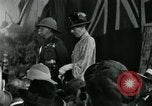
Herbert Plumer, British High Commissioner for Palestine, and his wife, Annie during ceremonies.
Field Marshal Herbert Charles Onslow Plumer, High Commissioner of the British Mandate for Palestine, and his wife, Annie Constance Goss Plumer, appear on a dais. High Commissioner Plumer inspects troops lined up in a Guard of Honor

A radio show called "Jubilee" featuring Rochester, Timmie Rogers, and Lena Horne
A U.S. soldier radio announcer introduces the radio program "Jubilee" as a band of Army musicians, in uniform, plays a fanfare. Opening montage features a man writing a V-mail fan letter to "Jubilee" to the Armed Forces Radio Service. Montage also shows V-mail staff women processing mail. Announcer Ernie 'Bubbles' Whitman then introduces 'Rochester' from the Jack Benny program. Lena Horne comes to mic and crowd applauds. Rochester and Lena Horne sing "Consequences." Timmie Rogers and Private Bate Wallace then perform, with Timmy Rogers singing, "Bring Enough Clothes for Three Days." Lena Horne is introduced again, finishing the program with the song, "That Man I Love." (World War II period).

U.S. Captain Carl Zimmerman speaks about U.S. Forces consolidating below 38th Parallel during Korean War.
Focuses on Korean War. Antiaircraft guns fire in combat with enemy. Refugees walk up on hill. Troops march on field. Tanks advance on battlefield. Captain Carl Zimmerman speaks at desk about the causes of events which took place during Korean campaign, picture of refugees walking up hill in the background. Captain recalls day 10th August in 1950 and summarizes the United Nations consolidation below the 38th Parallel. Map shows Pusan, Masan, Changnyong, Pohang and other places. Close view of map highlighting Chinju, Masan, South West region of Taegu, Uisong, Pohang, and Yongdok. Map of Korea depicts the ground support given by marines, navy and air force planes. U.S. forces counterattack. U.S. troops march on road near Pohang 30 August 1950. Tanks advance on street. Soldiers on tanks. Troops in combat with enemy. Troops fire guns. Troops take cover behind woods. Captain Carl speaks with Lieutenant Tom, Platoon Leader of 24th Division. He shares experience of his platoon moving North of Korea during war. He further speaks about air support and artillery used in war. He talks about captured communists and weaponry used by North Koreans and his platoon. Marines march across field. Marines climb up mountain. Enemy opens fire. Wounded marine runs back for aid. Marines rush to attack. Marines fire machine guns and rifles. American aircraft overhead drop bombs. Explosions on ground. Map of Korea marks date 10/8/1950 and depicts areas captured by U.S. forces below 38th parallel. Captain Carl speaks at desk.
Marines and U.S. seventh division recapture Seoul during Korean War, Seoul in Korea.
Focuses on Korean War (1950-1953). Marines and U.S. seventh division advance in Seoul under enemy fire. U.S. troops combat enemy in streets of Seoul. Troops take cover behind sand sacks. Troops fire rifles. Tanks advance through heavy smoke in streets. Smoke arises from explosions. Soldiers relax after five days battle with enemy. Soldier talks into radio. Soldier holds a paper cutting. Headlines read 'Marines enter Seoul, Fight Reds In Streets'.
Singer and actor, Al Jolson arrives at Pusan Air Base to entertain United States troops during the Korean War.
A U.S. Air Force VC-47B (VIP transport plane, tail # 43-49212) arrives at Pusan Air Base in Korea on 17 October, 1950. Singer and actor, Al Jolson steps from the plane and is greeted by American officers. Al Jolson gets into a jeep. .Next he is seen with officers on a sidewalk. Scene shifts to Jolson seated at a piano on and outdoor stage, where he just finishes performing and turns to speak to the large audience of soldiers present. The audience is seen applauding. Jolson is seen from behind, and then from various angles, as he sings a song. Some soldiers respond to the tempo of Jolson's music. (Narrator comments that 6 days after this performance, Al Jolson died from a heart attack, on 23 October, 1950 in San Francisco.) In final scene, he is seen raising the United Nations flag. (Note: this film is silent except for narration.)
CRITICALPAST.COM: About Us | Contact Us | FAQs - How to Order | License Agreement | My Account | My Lightboxes | Shopping Cart | Advanced Search | Featured Collections | Website Terms & Conditions | Privacy Policy ©2026 CriticalPast LLC.
License Agreement |
Terms & Conditions |
Privacy Policy
©2026 CriticalPast LLC.