


 Francais
 Deutsch
 Italiano
Refine Your Search
2nd-Rangers-D-Day stock footage and images
- Showing 3733 to 3738 of 13612 results more
more Hide
Hide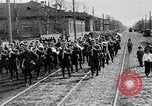
339th Infantry troops parade in Archangel, Russia during Allied North Russia Intervention of World War I.
U.S. 339th Infantry soldiers are led by their brass band playing a mournful dirge as they march slowly during a funeral procession in Archangel, Russia, during the Allied North Russia Intervention of World War 1. In a separate sequence, they are seen parading along with U.S. sailors, in Memorial Day, celebrations, 1919. A streetcar approaches in the background. (World War I; World War 1; WWI; WW1)
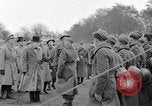
Winston Churchill seeing troops off to war and reviewing troops and sailors.
Winston Churchill seeing British troops off to war during a cold rainy day during World War II. Churchill walks with army officials. Troops lined up. Convoy of military vehicles moving along the road as Churchill waves his hat at them. He watches marching infantry depart along the rainy roadway. Mrs. Clementine Churchill is seen briefly on hill with Winston Churchill and military leaders, as they see the troops off to war. View from inside railroad train as it pulls into station where British troops wait to board. Winston Churchill on board a ship, inspects crew as he walks along a covered deck. He stops to converse briefly with one of the sailors. Churchill reviews a line of sailors on shore. He receives a cheer from a number of citizens lining a roadway
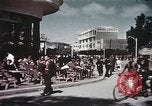
Moroccan city. No cars are seen, but some buses. People travel by burro, camel, bicycle, horse, carriage, and on foot.
Every day street scenes in a Moroccan city in North Africa. The street is very wide. Local residents walking; waiting for public transport. and siting in outdoor sidewalk cafe. Two American soldiers riding in a pedicab pulled by two bicycle riders. Many bicycle riders. Two Western women riding in an open carriage pulled by team of two horses. Moroccan man walking behind burro laden with sacks. Two Moroccan soldiers, or policemen, wearing uniforms with Fezes, walk past and give friendly salute to cameraman. Moroccan man on bicycle, stops to converse with Moroccan woman who is completely robed, to expose only part of her face. A Moroccan man rides a horse in the street, and another rides a burro. Nomads with camels and livestock rest at side of road. As two women sit, looking on, a man stomps some kind bread dough with his feet with dance-like movement. One of the women rises and does the same. (World War II period).
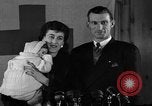
English war bride is interviewed on arrival in New York, where she and her child are reunited with husband
Upon arrival in New York City, by steamer from England, a British war bride Ethel (Barcham) Johnson with her child Carol Ann Johnson, is interviewed with her former American serviceman husband Herbert W. Johnson. She says she is on her way to Kansas City and feels nervous. Her husband says they are going to spend a few days in New York. The wife says she is looking forward to meeting her mother-in-law, whom she hopes will like her.
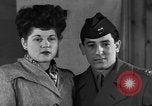
Several British war brides are interviewed with their American husbands, upon arrival in New York City by ship from England
An English war bride is interviewed with her husband, a United States Army Captain, in uniform, upon her arrival in America after World War II. She says she doesn't know what to say, they have waited so long for this day. Another couple is interviewed with their baby. The British woman says it had been weeks and weeks since she had seen her husband. A third English war bride and her baby, reunited with her American husband, said she read, in American newspapers, that American girls are not too pleased about soldiers marrying English girls. She says further, that she hopes they won't feel too badly about it, because love is love, all over the world.
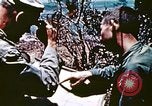
Artillery and dive bombers bombard Naha in Okinawa, Pacific Theater.
Okinawa Operations in Pacific Theater. United States Marine units and 24th Army Corps advance on Naha. Two Marines look at a map and confer. Artillery and dive bombers bombard Naha. U.S. Marines occupy the outskirts. Fire and explosions. Heavy black smoke rises up. Bombing at day and night. Tank guns fired. Firing in streets of Naha. (World War II period).
CRITICALPAST.COM: About Us | Contact Us | FAQs - How to Order | License Agreement | My Account | My Lightboxes | Shopping Cart | Advanced Search | Featured Collections | Website Terms & Conditions | Privacy Policy ©2026 CriticalPast LLC.
License Agreement |
Terms & Conditions |
Privacy Policy
©2026 CriticalPast LLC.