


 Francais
 Deutsch
 Italiano
Refine Your Search
2nd-Rangers-D-Day stock footage and images
- Showing 4045 to 4050 of 13612 results more
more Hide
Hide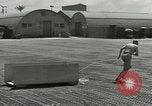
Men work and unload camera equipment and air sampling devices from DB-17P aircraft at Enewetak atoll in the Pacific Ocean.
Removal of air sampling equipment from an aircraft at Enewetak atoll (sometimes spelled Eniwetok or Eniewetok) in the Pacific Ocean on day of Able shot atomic test on Bikini Islands during Operation Crossroads. A man standing near a trailer. United States Army Air Force DB-17P Flying Fortress drone controllers aircraft parked at an air base. The trailer under the aircraft. Air sampling devices and camera equipment are unloaded from the aircraft. Jeeps parked at the air base. Men working. Other airplanes parked at the air base. Men carrying a crate.
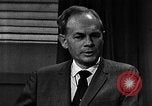
During an interview in the US, Lieutenant General Ira Eaker talks about the court martial of General William Mitchell.
An interview of United States Air Force Lieutenant General Ira Eaker conducted by Dr. Maurer in the United States. General Eaker talks about the court-martial of United States Army General William Lendrum Mitchell. He says that the President announced that General Mitchell would be courtmartialed. He says that all young officers including him had a tough decision to take. He says that they realized that from the standpoint of military discipline and morale the war department can take an action against him. They spent the whole evening preparing a presentation for the next day before the court martial. He says that they consider Mitchell as a great hero and a gallant citizen. Mitchell died of influenza in the early periods of World War II.
Private Wilmer being treated in Italy and in United States after receiving a head injury during World War II.
A U.S. Navy training film titled 'Medicine in action: Head injury of a battle casualty' about the treatment and recovery of a soldier wounded during World War II. Private Wilmer of the U.S. 6th Army. A map of Casino Italy where Wilmer was injured during the battle of World War II. Aerial views of an evacuation hospital where Wilmer was given initial medical assistance after being injured. Wilmer with bandage on his scalp at a general hospital in Italy. Doctors clean the wound on the scalp. They try to control the bleeding. Blood clot being removed and wound being checked for infection. Bone fragments being removed from the wound. Wound being stitched. After six days wound being examined. Private Wilmer arrives in Naples in an ambulance. He boards a hospital ship in England and leaves for North Africa. At a camp he talks to other injured patients. Private Wilmer gets off a jeep and boards U.S. Army hospital ship Acadia to leave for United States. At Walter Ridge hospital he moves his hands and legs to demonstrate physical normality after being injured. Doctors administer anesthesia on his scalp and work on the wound. After treating the wound the scalp being closed and bandaged. Private Wilmer after recovering from the injury. He walks out of the hospital after being discharged.

Plague causing bacteria being examined by U.S. Navy in a laboratory in North Africa.
A U.S. Navy training film about the prevention and cure of plague in North Africa. Animation shows the nature of rat population that leads to spread of plague. It depicts the tactics to be adopted by the plague control team. A man uses kerosene to kill fleas and catches a rat. Rats caught, are brought to plague control laboratory. Captured rats are chloroformed. Fleas being removed from rats. Fleas being counted and identified. They are placed on slides and a technician looks at the fleas through microscope. Rats being mounted on a table and dissected and being searched for pasteurella pestis. Man looks into a microscope at pasteurella pestis. A guinea pig being inoculated with it and observed for next few days for symptoms of plague. A dead pig being dissected and it shows signs of plague.

Wilhelm Bruckner and Walther Hewel on the terrace of Berghof in Berchtesgaden, Germany.
German Chancellor Adolf Hitler's residence at Berghof in Berchtesgaden, Germany during World War II. Adolf Hitler's companion Eva Braun tries to hold onto her hat on a windy day. Guests at Berghof terrace. Hitler's Chief Adjuntant Wilhelm Bruckner talks to an official. Two young boys get into a wash tub and play. Hanni Morell seated with two officials on the edge of the terrace. Nazi diplomat Walther Hewel talks to a man and reads a newspaper. Aerial view of ice in a fjord.
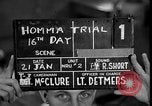
Major Tisdell recalls events of April 8, 1942 in Bataan, Philippines during the Homma trial in Manila, Philippines.
U.S. Army Major Achille C. Tisdell testifies before a military tribunal in Manila, Philippines during the trail of Japanese Army General Masaharu Homma for World War II crimes. Major Tisdell takes an oath on the 16th day of the Homma trial. He says that he was aide-de-camp to Major General E.P. King, Commanding General of the American forces in Luzon in April, 1942. Major Tisdell recalls that Japanese forces had pushed back the American forces in Bataan to a point that it was difficult for the Americans to reorganize. He also talks about the lack of ration for the American forces. Major Tisdell says that U.S. reserves were released for the forces. He says that on 9th April, 1942 General King was unable to make contact with Japanese commander and Colonel Edward C. Williams volunteered to make contact with the Japanese.
CRITICALPAST.COM: About Us | Contact Us | FAQs - How to Order | License Agreement | My Account | My Lightboxes | Shopping Cart | Advanced Search | Featured Collections | Website Terms & Conditions | Privacy Policy ©2026 CriticalPast LLC.
License Agreement |
Terms & Conditions |
Privacy Policy
©2026 CriticalPast LLC.