


 Francais
 Deutsch
 Italiano
Refine Your Search
2nd-Rangers-D-Day stock footage and images
- Showing 4399 to 4404 of 13612 results more
more Hide
Hide
Emergency operating procedures including ejection and landing of the U.S. Navy T2V-1 SeaStar.
Emergency operating procedures of the U.S. Navy T2V-1 SeaStar. The aircraft in flight. Simulation of ejection procedure. Pilot in the cockpit and view of gauges and flight controls. Pilot places his feet in the stirrups, sits erect in the seat with head braced against head rest. He pulls the emergency bail out cord, disconnects oxygen hose at the mask connection, and pulls down face curtain handle firing the canopy and ejecting the seat. He pulls the auxiliary canopy jettison handle and turns on the canopy open switch. In case this procedure fails, the pilot demonstrates a back up including adjustment of canopy interlock release handle, pulling of the face curtain to eject the seat through the canopy. Air start: The pilot moves the throttle to off position. View of altimeter as pilot lowers the plane to maximum altitude for an aircraft and assumes a glide. He drains the tail pipe of residual fuel and places the plane in a shallow dive. He adjusts the battery generator switch and holds position. Landing: A stylized illustration of the landing pattern depicts adjustment of glide path and approach. The plane approaches the runway, maintains speed, decreases altitude, retracts landing gear and flaps, and touches down.
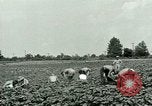
The Prisoner of War Camp prisoners work on a farm in Southern United States during World War 2.
A German prisoner of war camp in the United States during World War 2. Prisoners work in Southern United States. The prisoners work on a farm. A guard with a gun keeps a check on them. Prisoners pick beans and put them into the basket.
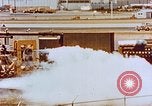
Static test of XLR-11 engine for X-15. Test number 1051, February 2, 1959, at Edwards Air Force Base in California.
Static test number 1051 of XLR-11 engine for X-15, on February 2, 1959 at Edwards Air Force Base in California. Engine is in test stand.
Technicians work on NASA Redstone Mercury Rocket (MR) 2 and Mercury Spacecraft 5 in United States.
Project Mercury, the first human spaceflight program, in United States. A rocket on a gantry. A sign reads 'United'. Technicians work on a spacecraft. They work on the Redstone MR-2. A ladder in the background. A technician works on a part of the rocket. Different control systems in the spacecraft. Technicians work on different parts of it. A man tests a part of the spacecraft.
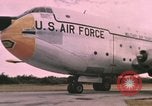
The Redstone MR-2 rocket is taken to a hangar for service and a spacecraft is hooked and pulled up in United States.
Project Mercury program in United States. A Redstone MR-2 rocket is unloaded from the military air transport. It is towed with a tug and is taken to a hangar for service where technicians work on it. It is taken out of the hangar and is raised up to the level of a gantry. The rocket is tied to a rope and men pull the rope to raise the rocket. The rocket at the gantry. Men stand around it. Technician work on a spacecraft. A sign reads 'United States'. The technicians take pictures of the spacecraft. It is brought near the rocket. The spacecraft is hooked and pulled up. A sign reads 'Danger Explosive Installed'. Technicians talk and look up. Men on the gantry. A technicians looks into a book . The spacecraft is attached to a rocket by the technicians.
TBF Avengers, F6F Hellcats, A-25, SB2C and SBF Helldivers land on the deck of 'The Fighting Lady' in the Pacific Ocean.
U.S. Navy Documentary highlights functions, duties and crew activities aboard 'The Fighting Lady', pseudonym for the USS Yorktown CV-10 in the Pacific Theater during World War II. A sign reads 'US Naval Communications'. Women work in a room on typewriters. TBF Avengers, F6F Hellcats, A-25, SB2C and SBF Helldivers fly out towards the carrier. Aircraft in flight with insignia of the United States. A ship 'The Fighting Lady' underway. Crewmen stand on the deck. A plane lands on the deck. Planes in flight in background. Wire barriers on the deck in case the plane fails to land on the resting gear. A landing signal officer on the deck. The plane lands on the ship's deck. People stand on the deck. The planes are to be rearranged for a take off. The skipper of the ship stands on the deck. The crew stand on the deck. The skipper reproofs the flight deck. He asks the deck crew to arrange the planes properly. A diagram of the carrier and an account of the hangar deck. A structure on the mid ship.
CRITICALPAST.COM: About Us | Contact Us | FAQs - How to Order | License Agreement | My Account | My Lightboxes | Shopping Cart | Advanced Search | Featured Collections | Website Terms & Conditions | Privacy Policy ©2026 CriticalPast LLC.
License Agreement |
Terms & Conditions |
Privacy Policy
©2026 CriticalPast LLC.