


 Francais
 Deutsch
 Italiano
Refine Your Search
2nd-Rangers-D-Day stock footage and images
- Showing 4447 to 4452 of 13612 results more
more Hide
Hide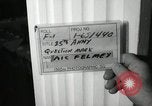
Retired Officers' Luncheon at Bolling AFB celebrating the 35th Anniversary of the 1929 record endurance flight of the Fokker C-2 Question Mark.
Film opens showing a display case in the Bolling Air Force Base Officer's Club, containing a model of the Atlantic-Fokker C-2A aircraft flown by pilots of the U.S. Army Air Corps, in January, 1929 when they set an endurance record of more than 150 hours sustained flight. Below it is a Wright J-5 Whirlwind R-790 engine that powered the flight. Next a large poster is shown commemorating the 35th anniversary of the feat (1929 to 1964). It contains photos of highlights from that event. Next, the retired officers pass the display of model and engine as they descend stairs and enter dining room. Most are in civilian clothes. But several attendees are active duty officers in uniform. Major Sidney Kubesch, pilot on record-breaking B-58 flight from Tokyo-to-London, pauses to stand and look at the display case. General Nathan Twining; General Ira Eaker seen briefly at the display case. At end of clip, General Carl Spaatz stands alone, looking at the display.
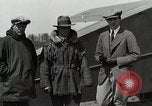
Pilots Bernt Balchen and Floyd Bennett stand in front of a Fairchild FC-2W aircraft
Pilots Bernt Balchen, in a cap, and Floyd Bennett, in a fedora hat, stand in front of a Fairchild FC-2W airplane, at Lac Ste. Agnes (Lake St. Agnes) in Quebec, Canada. In another scene, Dr. Louis Cuisinier, technical director of Trans Continental Airways Limited,stands with them. He points to a page in a book and gives Floyd Bennett a box of cigars to be taken to the Junkers aircraft "Bremen" that had force-landed on Greenly Island, Quebec, after a transatlantic flight. (Note: Floyd Bennett was suffering with pneumonia, and became gravely ill soon after these shots were made. He did not pilot a plane to Greenly Island. Instead, he was rushed to Jeffrey Hale Hospital in Quebec City , where he died on April 25, 1928.)
Aeronca "C-2" airplane on a field in United States.
Aeronca "C-2" airplane on a field in United States. Men gather in the field. They discuss amongst themselves about the plane. Plane takes off. It flies in the sky. The plane lands. Another plane flies. Vehicles on the field. Houses in the background. Other airplanes stand on the field.
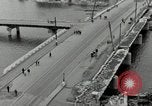
Views of damage in Hiroshima, Japan caused by Atomic Bomb explosion in World War 2
Elevated view of people walking on the damaged Ai-Oi Bridge over a river in Hiroshima, Japan. Bridge shows damage from the atomic bomb explosion in World War 2. A U.S. soldier examines a steel bridge post etched from flying debris during the blast. Views of various wrecked buildings in the city. Exterior and interior views of a destroyed school building. A building knocked partially off its foundation and leaning sideways. Ruins of destroyed Japanese military headquarters. View of he Chugoku Electric Company building made of reinforced concrete that withstood the blast better than many buildings.
U.S. Aircraft carriers carry air war to Japan. Gun camera footage of bombing and strafing of Japanese shipping and airfields (WW2)
U.S. aircraft carriers in the Sea of Japan. Launch of carrier-based missions to attack Japanese shipping and airfields in World War II. Aircraft readying on carrier deck including F6F Hellcats, TBF Avenger, and SB2C Helldivers. Scenes of attacks by U.S. aircraft on Japanese targets in Tokyo Bay, seen via gun camera footage. U.S. Navy fighter aircraft returning to land on carrier have accidents. One lands but overshoots and runs off the end of the deck and into the ocean, striking another aircraft on the way. Another fighter aircraft is seen landing on a carrier deck but the supplemental fuel tank beneath it detaches and explodes and the plane erupts into flames. The burned pilot is rushed to safety by crews and firefighting crews battle the blaze. Scenes of dead American sailors and airmen being buried at sea.
Four Kamikaze pilots walk in a Shinto shrine in Chofu, Japan (WW2)
Reenactment depicts four Kamikaze pilots visiting a Shinto shrine in Chofu, Japan during World War II. The four Kamikaze pilots come toward the camera and bow., and then do an about face and walk away. Three are dressed in flying gear. The 4th pilot wears a Class A uniform and carries a sword. (World War II; WW II; World War 2; World War Two)
CRITICALPAST.COM: About Us | Contact Us | FAQs - How to Order | License Agreement | My Account | My Lightboxes | Shopping Cart | Advanced Search | Featured Collections | Website Terms & Conditions | Privacy Policy ©2026 CriticalPast LLC.
License Agreement |
Terms & Conditions |
Privacy Policy
©2026 CriticalPast LLC.