


 Francais
 Deutsch
 Italiano
Refine Your Search
2nd-Rangers-D-Day stock footage and images
- Showing 4597 to 4602 of 13612 results more
more Hide
Hide
Aerial view of the countryside in German-occupied Ukraine during World War 2.
From a German travelogue filmed during World War 2. An aerial view of Ukraine. View of the countryside. Houses, buildings, factories, roads, trees and mountains visible. View of the sea.

Dutch Princess Juliana with her children at their Canadian refuge (WW2)
The Dutch royal family in Montebello during their exile in Canada (World War 2). Dutch Princess Juliana with her children in Château Montebello (392 Rue Notre Dame, Montebello, QC J0V 1L0, Canada). The Dutch royal family fled the Netherlands after Nazi German invasion. Princess Juliana and her children later left England for Ottawa, Canada. Children, Princess Beatrix and an unidentified girl playing near a waterway. Princess Irene inside a playpen. Princess Juliana pushes her two children sitting together on a swing. Princess Beatrix falls off-balance from the swing while Juliana is holding the infant Princess Irene.
Allied air attack and German defense in the city of Caen during the Invasion of Normandy, France in World War 2.
German newsreel about the Invasion of Normandy region of France in World War 2. English narration overlaid on the newsreel by the U.S. Office of Strategic Services. A German soldier looks through binoculars. Artillery units move forward. North American bomber flies over. German Anti Aircraft batteries in action. Bombers drop bombs. Wreckage in the city of Caen. German pursuit planes fly to break U.S. plane formation. Ruins in the city following bombing by Allied air forces. French refugee civilians leaving the bombed city. German divisions of tanks and mobile artillery underway. Allied armed divisions air troopers and paratroopers captured. U.S. Sherman tanks knocked out. Bullet holes in the tanks. German troops advance. Germans soldiers fire rifles, machine guns and rockets.
Workers and employees of the U.S. Army Signal Corps work with great care in the United States (WW2)
Film highlights many different ways that American soldiers and civilians contribute to the war effort in World War 2, including on the home front in America. A woman works at the United States Army Signal Corps office during World War II. She answers the phone. A paper containing sensitive information drops from her desk. Soldiers fighting in the Pacific Theater. A Mickey Mouse watch on the wrist of a dead soldier. A woman clerical worker puts a file in a drawer. A soldier runs and throws a grenade at Japanese positions. A screw is tightened on an equipment. A man works on a blueprint. Closeup of hands of a woman typing on a typewriter. Women writing number codes in columns on paper, and stamping documents. A man welds some equipment. A forklift lifts packets and stores. Carts with cables and machines. Cargo trucks in front of a warehouse depot. Logistics loaded on a ship. Smokestacks of a factory. Spools of cable and crates on deck of cargo ship. Cargo ship supplies logistics to different units. Soldiers board a troop transport ship on the way to the war front and they wave from the deck. A landing craft on a beach. Soldiers run on the beach. A closeup view of a German wrist watch with a Nazi swastika symbol on it. Various scenes of United States soldiers firing artillery. Signal Corps women typing, working in factories, signing documents, operates switchboards, and pulls out a file from a drawer.
Damaged buildings and casualties after atomic bomb raid over Hiroshima in Japan during World War 2.
U.S. Strategic bombing survey film about the situation in Japan after atomic bombing in World War 2. Film titled 'Effects of Atomic Bomb on Hiroshima and Nagasaki'. Map of Japan. Location of Hiroshima. City of Hiroshima. Camera pans over view of the city of Hiroshima before the atomic bomb destroyed the city. Buildings and huts in city of Hiroshima pre-destruction. Portrayal of events on August 6, 1945: Sentry standing on a platform. Sentry stands near 'bell' air raid alarm. Sentry in dugout cave. Narrator relates that bomb was dropped. Still image of Hiroshima mushroom cloud explosion seen. Views of destroyed Hiroshima (from September 1945). Bomb damage to large concrete building. Ruins of the city. Damaged street cars in street. Hiroshima station. Hiroshima Prefecture office building damaged by blast. Damaged buildings. Statistics of casualty and damage.
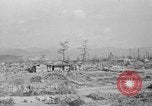
Devastation in Hiroshima and Nagasaki following atomic bomb attacks in World War 2, and view of atomic bomb blast over Nagasaki
Devastated area in north eastern Hiroshima following August 6, 1945 atomic bomb attack in World War 2. Simple shacks and buildings are being built using rubble material after the devastation of Hiroshima. Damage at Higashi station. Newspaper headlines about the atomic bomb attack on Hiroshima, and the warning to Japan by the President of the United States. A map of Japan shows the location of Nagasaki. Scenes of Japanese workers in arms factories building torpedoes and munitions, some wearing kokumin-fuku worker uniform. Workers in an assembly line munitions factory of Mitsubishi. A map shows a torpedo plant in the north and a steel and an arms plant in the south, then plots the center point between them as the U.S. target for the "Fat Man" atomic bomb attack. View of the atomic bomb explosion over Nagasaki on August 9, 1945, as seen from the B-29 bomber "Bockscar" (sometime called Bock's Car or Bocks Car). Mushroom cloud rises up to the sky. Wing of the B-29 bomber in the foreground. An aerial view of rubble and destroyed buildings in Nagasaki following the atomic bomb attack. Destroyed Mitsubishi steel plants beside the sea.
CRITICALPAST.COM: About Us | Contact Us | FAQs - How to Order | License Agreement | My Account | My Lightboxes | Shopping Cart | Advanced Search | Featured Collections | Website Terms & Conditions | Privacy Policy ©2026 CriticalPast LLC.
License Agreement |
Terms & Conditions |
Privacy Policy
©2026 CriticalPast LLC.