


 Francais
 Deutsch
 Italiano
Refine Your Search
2nd-Rangers-D-Day stock footage and images
- Showing 4747 to 4752 of 13612 results more
more Hide
Hide
U.S. Women Army Corps march, and woman work in war production factories in World War 2 in the United States.
Contribution of U.S. women in the war effort in the United States during World War 2. U.S. troops fire a camouflaged artillery. Aircraft parked in a line. The aircraft take off one after the other. The aircraft in flight. A woman Marine looks through binoculars. Another Marine stands beside her. A ship underway in the background. The women Marine looks into documents. The members of the U.S. Women Army Corps (WAC) at work. Women war production workers in war production factories and machining factories make tools to help with the war effort. A woman worker operates industrial equipment. American soldiers carrying supplies embark a ship. Animated map shows the location of Berlin and Tokyo. The women walk in a group. A woman speaks to a man at an office. The Women Army Corps (WAC or WACC) march on a street. Buildings in the background. Narrator asks women to join the war effort as war workers or by joining the armed forces. The women march. The troops fire guns. Smoke rises due to explosion. The areas where women are needed.
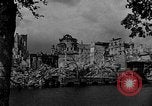
People in the U.S. listen as President Truman speaks during the United States flag raising ceremony in Berlin at end of World War 2
Filmed shortly before the Potsdam Conference in Berlin, Germany. A view of the devastated city of Berlin shortly after the end of World War 2 in Europe. Aerial views of bomb damaged Berlin and point of view shots from a moving car passing destruction, rubble, and skeletons of buildings from bomb damage. U.S. President Harry Truman surveying the damage from an open car, and view of his car approaching the Brandenburg Gate and driving on the Unter den Linden. Three flag towers each decorated at the base with an image of Truman, Stalin, and Churchill. U.S. President Harry S. Truman is riding through Berlin with General Secretary of the Communist Party of the Soviet Union Joseph Stalin and Soviet Foreign Minister Vyacheslav Mikhailovich Molotov. Flashback shows German Fuhrer Adolf Hitler parading in Berlin. People crowd on either side of a street to cheer. Close up back and side profile view of Hitler as he stands in a moving car waving to the crowd. Hitler speaking at a Nazi Rally, forcefully and animated, about Germany wiping out inferior races, and decrying America's society of mixed people, saying that it has a ridiculous notion of equality and freedom that cannot stand up against Germany. The German people in the hall applaud. Truman speaks into a microphone in Germany after the war. U.S. delegates stand in the background. A radio tower. A U.S. military serviceman operating controls for the radio broadcast. People in the U.S. listen to President Truman speaking from a Berlin Radio Station. A hand on a typewriter. People of the United States in groups listening to radio: Men gathered at a city store listening to the radio speech; a woman typist listening to the radio beside her typewriter; men in a rural general store gathered around a radio near a wood stove; farmers listening to a radio; office workers gathered around a radio; a family in a living room listens to the radio; group of U.S. Army soldiers gathered to listen to the radio . Truman speaking on the grounds of the United States Group Control Council Headquarters in Berlin. He is in a courtyard that had been the home of the German Air Defense for Berlin. An honor guard from Company 'E' of the 41st Infantry is present, along with Secretary Stimpson, Assistant Secretary McCloy, and Generals Eisenhower, Patton, Clay, and Bradley. Soldiers stand in formation in the background. He speaks about peace in the world during the ceremony raising the United States flag over the U.S. controlled area of Berlin. His words included the statement, "Let's not forget that we are fighting for peace and for the welfare of mankind. We're not fighting for conquest."

Test drive of a SRN2 hovercraft in Saint Lawrence River in Canada.
Test drive of a Saunders Roe SRN2 (Saunders Roe Nautical Two) hovercraft in Canada. The hovercraft with lettering "Westland" (for Westland Aircraft Ltd.) moves over a marshy area. Men operate the controls of the hovercraft. The hovercraft underway in Saint Lawrence River. The passengers seated inside the hovercraft which can accommodate 70 persons. The hovercraft underway in the river. A head of a passenger inside the hovercraft. The hovercraft moving across the water
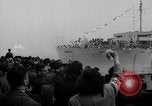
Arrival of SS Marine Flasher in New York, carrying displaced persons and refugees from Europe to the U.S. after World War 2
Views from dock in New York and from aboard ship as the SS Marine Flasher arrives in New York on May 20, 1946, after departing Bremerhaven Germany on May 11, 1946. Crowd of people gathered to greet passengers getting off the ship. Scenes show jubilant people and some reunions of family members or relatives. The passengers are largely displaced persons and refugees from World War 2. People disembark the ship. A woman with her child stands in front of a hatch. Three women aboard the ship pose. A woman kisses a man. People meet their relatives. People leave with their luggage. The luggage of the people with tags. Luggage tags with name (Ingeborg) Inge Rummeni of 824 North 38th St. Milwaukee Wisconsin on them. A woman and a child show concentration camp number tattoos on their arms from a Nazi German prison camp.

The U.S. Army Quartermaster Corps with their loads of supplies at times of war overseas (during World War 2).
The United States Army Quartermaster Corps in the United States during World War 2. Supplies for the Quartermaster Corps like boots, dresses, cigarettes and hardware. A tent encampment. A soldier standing in a wooded region. An officer seated at a table in an office. The flag with the Quartermaster Corps insignia flutters from a pole. Point of view shot at nearly eye level with large column of U.S. Army soldiers marching toward camera position, holding rifles as they march in formation. The soldiers eat seated at tables in a dining hall or mess area. The Quartermaster Corps unload boxes of supplies during a war overseas. A number of boxes of supplies on a beach. Several Quartermaster Corps unloading boxes from landing crafts on the beach. View of a pair of boots which is part of the necessary uniform equipment. A large number of cabbages in a heap. Pieces of hardware hung on stands on a wall. The boxes of supplies are stacked in a store before distribution. The corps distributed uniforms. United States Army Soldiers on tanks moving on a path. The soldiers arrive at landing crafts on a beach. Large columns of U.S. Army soldiers march in formation. Women's Army Corps (WAC) and nurses move in formation. Women working in textile webbing factory with large spools of webbing or string during manufacture process. The soldiers march. Ships in a harbor. Supplies at a dock for army and navy requirements.
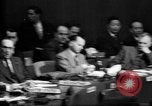
A resolution is adopted by 9 votes in favor with 2 abstentions at a UN Security Council session in Lake Success, New York.
A United Nations Security Council session held in Lake Success, New York during the Cold War. Representatives of different nations are seated. U.S. Ambassador to the United Nations Warren Austin speaks that the pending matter is the draft resolution (document S/704) introduced by the representative of the United States at the 275th meeting of the Security Council calling for a truce in Palestine. He states that the objective of this resolution is to save human life. The resolution is adopted by 9 votes in favor with 2 abstentions.
CRITICALPAST.COM: About Us | Contact Us | FAQs - How to Order | License Agreement | My Account | My Lightboxes | Shopping Cart | Advanced Search | Featured Collections | Website Terms & Conditions | Privacy Policy ©2026 CriticalPast LLC.
License Agreement |
Terms & Conditions |
Privacy Policy
©2026 CriticalPast LLC.