


 Francais
 Deutsch
 Italiano
Refine Your Search
2nd-Rangers-D-Day stock footage and images
- Showing 5659 to 5664 of 13612 results more
more Hide
Hide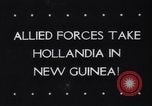
Allied forces capture Hollandia in New Guinea during World War 2
A film titled 'Allied forces take Hollandia in New Guinea!' shows Allied attack at Japanese bases at night to capture Hollandia in New Guinea. A map shows the allied attack on the island. Naval and aerial barrage helps to take control of Hollandia. American bombers drop bombs over the island. Allied soldiers in boats reach Hollandia amidst heavy firing. American tanks and infantry moves into wet, muddy jungles. General MacArthur inspects the area and greets General Walter Krueger.
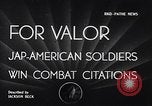
General Mark Clark presents citations to 100th Infantry Battalion in Italy during World War 2
A film titled 'For Valor- American Japanese soldiers win combat citations' shows General Mark Clark presenting citations to United States 100th Infantry Battalion soldiers of Japanese descent also known as Nisei, with citations for their services in Italy during World War II. General Clark attaches citation to battle colors in Italy.
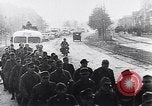
Japanese -American soldiers fire at enemy positions in France during World War 2
Japanese-American soldiers arrive in France during World War II. Soldiers boarded in trucks move towards the battlefront. Japanese-American soldiers fire at enemy positions in the field. Injured soldier being treated by a member of the medical team.

Benito Mussolini declares the entry of Italy into World War 2
Italian Prime Minister and Duce Benito Mussolini declaring Italy's entrance in World War II. Benito Mussolini delivers a speech from a balcony in Palazzo Venezia (Palazzo Venezia Piazza di S. Marco, 49, 00186 Roma RM, Italy). People with Italian flags cheer for Mussolini after the declaration. Huge columns of Italian soldiers marching in streets of Rome, and Italian tanks and military trucks move towards the war front. Italian soldiers marching out of Rome. Italian Navy ships and various vessels are also seen at sea.

Captain John Godfrey and Captain Don Gentile being welcomed by family in Washington DC in United States (WW2)
Newsreel titled 'Capitol hails Yank air aces' shows United States Army Air Force Captain Don Gentile and Captain John Godfrey being welcomed by family members as they return for rest from World War II. The two flying ace destroyers of Nazi German planes are seen on steps of Pentagon with family members.
Japanese attack Hawaii islands in United States during World War 2, and U.S. response to attack.
A film titled 'Jap-US at war' shows Japanese diplomats leave the venue of the diplomatic talks in Washington DC in United States, soon after Japanese attack on Pearl Harbor, Hawaii islands. Secretary of State, Cordell Hull also leaves the building. President Roosevelt is seen. Japanese troops prepare for war. Japanese troops in mainland Japan board trains as crowds of Japanese citizens wave Japanese flags and cheer for their troops leaving for war. Scenes of Diamond Head in Hawaii in peaceful times are shown, including buildings, people on beaches with sunbathers and fast small boats with outriggers in the surf. City streets in Honolulu Hawaii are shown with cars and shops and view of Aloha Tower lighthouse in background. Japanese planes drop bombs over Pearl Harbor in Hawaii. United States Presidential Secretary Stephen Early tells the press of Japanese attack and the damage suffered by America. People in American cities read newspapers and scrolling lit sign (likely Times Square New York) with news about Japanese attack as the lead story. American citizens buying newspapers describing the attack at newsstands. U.S. troops march in front of War Department - Navy munitions building in Washington DC. Night time view of soldiers on guard in Washington DC. Sailors return to battle stations. U.S. Navy sailors boarding ships of U.S. Navy in the U.S. west, bound for battle. Brief scenes from American ports in Guam and Wake Island. U.S. Navy fleet ships underway in Pacific heading west toward battle with Japanese forces. Biplanes launched via catapult from U.S. Navy ships and then seen flying over Navy ships in formation as narrator encourages Americans to work together and put aside differences to win the war. Overhead view of a U.S. Navy ship passing under a bridge with deck busy with sailors and operations.
CRITICALPAST.COM: About Us | Contact Us | FAQs - How to Order | License Agreement | My Account | My Lightboxes | Shopping Cart | Advanced Search | Featured Collections | Website Terms & Conditions | Privacy Policy ©2026 CriticalPast LLC.
License Agreement |
Terms & Conditions |
Privacy Policy
©2026 CriticalPast LLC.