


 Francais
 Deutsch
 Italiano
Refine Your Search
2nd-Rangers-D-Day stock footage and images
- Showing 571 to 576 of 13614 results more
more Hide
Hide
Company D, United States 87th Chemical Mortar Battalion soldiers dig emplacement and assemble a chemical mortar near Carentan, France.
Soldiers of Company D of the United States 87th Chemical Mortar Battalion near Carentan, France during World War II. A soldier, Corporal George Kowach, takes target information from a forward observer team over a field phone at a mortar command post. He relays this information to his platoon leader, First Lieutenant Charles W. Kidd, who plots the target on a map and writes coordinate information into his notebook. The target plot will be passed to the gun positions for firing. Company D soldiers dig an emplacement in a field. Soldiers assemble 4.2 chemical mortar in preparation for the fire mission. (Note: On this day, Company D, operating in support of the 12th Infantry Regiment, 4th Infantry Division, fired 85 rounds on strong points and hedgerow defenses.)
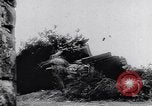
German forces defending against British air attacks during the invasion of Normandy in World War II.
German forces moving to defend against the Allied invasion of Normandy during World War 2. German troops run past a disabled American Sherman tank as they take cover from attacks by British fighter bombers. Several German Stug III tank destroyers make their way along a dirt road. They are covered in natural foliage as camouflage. A German infantryman with rifle in a trench, looks up as Allied aircraft attack. German artillerymen firing Flak 18 (88mm) antiaircraft guns at the British planes. Another German gunner, seated and firing a 20mm Flak 30 light antiaircraft gun. British Hawker Typhoon IB fighter bombers dropping bombs from low altitude and strafing. Smoke rising from bomb bursts. Germans firing a Flak 36 (88mm) antiaircraft gun. View of Hawker Typhoon flying close overhead with rockets and gun barrels protruding from wings. An airplane with slight smoke trail. Another close low altitude pass by a Hawker Typhoon aircraft. German gunner seated at his antiaircraft gun. Half a dozen British aircraft making bombing runs. British Typhoon aircraft in D-day stripes, flying past, low and climbing. German gun crew firing as bombs continue to burst. A British airplane is hit and burning. Closeup of some burning unrecognizable aircraft wreckage in a grassy field. German gunners, carrying small arms, jump over their emplacement wall and run to a British Typhoon aircraft in D-Day stripes, that has crash landed not far away, near the shore. Four armed German soldiers search around the downed aircraft. The German antiaircraft gun crew paint another white ring on their gun barrel, to credit a plane shot down.
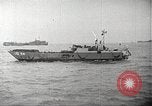
LSTs unload equipment and ammunition Omaha Beach in Normandy, France during World War II.
LCI(L)s approaching the Omaha Beach shore during the D-day invasion of Normandy in World War 2. Among those see is LCI(L)541. Officer calling with a megaphone from ship's deck. The LCIs advance toward the beach. Explosion seen ahead. U.S. troops wade from LCIs under continuous German machine gun fire. Larger Landing Ships Tank, including USS LST-282, waiting out of range of enemy fire. U.S. troops and motorized equipment on shore. Burning U.S. truck. Fallen U.S. soldiers in the sand.M4A1 Sherman tank with bulldozer blade and "DT-7" painted on its side, moving along Utah Beach. LCI(L)88 pulls up to a transport ship to load more troops for transport to the shore. Vehicles being transferred from an LST to a LCT. Larger vehicles, such as tanks, being transferred to "Rhino Ferries" (powered barges) to be taken ashore.Troop reinforcements being landed at the beachhead. Major General Charles H.Corlett, " Cowboy Pete," Commander of XIX Corps,US 1st Army, seen speaking on the radio, after landing on D-Day+4 (June 10th) at Omaha Beach, near Colleville-su-Mer. Army trucks drive ashore in surf. A buldozer moves in the surf.

United States troops with ambulances, trucks and tanks retreats from Wirtzfeld to Elsenborn, Belgium
United States 2nd Infantry Division retreats from Wirtzfeld to Elsenborn, Belgium. Ambulances move on road. Snow covered field in the background. Troops of 2nd Division pack and load luggage on 2 ½ ton trucks and leave the town. M 10 motor carriage move towards front near Soldiers sit on trucks and jeeps. Artillery moves in town. Soldiers walk on road. Three soldiers walk on road. Snow in the background. Medics and Headquarter troops move to rear along road through snow covered fields. Soldiers of 1st Infantry Division rest besides road. (World War II period).
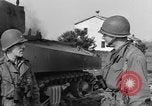
Officers talk near a burning U.S. tank and battle worn U.S. troops walk on a road in Anzio, Italy, during World War II.
A daylight raid by troops of the Joint US-Canadian 1st Special Service Force, on a German operation post at a beach in Anzio, Italy during World War 2. Brigadier General Robert Tryon Frederick, Commander of the First Special Service Forces (Black Devils Brigade) speaks to Commanding Officer 2nd Battalion, 2nd Regiment of 1st Special Service Force, Lieutenant Colonel Robert S. Moore alongside a burning tank. A tank moves on a road. Battle worn troops on a road. The troops cross the Mussolini Canal. An officer near a burning tank. A tank moves past a burning tank. Troops walk in a line. (Note: the U.S. tanks were knocked out by German teller mines.)
U.S. aircraft begin flight operations on Betio airfield in World War II. Navy F6F aircraft land at airfield. Marines leave to embark on troop ships
U.S. Marines complete capture of Tarawa from Japanese defenders in World War 2. U.S. Navy F6F aircraft are seen landing on the Betio airfield, Tarawa atoll, 24 hours after Seabees began to restore it to operation. One of the pilots poses with marines after landing. Marines of the 2nd Battalion, 6th Marine Regiment, wade ashore to relieve the others, provide protection for Seabees, and clean up ordnance in and around the airfield. Formal flag-raising ceremony officially establishing Tarawa under American control. The flag is raised as marines salute. The American flag flying high over the atoll. Battle-weary marines leaving Tarawa to embark on their transport ships, as members of the 2nd Battalion, 6th Marines, bid them farewell.
CRITICALPAST.COM: About Us | Contact Us | FAQs - How to Order | License Agreement | My Account | My Lightboxes | Shopping Cart | Advanced Search | Featured Collections | Website Terms & Conditions | Privacy Policy ©2026 CriticalPast LLC.
License Agreement |
Terms & Conditions |
Privacy Policy
©2026 CriticalPast LLC.