


 Francais
 Deutsch
 Italiano

Refine Your Search
8-inch-howitzer stock footage and images
- Showing 769 to 774 of 2106 results more
 Hide
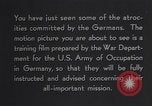
Training film for U.S. troops with the Army of occupation in Germany after world War II
Opens with bell tolling Victory against Germany in World War II. Next, a slate reads: "Victory Leads to Peace," and a farmer is seen with cattle pulling a plow. But narrator says "the problem now is future peace," and a map of Germany is shown overlaid with "Your Job in Germany." A cartoon of a soldier is superimposed on the map, along with one of a World War 1 American soldier and a figure of possible future soldier with similar mission. Camera focuses on parts of German aircraft in a jumbled heap. Closeups of weary defeated German soldiers at end ot World War II. Glimpse of Adolf Hitler speaking and haranguing an audience from a podium in an animated and forceful way. Swastika flags displayed from houses in a quaint German town. Joseph Goebbels, Nazi Reich Minister of Propaganda, at a microphone. Glimpse of a German concentration camp. But as they appear, each of the Nazi elements promptly disappears, showing the scenes without such Nazi symbols and persons. Skeleton remains of bombed buildings. Flower displays. Bucolic German rural countryside and quaint old villages in peaceful settings. Camera focuses on a book titled "German History." Chapter I, titled "Blood and Iron," shows Image of Otto von Bismarck. German troops march in a parade. Narrator states that "under Bismarck, the German empire was built." (He formed the German Empire in 1871, unifying Germany with himself as Imperial Chancellor, while retaining control of Prussia at the same time.) The film shows mounted German lancers as it alludes to Bismarck's campaigns against Denmark in 1867; Austria in 1866; and France, in 1870. Germany's leaders celebrating its status, in 1871, as the mightiest power in Europe. Troops marching and girls dancing nearby. Farmers plowing field with a horse and cow. Classic peaceful rural alpine scenes with local people in agricultural pursuits. A group of local German musicians playing folk music as village people dance outdoors. Back to the book, Kaiser Wilhelm II is shown on Chapter 2, entitled: "Deutschland über Alles." Gathering of German soldiers in Pickelhaube (spiked helmets). A German Big Bertha howitzer firing. German troops marching against Serbia; Russia; and France (with view of war damaged French cathedral). German invasion of Belgium in 1940 (with view of clock tower resting in rubble). German troops seen in Italy, walking past battle-damaged buildings. German Zeppelin dropping bombs on British targets and view of bombed out London neighborhood. Next scene shows a capsized ship with survivors running across its hull. Film slate labels the scene as United States, as if it is a U.S. ship attacked by Germany. (Actually, it is the Austro-Hungarian Battleship, SMS Szent Istvan, torpedoed, by Italian torpedo boats, during World War I.) Next, American soldiers in trench are seen going "over the top" and into "no man's land" on the western front of World War 1. Glimpse through a window of Kaiser Wilhelm II, after defeat of Germany, in 1918. View of Germans in a Beer Garden. Picturesque view of German town. A German orchestra performing. American soldiers marching out of Germany, with flags waving. Back to the history book,as chapter III is revealed, entitled "Today Germany, tomorrow, the world," and featuring Adolf Hitler. German troops invading Austria (where a civilian lies dead on the ground). German troops entering Czechoslovakia (where local people in tears render the Nazi salute). They march into Poland (where a girl weeps over someone, not seen, on the ground). They march into France (where a wounded, bandaged child cries in a bed). Next, is a scene from England, where a British child victim of bombing lies dead in the remains of a shelter. German troops invading Norway, Holland, Denmark, Belgium, Luxembourg and Russia (where a woman tries to rouse a dead woman). They invade Yugoslavia (where women sit near coffins of children) and Greece (where a woman rescues a naked child). A U.S. merchant ship explodes after being torpedoed by a German submarine (unseen). Scenes of destruction with people plucking dead victims from rubble of buildings. American troops invading Normandy, France on D-day, June 6, 1944. Several American soldiers fall to German gunfire on the beach. Wounded American soldiers being transported in jeeps on the battlefield and being placed on landing craft for evacuation. Americans walking past huge piles of destroyed aircraft parts. A landing craft filled with wounded American soldiers. American wounded and dead on a battlefield. Sailors abandoning a burning American ship by jumping into the sea. A sailor picked up in a life boat. A wounded American soldier being dragged from the beachhead at Normandy. Various wounds being treated by U.S. Medical Corps personnel. More scenes of American wounded being moved on stretchers. Scene shifts abruptly to German people folk dancing. Film concludes with question marks about the future.
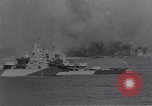
American forces in combat on land and sea, in Europe and the Pacific during World War II
American naval triple guns firing, in World War 2. The battleship, USS West Virginia, modernized and in camouflage, firing guns at a Pacific island. U.S.troops firing weapons from a beachhead. American soldiers manning a 155mm howitzer under camouflage netting. Another gun crew firing at zero elevation from heavily sandbagged position near buildings. Black flak clouds filling the air as American aircraft carrier fights off Japaneae Kanikase attack. The Kamikase plane appearing to by hit by flak. Cluster of Doouglas Dauntless planes on the carrier deck. Closeup of sailors firing double Bofors 40mm anti-aircraft guns from the carrier. Downed aircraft plunging into the sea. American troops riding a landing vehicle tracked (LVT) during amphibious assault. Landing craft stacking up along beach and subject to intense enemy fire during amphibious assault. One is hit and blows up. Flame thrower being usee to drive Japanese defenders from fortified positions. One runs out aflame. U.S. soldier throwing a grenade. American troops quick time entering an occupied town in Europe. Explosions and U.S. infantry passing destroyed buildings. Soldier firing a mortar. U.S. soldiers carrying a wounded on stretcher under fire.
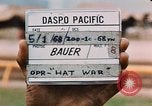
Men of 605th Transportation Co and 11th Aviation Bn Pathfinder Det prepare for airlift operation, in Lai Khe, South Vietnam.
A signboard '605th Transportation Company (ADS) Headquarters' and the names of commanding officer and first sergeant written below it. A soldiers in black cap stands near a signboard written 'Airborne, 11th Aviation Bn Pathfinder Det'. The black cap adopted by men of this battalion. Two soldiers at an airbase wearing black caps check sling riggings on 105 mm Howitzer waiting to be airlifted. Soldier fastens strap belts of material to be airlifted. Soldiers in black caps stand and discuss with helicopter pilots. A wireless telephone set at the back of a soldier. A helicopter gets ready for an airlift. (Vietnam War period).
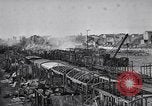
Allied forces pursue retreating German forces in South of France during World War II.
A railroad yard demolished by retreating German forces, in Vallon, France, during World War II. U.S.Army Combat Engineers are machine-gunned as they attempt to build a bridge across the Rhone River, in Lyon, France. They return fire as civilians seek cover. Allied soldiers in trucks enter the city as huge crowds welcome them. U.S. troops riding in M4 Sherman tanks. Knocked out German tanks and 88mm guns mounted on half tracks. Captured German Panther tank of 11.Pz.Div in Meximieux, abandoned Pz.III and Hummel 150mm SP Howitzer. General Patch's Army and the United States 3rd Army troops enter the city of Bourg. Thank You banners are displayed at two windows.
Units of United states 14th Corps capture Clark Field as they advance toward Manila, Philippines, during World War II
American troops in their drive toward Manila, in 1945, during World War 2, pass several knocked out and burning Japanese Type 89 Chi-Ro tanks. A dead Japanese soldier, shot dead while trying to commit suicide, lies on the ground with an undetonated hand grenade in his mouth. U.S. M4A2 sherman III tanks and infantry of the XIV Corps moving on the Lingayen Plains Philippines, leading to the capital, Manila. U.S. armor towing artillery ford a stream, as they pass beneath framework of an apparently unusable bridge. A battery of U.S. M101 105mm Howitzer artillery pieces is set up and bombards the Clark Field area. One striking shell produces an explosion, fire and column of black smoke. U.S. troops ride forward atop tanks. Glimpse of one soldier with flamethrower tanks on his back. American tanks firing their guns. Destroyed Japanese aircraft on the ground. A soldier using a mine detector to sweep the area. He signals to another soldier who comes to probe the area with a long knife. Next a soldier is seen standing in a hole dug around a bomb Placed nose up under the ground by the Japanese. Soldiers pull it from the hole, using a rope. U.S. soldiers walk in area full of similar holes and bombs pulled from them. General Douglas MacArthur is seen, on January 26, 1945, walking among remains of Japanese aircraft at Clark Field. He visits the Filipino cemetery at Camp O'Donnell, which was a prisoner of war camp, considered the terminating point of the Bataan Death March, where some 20 thousand Filipinos and almost 2 thousand Americans died during the Japanese occupation of the Philippines. MacArthur is seen standing by a large Christian Cross monument, and walks among untended graves marked with small wooden crosses. The Mount Pinatubo volcano is seen on the horizon in the background. MacArthur and those accompanying him walk around a large monument containing a placard written in tagolog. U.S. soldiers start a mortar barrage against Japanese forces dug in on "Hill 70." Infantrymen move through trees and brush to flush out the entrenched enemy. Glimpse of type of improvised device made of explosives and gasoline, that U.S. soldiers are using to drive Japanese troops out of their fortifications. As a soldier watches with binoculars, the camera records several of these devices exploding with great force. Glimpse of a dead Japanese soldier on the ground. U.S. troops ride atop an M18 Gun motor carriage of the 637th Tank Destroyer Battalion, as it crosses a river. American tanks and infantry moving cautiously across a bridge as shells explode ahead of them. Tanks firing at Japanese troops entrenched in hillside above a road. Large numbers of American infantry marching along a road accompanied by tanks. Areas around them burning from fires set by retreating Japanese forces.

Allied preparation and landing in Normandy on D-Day (WW2)
A film titled 'D-Day' shows General Dwight D. Eisenhower and his aides planning the Normandy invasion by looking at a map of Europe. Animated map showing Northern Europe. Slave labor building "West Wall" defense system, according to narrator, but scenes appear to show coastal gun emplacements and defenses more consistent with the Atlantic Wall. Hitler and Nazi German officials. Construction sites as defenses are built by slave labor workers under German guard. German coastal defense in Western Europe showing Howitzers, fortifications, and Nazi German guards. Allied tanks, guns, locomotives and other military equipment is massed on beaches in the United Kingdom before D-Day. Fighter planes in airfield. Men unload supplies and war materiel from the United States. Allied locomotives, brake cars, tank cars, and an armada of Naval ships and landing crafts for D-Day. Assault boats and invasion barges are launched from ships in England. A man smokes a pipe. Barrage balloons flying over ships. Troops, transport, artillery, and materiel are loaded into ships bound for Normandy. A fleet of ships move across the English Channel. United States paratroopers land in Normandy. Firing and bombardment between the Allied forces and Nazi Germany. Bomb explodes off the coast of Normandy. Soldiers in landing craft on the way to Normandy. First landings in Normandy on D-Day during World War II. Soldiers rush to the beachhead, climb cliffs, and put out fires. A soldier rolls in the ground. Soldiers disembark from landing crafts and ships. Barrage balloons over the Normandy beachhead.