


 Francais
 Deutsch
 Italiano

Refine Your Search
8-inch-howitzer stock footage and images
- Showing 91 to 96 of 2105 results more
 Hide
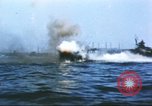
Color scenes of WWII including Pearl Harbor, D-Day, and Pacific campaign.
Montage of scenes dealing with Japanese attack on Pearl Harbor in World War 2. Bombs exploding and ships on fire; Japanese airplane diving from formation; a jeep driving past a burning airplane; hangars burning; Sailors firing anti-aircraft guns from an American ship; A New Orleans class American Cruiser firing her 8-inch guns; A South Dakota Class battleship firing her 16-inch guns; Group of American M3 Stuart light tanks in a field; U.S. Aviation Cadets marching between rows of Boeing Stearman Model 75 training biplanes; American soldiers marching in huge formations; Paratroopers in training jumps from towers; U.S. soldiers climbing down netting on side of troop transport ships to board small landing ships in the Pacific.; Marines in a landing craft carrying a large American flag; Landing craft in an amphious assault; Troops coming ashore from a Higgins boat, during training; An amphibious invasion task force at dusk; Troops wading ashore during the invasion of France in World War II, with barrage balloons aloft and support ships offshore. Staged scene of soldier on transport ship using flash light to read letter from home. Capital warships firing heavy guns and soldiers descending rope nets to enter landing craft. Soldiers landing on shore from Higgins Boats during training, and then on the shores of Normandy during the D-day invasion. American tank crew on an M26 Pershing tank. Major General George Patton with 1st Armored Division patch on his uniform sleeve. General George Marshall. General Dwight D. Eisenhower decorating an officer. Lieutenant General Henry (Hap) Arnold. Paratroopers jumping en masse from C-47 transport planes. German forces retreating in trucks along a road. Japanese General Yoshijirō Umezu, Chief of the Army General Staff, signing Surrender document aboard the USS Missouri, ending World War II, in the pacific. Glimpse of troop ship arriving in a U.S. harbor. View of U.S. military cemetery. Scene shifts to John Charles Daly, speaking in front of wall with names of Medal of Honor recipients, in the Hall of Heroes at the Pentagon, Arlington, Virginia, in 1968.
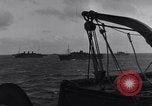
Allied Forces in Battle of Casablanca and North Africa in World War II
Operation Torch in World War 2. Allied invasion convoy off Casablanca, Morocco. American troops on ship's deck, cleaning and checking their rifles. Closeup of a wire from the Invasion Task Force Commanders, listing signals that will tell of the French forces' decisions. Closeup of U.S. troops boarding Higgins Boat from a transport ship. Rear Admiral H. Kent Hewitt on the USS Augusta (CA-31). U.S. President Roosevelt, Free French Commander, Charles de Gaulle, and French General Giraud, all issue calls for French forces not to resist Allied invasion. View of triple turret 8-inch guns on the USS Augusta. Sailors in their bunks. Suddenly guns from the shore begin firing on the invasion convoy. Shells explode in water near convoy ships, as sailors man battle stations and begin returning fire on Casablanca. French defenders signaled friendly attitude by directing searchlights vertically. British spitfire aircraft launch toward Algiers, from Gibraltar. British troops in an amphibious landing at Algiers on November 8, 1942. View of French Admiral Jean Darlan. Allied troops enter Algiers. American airborne troops parachute from C-47 transport aircraft over Oran, Algeria. Next section covers Battle of Casablanca: Allied warships fire at Vichy French ships and aircraft and more troops head to shore in landing craft. Sailors firing anti-aircraft guns from landing craft, at enemy aircraft overhead. A U.S. carrier-based SBD Douglas Dauntless aircraft as it descends in the sky. French sailors load 380mm guns on battleship Jean Bart and fire her guns. Glimpse of French Shore defense guns firing with shells exploding in waters offshore. Gunners aboard U.S. warship loading a heavy gun. Angered over British attack on the French Fleet in 1940, Admiral Daran refused to negotiate with the British. Inserted footage of French battleship Dunkerque exploding during British attack on French fleet at Mers-el-Kébir, July3, 1940. A tank driving ashore from a landing craft. Closeup of a French soldier (from the rear) firing his rifle at invading Allied troops. Allied medical corpsmen on the sandy shore, running with a litter. A jeep pulling a towed artillery field piece ashore from the surf. Medical corpsmen carrying a wounded on a stretcher. Allied troops fighting defenders in Casablanca. Animated map shows German invasion of Vichy France. View of Philippe Pétain, Head of Vichy France. View of Admiral Darlan saying goodbye to U.S. Lieutenant General Mark Clark after secret meeting of the two. Officers of German Armistice committees departing a North African city. Cheering crowds are happy to see them depart in a truck. French crowds cheering American troops. British Lieutenant-General Kenneth Anderson arriving at Algiers. French General Henri Giraud salutes. General Dwight D. Eisenhower salutes. Parading color guard with flags of France, Britain, and the U.S. Animated map shows German forces pouring into Tunisia. View of German troops on deck of a ship and at ship's anti-aircraft positions. General Eisenhower conferring with British and French allies. Camels used on rough terrain. American writes "Tunis Toonerville." in chalk. Allied troops sitting on floor of freight rail car with door open as old steam engine moves the train. Animated map shows German and Allied supply lines. A U.S. Douglas A-20 Havoc bomber landing on an airstrip. Numerous German warplanes parked in Tunisia. U.S. M2 tanks and other military vehicles moving along narrow mountainous roads. Locomotive transporting mules in stock cars. C-47 transport airplanes drop British and American airborne troops. Commandos disembark from ships at Bone, Algeria. Allied aircraft parked on a captured enemy airfield, under attack by German Dornier Do 17 and Heinkel He 111 bombers. A Parked American B-25. Allied soldiers firing small arms and anti-aircraft guns at German planes.
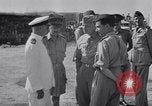
Allies force German forces almost completely out of Tunisia, North Africa, during World War II
Opens with General Dwight D. Eisenhower, Supreme Commander of Allied forces conferring with his deputy for land forces, British Field Marshal Harold Alexander, his deputy for sea forces, British Admiral Andrew Browne Cunningham, and his deputy for air operations, British air marshal Arthur William Tedder, during North African campaign in World War 2 . Map illustrates Allies military plans as analogous to internal combustion engine. General Eisenhower on an airfield consulting with his British Deputy commanders. B-17 bomber in background. Eisenhower salutes the British officers as he walks away. Lieutenant General Carl Spatz, Commander of the North West African Air Force, confers with British air marshal Tedder. Major General Jimmy Doolittle briefs airmen and smiles for camera. Strategic bombers with nose art names Pluto, Yankee Doodle, Jersey Jackass, Alice the Goon, and Fancy Pants. Picture of British Air Vice Marshal, Sir H.P. Lloyd, chief of Coastal air Force. A British Avro Anson aircraft flying air cover over a convoy of Allied ships. Diagram shows how all British and American fighter aircraft and attack bombers were placed under the command of British Air Marshal Cunningham, who is seen stepping from an airplane. British Field Marshal Harold Alexander in command of all ground forces is also seen stepping from an aircraft. Both are seen at a small camp trailer that they shared in the Tunisian mountains, where they work together, at a planning table. Marshal Cunningham is seen briefing air crews in mid March, 1943. B-24 Liberator bombers fly in formation and drop bombs on German Mareth fortifications in Tunis. German anti-aircraft guns create many black flak clouds among bomber formation. View from B-24 aircraft of the bombs exploding on the ground. British Field Marshal Harold Alexander is seen walking with a member of his staff across the sands. Diagram shows planned advance of the British 8th Army. Numerous British heavy guns fire nighttime barrages against the German positions, as British infantry advance during battle. They use scaling ladders and sappers detonate charges. Soldiers carry sticks to line trenches and set up defensive fortifications. Tanks advance. Heavy rain creates problems and some armor bogs down in mud. The next morning British troops are seen in their trenches as smoke drifts across the area. British soldiers moving cautiously under fire. German Field Marshal Rommel looks through binoculars. Additional German armored units entering the area. British gunners firing field artillery and mortars. Map illustrates how 2nd New Zealand Division under Lieutenant-General Bernard C. Freyberg, swings around behind the German line. Formation of British B-26 Marauder aircraft flying over desert. British Vickers Wellington bomber in flight. Bombardier in aircraft pressing a release button and close-up view of open bomb bay door with bombs away view as each bomb is released, followed by huge explosions on ground. British mosquito bomber flying low. Bomb explodes on ground and Mosquito aircraft pulls up and away. Another Mosquito aircraft flying low on a strafing run. Tanks of 2nd New Zealand Division welcomed into El-Hamma, Tunisia, in the Battle of the Mareth line. View of South African army engineers using caterpillar tractor to build roads for Allied forces. Glimpse from rear of three British warships underway in the Mediterranean sea. Front view of a British Queen Elizabeth Class battleship underway. The battleship firing her 15-inch guns. U.S. P-38 fighter planes in formation. Glimpse of pilot in cockpit wearing leather helmet and earphones. Formation of German Junkers Ju-52 aircraft flying low over sea, carrying German troops to reinforce those in Tunisia. View of German soldiers inside the cabin of a Ju-52. Closeup of three Ju-52 transports flying very low over water. Several U.S. P-38 fighter planes attacking the transports. Pilot in one, pressing button to fire his guns. Scenes of aerial dogfight combat between U.S. Army Air Force aircraft and German Luftwaffe aircraft. Gun camera images of P-38s shooting down German transport planes. Map shows American, British, and French forces pressing Eastward against Germans. Views of battle and U.S. Lieutenant General George Patton at the front as his forces move forward during Battle of Guettar. American patrols of light tanks meet up with British patrols from their 8th Army on April 7. Views of the U.S. and British soldiers happy to meet one another and sharing cigarettes. Map shows Allied forces pushing the Germans further. Allied infantry walking into town of Enfilaville. Local families returning to their homes with all their belongings, in carts pulled by donkeys and other animals. In the town, encouraged by British troops, a group of Jewish boys remove Jewish star of David emblems from their jackets that had been used by occupying Germans to identify them as Jewish. British army doctors tending to local women and children.
U.S. Task Force attacks Japanese positions on Island of Wotje in Gilbert and Marshall Islands during World War II.
Attack on Wotje Island, February 1, 1942. Crew members move F4F-3 Wildcat's and Douglas Dauntless SBD aircraft across crowded flight deck of the U.S. aircraft carrier, USS Enterprise (CV-6) during raid against Japanese positions in the Gilbert and Marshall Islands, by Task Force 8, of the U.S. Pacific Fleet, commanded by Vice Admiral William Frederick Halsey, Jr, during World War 2. Oversize U.S. stars are evident on the aircraft, at this early stage of the war (1942). Crewmen roll bombs, on dollies, across the deck. F4F Hellcat aircraft sit with engines running as some Douglas Dauntless aircraft commence take off. The destroyer USS Gridley, DD-380 passes abeam the Enterprise at time 00:37. A Curtiss SOC Seagull airplane catapults from the heavy cruiser USS Northampton, CA-26. Several U.S. aircraft seen in flight. View from stern of a U.S. heavy Cruiser as a destroyer crosses her wake, behind. The heavy cruiser USS Northampton, CA-26 and the heavy cruiser USS Salt Lake City, CA-25, in background (time 1:09 to 1:11) bombard Wotje island. Black smoke billows from a ship burning close to shore. Brief glimpse of the heavy cruiser USS Northampton, CA-26's triple battery of 8-inch guns. The heavy cruiser USS Salt Lake City, CA-25 fires a broad side. Scene from the stern of heavy cruiser with fires burning on Wotje Island in background. Formation of Japanese aircraft attacking U.S. ships are fired upon by antiaircraft guns. Black flak bursts seen in the sky. Vice Admiral Halsey consulting with other officers aboard his flagship, USS Enterprise.

Survivors from the USS Hornet, are transferred from the USS Russell to the cruiser USS Northampton during World War II.
Battle of Santa Cruz Islands in the Pacific during World War 2. Survivors from the abandoned aircraft carrier USS Hornet, CV-8, are being transferred, from the port side of the USS Russell, DD-414 (one of the destroyers that rescued them) to the starboard side of the cruiser USS Northampton (CL-26), by means of lines and breeches buoy. After several are transferred, this way, some wounded on litters are also transferred. Initial views are toward the Russell's stern, from the deck of the Northampton, where sailors are handling lines. Camera pans as survivors move across the space between the ships and are lowered to the Northampton deck. View from Northampton toward bow of Russell, showing two of her single turret 8-inch guns (one pointed up) as a litter passes between the ships. (Camera changes viewpoint occasionally.) An officer transfers on a bosun chair, followed by a sailor. In the final seconds, the USS Salt Lake City (CV-25) is seen in the background.

A Roman Catholic chaplain conducts the Mass at 105 mm howitzer position in Vietnam.
A United States Roman Catholic chaplain holds field memorial services in Vietnam during the Vietnam War. A chaplain celebrates Mass for United States soldiers. Men of 3rd Battalion, 8th Infantry, 4th Infantry Division present at the memorial services. The Mass being conducted at 105 mm howitzer position.