


 Francais
 Deutsch
 Italiano

Refine Your Search
8-inch-howitzer stock footage and images
- Showing 1573 to 1578 of 2106 results more
 Hide
Color Sound
U.S. Army soldiers stand in front of a house in Saint Mere Eglise, France and enjoy coffee from a French civilian woman.
Soldiers of U.S. Army 1st battalion, 8th infantry regiment, 4th division in the days after invasion of France. The U.S. Army soldiers stand in front of a house in Saint Mere Eglise, France. A French woman pours coffee into canteen cups held by soldiers. Soldiers drink coffee and several smile and enjoy the coffee. They talk amongst themselves. (World War II period).

Investigators work at a laboratory in National Aeronautics and Space Administration (NASA) in United States.
Sign reads: Panel 8 Materials entrance Room 1849." Slate reads: Material Analysis Branch." Technician in white lab coat prepares specimens for analysis. Sign reads: "Malfunction Investigation Laboratory. Class 100, Laminar flow clean room." Technician takes seat at work station and makes observations. In another room, two technicians connect a device for testing.

National Aeronautics and Space Administration (NASA). Astronauts Michael Collins and William Anders with pieces of Apollo 1
Apollo 204 review board at National Aeronautics and Space Administration (NASA) in United States. Wrecked command module shell behind picket fence in hangar. Technicians and other men look at a document and discuss it. Posters telling visitors not to touch anything. The wrecked parts of spacecraft in plastic bags on the table inspected. Photographs of the wrecked parts of the spacecraft on boards in the background. Man inspects the wrecked portion of the spacecraft on the table by flashing light on it. Astronauts Michael Collins, later pilot of Apollo 11 and William Anders, who later flew on Apollo 8, examine damaged and burned pieces of Apollo 1 command module.
Launching of NATIV missile under Project MX770 in California United States.
A scientist makes a presentation of Project MX770 showing coverage of model and various phases of missile development from 1946-1951. Development of NATIV (NORTH AMERICAN TEST INSTRUMENTATION VEHICLE) missile is between 1946-47 while NAVAHO is developed between 1948-49.The presentation shows the pulling of test vehicle under launching tower and its vertical position. A technician ties guide wires near the top of the missile.The missile is fired. Graphical presentation shows the parabolic pathway of missile showing altitude of 400mt and speed of mach8 (2722.32m/s). The firing range of Navaho is 3000mt from surface to surface.The missile uses Ramjet engines. Models of three missiles are also shown.

Missile Nativ at launch station under Missile Project MX770 in Denver Colorado United States
A scientist makes presentation of the Project MX770.Technicians work at launch station. RTV-A-5 missile is taken and kept in a supersonic wind tunnel for some tests.Another technician takes XSSAM-4 missile from its pack and assembles it prior to its placement in supersonic wind tunnel. A machine shows movement of needle from 0 to 8.
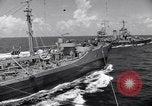
Invasion Task Force of U.S. warships headed for Sicily during World War II.
Scenes from Task Force of U.S.Naval warships en route for the invasion of Sicily in World War 2, as filmed from the destroyer USS Nelson, DD-623. Fueling operations between the fleet oiler USS Chemung, AO-30, the destroyer USS Nelson, DD-623 and an unknown Baltimore Class light cruiser. The crew of the USS Nelson cast off from the USS Chemung. A signalman controls a signal light as the USS Nelson pulls ahead of the USS Chemung. Port side of the attack transport USS William P. Biddle, APA-8, with more of the convoy in the background. Stern and port side of the attack transport USS Susan B. Anthony, AP-72. On the USS Nelson, DD-632, looking aft at the starboard dual mounted 40-mm bofors anti-aircraft gun and number three turret for a 5"/38 dual purpose gun. On the USS Nelson, DD-632, looking aft at the fan-tail and depth-charge racks. Crew members washing clothes, sunning, relaxing and with two on watch with sound-powered phones.
CRITICALPAST.COM: About Us | Contact Us | FAQs - How to Order | License Agreement | My Account | My Lightboxes | Shopping Cart | Advanced Search | Featured Collections | Website Terms & Conditions | Privacy Policy ©2026 CriticalPast LLC.
License Agreement |
Terms & Conditions |
Privacy Policy
©2026 CriticalPast LLC.