


 Francais
 Deutsch
 Italiano

Refine Your Search
8-inch-howitzer stock footage and images
- Showing 1891 to 1896 of 2105 results more
 Hide
Color Sound

A damaged building and flak tower at Tiergarten Zoo after Allied bombings in Berlin, Germany during World War II.
Damaged buildings at the Zoologischer Garten zoo (Hardenbergpl. 8, 10787 Berlin, Germany) in Berlin, Germany due to Allied bombings during World War II. A wall of a building with Egyptian carvings at the zoo, riddled with bullet holes. Carvings on the walls with extensive damage. A flak tower (the Zoo Tower, presently the site of the Hippopotamus Park inside the zoo) with a sign on it that reads 'ZOO'. The damaged flak tower at the zoo. A wrecked iron gate at the zoo.
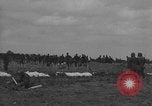
Graves being prepared for fallen U.S. troops at the temporary American St. Laurent Cemetery, in France, during World War II.
German prisoners of war at work digging graves for fallen American soldiers, at the temporary American St. Laurent Cemetery, established by the U.S. First Army on June 8, 1944, shortly after the D-Day invasion of Normandy (Operation Overlord). This is the first American cemetery on European soil in World War II, and located on a cliff overlooking Omaha Beach and the English Channel, east of St. Laurent-sur-Mer and northwest of Bayeux in Colleville-sur-Mer. (It is now the Normandy American Cemetery and Memorial.) Vertical posts with dog tags attached, mark the gravesites of the fallen troops. American soldiers sit near covered dead bodies of the fallen and perform tasks of identification and grave assignment. Covered remains of one soldier are carried across the field on a stretcher. Barrage balloons are seen in the sky overhead.

Soviet tanks and armored carrier personnel at a parade at the Moscow Kremlin in Moscow, Soviet Union.
The Soviet Army parades past the Moscow Kremlin in Moscow, Soviet Union. A BMP-1 (Boyevaya Mashina Pekhoty), an Armored Personnel Vehicle, with soldiers loaded on it moves past a large crowd at the Kremlin. Soviet assault gun or tank destroyer ASU-8Js pass in review at the parade. Soviet tanks T-62 at the parade with buildings at Red Square in the background. Soviet tracked anti aircraft weapon system ZSU-23-rolls past the crowd at the Kremlin.

U.S. Brigadier General Ira Eaker leads B-17 raid on Rouen, France, during World War 2
U.S. Army Air Force armorers ride atop bombs on trolleys, being pulled by a tug on an airfield in England during World War 2. Airmen gather around a bomb as one writes in chalk, "To Schicky (referring to Hitler family, Schickelgruber) this is only the start, Love, L.E.Z." Views of Airmen rolling bombs on carts under a B-17E aircraft. View from inside a B-17 as ground crews look up through open bomb bay doors. B-17 combat crewmen walking and riding bicycles, to attend a mission briefing. Inside the assembled aircrews are briefed by a British RAF officer, who says, "We're going to work. The target is XZ 462." He goes on providing details to be followed by aircrews. The crews leave the briefing room. Next, B-17s are seen taxiing out for takeoff. The lead aircraft is "Yankee Doodle" piloted by Brigadier General Ira Eaker. Another is "Stinky." Next is "Little Skunk Face."And the last one "Berlin Sleeper." Ground crews watch as the B-17 bombers take off and assemble into formation overhead. Views from inside a B-17 as bombs fall and its gunners fight off German fighter planes. Bombs seen falling and exploding on the ground and raising clouds of smoke. Glimpse of gunners firing at attacking German aircraft. Narrator states there is anti-aircraft fire all around them, that jolts the aircraft. The B-17s assemble in formation for the flight home. Back at the base, some wait atop the tower for the returning aircraft. General Ira Eaker, Chief of the U.S. VIII Bomber Command, steps from a returning aircraft, and greets Major General Carl Spaatz, Commander of the 8th Air Force. Final scene shows Brigadier General Eaker, smoking a cigar and surrounded by civilian and military reporters. ( Note: Reportedly, the B-17 "Stinky" crash landed in Athenry Co Galway Ireland on the 15th January 1943 with General Jacob Devers and a party of other Generals onboard, but none were injured and and all arrived safely at 2AM the same day, in Belleek, Northern Ireland.)
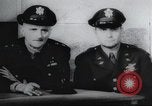
U.S. General Ira Eaker discusses the air raid after bombing Rouen, France during World War II.
Discussion of the first B-17 raid in the European theater (on Rouen, France) during World War II. Major General Carl Spaatz, Commander of the U.S. 8th Air Force, comments about this first such use of American heavy bombers against German targets in World War 2. He notes that this raid was led by Brigadier Ira Eaker, head of U.S. Bomber Command. He invites Eaker to comment on the raid. General Eaker reports that pilots maintained good formations and gunners caused German fighters to back away. He states that the main targets during the air raid were marshalling yards and a Locomotive repair facility. An intelligence officer debriefs two members of a flight crew, following a mission. They answer questions. One of the crew members points out their target on a map, and reports success at hitting their targets..
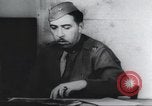
U.S. VIII Bomber Command, 97th Bomb Group, 342nd Bomb Squadron Commander is debriefed by a 97th Bomb Group Intelligence Officer (WW2)
Film opens showing a Captain, Intelligence officer with the U.S 8th Airforce 97th Bombardment Group, debriefing Captain William “Bill” Musselwhite, Commander of the 342nd Bombardment Squadron, about his unit's experience participating in the first Eighth Air Force heavy bomber mission in World War II, attacking the Rouen-Sotteville marshalling yards in France, on August 17, 1942. Referring to a map, he asks Captain Musselwhite where his Squadron dropped their bombs. Musselwhite points out the path of his units aircraft and that his first aircraft overshot the target, but those following dropped "on range," bracketing the target on left and right, with one "stick" of bombs going right down the middle. He mentions one ship straying over the town of Rouen, itself.
CRITICALPAST.COM: About Us | Contact Us | FAQs - How to Order | License Agreement | My Account | My Lightboxes | Shopping Cart | Advanced Search | Featured Collections | Website Terms & Conditions | Privacy Policy ©2026 CriticalPast LLC.
License Agreement |
Terms & Conditions |
Privacy Policy
©2026 CriticalPast LLC.