


 Francais
 Deutsch
 Italiano

Refine Your Search
8-inch-howitzer stock footage and images
- Showing 409 to 414 of 2105 results more
 Hide
Color Sound
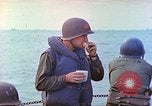
U.S. forces launch amphibious Assault on Iwo Jima in World War II.
U.S. invasion of Iwo Jima during World War 2. A sailor eats a sandwich. U.S. Landing ship Infantry (LSI) No. 1029, firing rockets at the shore of Iwo Jima. Change of scene to aboard ship further from shore. Mount Suribachi visible in background. Other ships closer to shore. A U.S. Destroyer off the shore. A line of armed landing craft approaching Iwo Jima, headed by LCI-717. Views and closeup of USS Brule (APA-66) . Attack transports USS Cape Johnson (AP-172) and USS Fond du Lac (APA-644). the Destroyer Escort, USS Vammen (DE-644). The camouflaged Light Cruiser, USS Vicksburg (DL-86) bombarding the coast of Iwo Jima with 5 inch and 6 inch guns. A landing craft infantry approaching the shore, firing rockets. Large explosions in the water at a distance. USS LCI-65 returning from the shore. (Note: The ship at the 1:07 - 1:18 sec mark is a Pensacola class heavy cruiser and the ship at the 2:11 - 2:40 sec mark is the battleship USS North Carolina BB 55.)

Cadets watch the demonstrations of different equipment at Aberdeen Proving Grounds in Maryland.
Activities of West Point cadets in the United States. The cadets attend ordnance exercises at Aberdeen Proving Grounds in Maryland. Officers aboard an armored car moving along the ground. The car moves along a ramp. Trees in the background. A cadet looks through a pierced armor plate which was pierced as a result of firing a 12 inch armor piercing projectile. Men look for the projectile which bursts after piercing the armor plate. The cadets gather for the demonstration of a 16 inch seacoast gun. Officers stand nearby and fire the gun. Smoke rises as the gun is fired.

Great flood of the Potomac River near Washington DC after heavy rains add to melting of ice and snow
The working of weather bureau in the United States. Snow covered shores of the Potomac River at Great Falls, west of Washington DC, following 15 inch snowfall in February 1936. Two people walking on a high snow covered bluff near the Great Falls. The frozen Potomac River, covered with ice. View of the Memorial Bridge spanning a totally frozen Potomac River, with the Lincoln Memorial and the Washington Monument in the background. Views of the river carrying chunk of snow and ice as a thaw begins the breakup. Man photographs a woman next to a guard rail at the Potomac River, covered in chunks of thawing ice and snow. Frozen ice chunks flowing under the Memorial Bridge. Narrator describes flood beginning with heavy rainwall in Shenandoah River valley on March 17 and March 18, 1936. Scenes of Western Union Telegrams detailing reports of rain in the west from various towns in the Shenandoah foothills. One from Romney , West Virginia notes rainfall of 5 inches.

A sailor loads shells and a gun being fired from a ship underway in the Gulf of Tonkin.
Re-enactment of events that took place during 2-5 August, 1964, in the Gulf of Tonkin Incident. A U.S. ship underway in the Gulf of Tonkin. A sailor loads shells into a 3 inch gun. The gun commences rapid fire, stops and commences firing again. A pointer raises and lowers the twin three inch guns. Two crew members at a gun mount as the gun points. The gun mount rotates and stops. The gun mount manned by the gun crew.
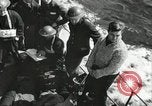
Scenes aboard a Royal Canadian Navy Anti-aircraft Destroyer on convoy duty during World War II
Canadian sailors, wearing steel helmets, aboard an Antiaircraft destroyer, in World War 2. They watch as two practice target shooting with rifles on the ship's deck. One of them wears a cap with Canadian Naval Petty Officer insignia. View of the rifle targets. Sailors hurry to a quad-mounted Mark III Vickers .50 antiaircraft machine gun position as an officer looks through a sighting device. The gunners begin firing. Another gun crew mans what appears to be a QF 3 inch 20 cwt anti-aircraft gun, while two sailors fire hand-held Lewis machine guns, skyward. View forward from the bridge of the ship. She appears to have two more forward deck-mounted 3 inch anti-aircraft guns. View astern showing the British White Ensign flying. Other warships are seen steaming on the horizon. A sailor standing near depth charges on deck, looks through binoculars. Steamships in a convoy are seen. View of a camouflaged two-stacker destroyer in the convoy. Crew members running forward on deck, followed by explosions seen in wake of the ship as depth charges she has launched detonate.

The displacement of a bridge and USSBS physical damage team shows flash burns on roof tiles in Nagasaki, Japan.
A survey of physical damage of bomb blasts in Nagasaki, Japan after World War II. View of a bridge. Displacement of the bridge towards the north. The south side of the bridge shows displacement over concrete support. The displacement on the back side of the bridge measures 2 inches and on the west side measures 6 inches. The pressure side of the bridge shows pylon nearest to zero. The underside of the bridge shows displacement. Displacement of girders on the abutment. Major Dragnet and Major Fletcher of the United States Strategic Bombing Survey (USSBS) physical damage team show flash burns on roof tiles found in a stream bed.
CRITICALPAST.COM: About Us | Contact Us | FAQs - How to Order | License Agreement | My Account | My Lightboxes | Shopping Cart | Advanced Search | Featured Collections | Website Terms & Conditions | Privacy Policy ©2026 CriticalPast LLC.
License Agreement |
Terms & Conditions |
Privacy Policy
©2026 CriticalPast LLC.