


 Francais
 Deutsch
 Italiano

Refine Your Search
8-inch-howitzer stock footage and images
- Showing 469 to 474 of 2105 results more
 Hide
Color Sound
American 52nd and 53rd Coast Artillery Regiments load and fire railroad gun at Belleville in France during World War I.
Shows U.S. Army 52nd and 53rd Coast Artillery Regiments troops loading 14-inch shells in a camouflaged railroad gun at Belleville in France during the Meuse-Argonne offensive. U.S. troops fire the railroad gun during World War 1 from underneath its camouflaged net position on the railroad tracks. After each firing, the regiment reapproaches the gun to reload and fire again.

Derby events being held in New York and California.
Shows the Suburban Handicap derby event being held in New York City. Spectators cheer from their stands. Seven year old horse Kalso loses to Iron Peg by inches. Shows another derby event at Hollywood park in California. South African horse Colorado King wins the event.

Radio stations inform Americans about the Japanese attack on Pearl Harbor. Ford Motor Company Facilities convert to war plants in World War II
Film begins showing Japanese flag spreading over the Pacific areas of Japanese control. Newspaper headline reads: "Japs Attack Pearl Harbor." Radio news broadcaster states the "While the Battle of the Pacific spreads over a 5 thousand mile front, the United States formally declares war on the Empire of Japan." A woman in her home goes to her radio to listen to the broadcast. A man listens to his car radio. A man and woman listen to the broadcast in the family living room. Film transitions to view of the Ford Motor Company Rouge River Plant in Dearborn Michigan. Then, the film begins to show products of the Ford Company as it converted to wartime production for the war. Several jeeps drive out of a yard holding thousands of them. View from camera below as jeeps drive above it. An Army officer and a civilian riding with a driver in a jeep being run through its paces at a Ford proving ground. An M4 tank running through mud. A 3-inch Gun Motor Carriage M10 (Tank Destroyer) Amphibious jeeps entering a body of water, Several seen driving on a dry road and then entering the water. Numerous Army trucks seen parked in an open field. View of an M-10 Tank destroyer running over some trees. A twin engine transport plane takes off towing a Ford-built Waco CG-4 glider behind it. Aerial view from above of several transport planes towing CG-4 gliders at low altitude below. Closeup of a Ford-built supercharger installed in a warplane. Closeup showing its flapper valve moving as a person spins its compressor with his finger. Aircraft engine starting up. Ford-built Electronic antiaircraft director is shown. The remainder of the film shows men and women assembling aircraft engines in a Ford Motor plant.
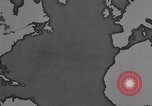
American naval forces join with British in Operation Torch to attack at Casablanca in Morocco, North Africa during World War 2.
Animated map shows the advancement of American forces toward North Africa, being joined by British Naval forces near Gibraltar for Operation Torch. American and British allied naval fleets position at key locations near Oran, Algiers and at Casablanca for simultaneous attack. United States Navy fleet starts its attack after being fired upon by shore batteries of Vichy French forces at Casablanca, commencing the Naval Battle at Casablanca. Carrier aircraft swarm the skies above the harbor at Casablanca. Antiaircraft guns fired by Vichy French. Huge explosions in water and on ships. Guns aboard a battleships fired. The unfinished French battleship Jean Bart is hit by a U.S. battleship's 12 inch shell. The ship Jean Bart erupts in flame and emits heavy smoke. Several destroyed French ships in harbor at Casablanca.
Eddie Rickenbacker, President of Eastern Airlines, hosts Cyrus R. Smith, President of American Airlines, after both airlines acquire DC-3 airplanes
Glimpse of U.S. Army gun crew operating a 3-inch M3 Anti Aircraft gun. Glimpse of 1st Lt Joseph H. Eastman and Captain Eddie Rickenbacker standing beside Rickenbacker's SPAD S.XIII #1 parked in front of a hangar at Foucaucourt Aerodrome, France, 1918. Sequence shifts to 1936, and office of Rickenbacker, now President of Eastern Airlines. A poster on the wall contains memorabilia from the 94th Aero Squadron, with which Rickenbacker flew in World War I. Camera pans over photographes bordering the poster. Next, Rickenbacker is seen conversing with his guest, Cyrus R. Smith, President of American Airlines, as they look at a picture of Rickenbacker and his Spad airplane, signed by numerous pilots who also served with the 94th Aero Squadron. A mounted model of a Douglas DC-3 airplane sits atop a table in the foreground. Rickenbacker and C.R. Smith, both hold onto the DC-3 airplane model as they shake hands. Closeup of the DC-3 model as Rickenbacker rotates it before the camera. (Note: Both Smith and Rickenbacker, presidents of their respective airlines, had mutual admiration for the Douglas DC-3 airliner. In 1934,Smith arranged to purchase 20 new DC-3 airplanes from the Douglas Aircraft Company. American's first DC-3 "Flagship Illinois," had its maiden flight on June 25, 1936. Eastern Airlines took delivery of its first DC-3 in December 1936.)
Review of U.S. Army Combat Team operations during the Korean War
Operation of a U.S. Army Combat Team from the Eighth United States Army (EUSA) during the Korean War. Infantry soldiers walk through rocky mountains carrying guns. Soldiers look through binoculars at observation posts and relay targeting information to artillery. U.S. Army artillery firing on enemy positions. Infantry dug in on a trench line. U.S. Army grasshopper observation aircraft in the sky scouting out target sites. Views of artillery being loaded, aimed, and fired, including by a group of African American soldiers. Tanks and infantry on the move together as an Armored Infantry Unit. Narrator discusses relationship between infantry troops and tanks and how they work together as a team. Mortar units aiming and firing. At an airfield, weapons are loaded onto planes including P-51 Mustang aircraft and jets. Planes being fueled. 5 inch rockets and 50 caliber machine guns are loaded, along with Napalm and demolition bombs. View of pilots in combat briefing and then exiting briefing to fly mission. P-51 Mustangs taking off from airfield. Mustang fighters in the air and views of Mustangs firing on enemy positions with guns and bombs. Air-Ground Liaison Team shown in a jeep on the ground providing targeting information to planes via radio.
CRITICALPAST.COM: About Us | Contact Us | FAQs - How to Order | License Agreement | My Account | My Lightboxes | Shopping Cart | Advanced Search | Featured Collections | Website Terms & Conditions | Privacy Policy ©2026 CriticalPast LLC.
License Agreement |
Terms & Conditions |
Privacy Policy
©2026 CriticalPast LLC.