


 Francais
 Deutsch
 Italiano

Refine Your Search
8-inch-howitzer stock footage and images
- Showing 523 to 528 of 2105 results more
 Hide
Color Sound

U.S. Coast Guardsmen aboard a transport ship prepare to lower an LCM while underway in the Atlantic Ocean during World War II.
Allied fleet underway in the Atlantic Ocean towards Normandy, France during World War II. The barrel of an open 5 inch 38 caliber mount. A man in a foul weather gear on a lookout in the foreground. A man works on a blinker light. A transport ship underway in the background. A boat crew readies an LCM ( Landing Craft Mechanized ). Gears of a winch in operation. A U.S. Coat Guard Lieutenant in a blue uniform and a garrison cap with two men on the deck of the ship. An anchor chain comes up. A hawsepipe as a stream of water goes down and washes the chain. Coast Guardsmen on the deck of a transport ship as they get ready to lower a gangway. Coast Guardsmen make a splice in a line.
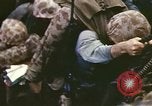
Marines load in LCVPs to move towards the Philippines coast as naval vessels fire at the coast during World War II.
United States Naval fleet off the coast of the Philippines during World War II. U.S. Marines climb over the side of cargo nets and into an LCVP ( Landing Craft Vehicle Personnel). The marines go over the side of a ship into the LCVP. A four barrel 5" 38 caliber naval gun aboard a destroyer fires. A United States destroyer of Fletcher class bombards the coast. 5" 38 caliber naval gun fires. The destroyer bombards the beach. An LSMR (Landing Ship Medium, Rocket) fires rockets. Shells explode on the beach. A United States battleship of Nevada class camouflaged by Thayer method bombards the beach. 5 inch and 40 mm guns fire at the beach. Crew loads and fires a 3"50 caliber gun. Explosions occur. An LCS ( Landing Craft Support) near the beach. The destroyer of Fletcher class bombards the beach. Aircraft fly over the convoy of ships. Sky lookouts on the bridge of a ship. Camouflaged destroyer and a heavy cruiser of Baltimore class bombards the beach. Twin mounts on a cargo ship bombard the beach. A man with a long glass leans against a signal lamp towards the beach.
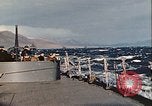
USS New York (BB-34) departs U.S. Naval Station Argentia, New Foundland, as part of convoy, during World War II
Gun crew,on the USS New York (BB-34),wearing steel helmets, check out her 3-inch antiaircraft gun on the stern deck, as she departs from U.S. Argentia Naval station, Newfoundland, during World War 2. Sailors are dressed in winter clothing. Snow-covered hills in background. As they are underway, a large transport ship is seen astern. Scene shifts to warmer, sunny weather at sea. Sailors play a game with quoits on the deck of the USS New York. Others relax in a warm sunny spot. Sailors stand on the deck. An island visible nearby. Sailors download a bomb from a Vought OS2U Kingfisher aircraft aboard the battleship New York. International maritime flags displayed near the bridge.
Warships bombard the coast of Iwo Jima, Japan during World War II.
Views of shells being fired by Allied warships at the coast of Iwo Jima, Japan during World War 2. Explosions occur at the coast of Iwo Jima as the shells strike the island. A twin Bofors 40mm gun being fired from a warship. Fire and billows of smoke rising from the coastline. A crew loads a 3 inch-50 caliber fixed round into a gun aboard a warship. The round is then fired.
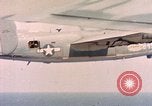
United States ships bombard the coast of Iwo Jima, Japan during World War II.
View from inside one of several U.S. Army Air Forces B-24 liberator bomber aircraft attacking Japanese positions on Iwo Jima in World War II. Dim aerial view of Iwo Jima from overflying Navy PB4Y. Smoke rising from isolated explosions on the ground. U.S. Navy warships, including battleships, cruisers, and gunboats, of Task Force 51, commanded by Vice Admiral Richmond Kelly Turner, are visible but not individually identifiable from the air. smoke rising onshore as shells from navy guns explode. Smoke also seen from the barrels of the warships themselves, as they fire barrages. Large white clouds of smoke obscure the beaches of Iwo Jima as the warships begin firing white phosphorus shells. At the same time, large numbers of amphibious landing craft are assembled in lines ready to move toward the beach. Bright images of the battleship, USS Idaho (BB-42) bombarding Iwo Jima with her twelve 14-inch guns. View from the air over Iwo Jima during the naval bombardment.

Large logs are cut by means of an automatic saw machine in a lumber mill located near Maizuru, Japan.
A lumber mill located near Maizuru, Japan. Interior of the lumber mill where large logs are being cut by means of an automatic saw machine. Boards are being cut into ½ inch width for use in repairing repatriation ships at the Eno Ship Building Company, Maizuru. The logs float in a lumber pond waiting to be cut into boards. A half completed wooden frame structure on a hillside near the main highway from Kyoto to Sonobe. This building was to be used as a small factory.
CRITICALPAST.COM: About Us | Contact Us | FAQs - How to Order | License Agreement | My Account | My Lightboxes | Shopping Cart | Advanced Search | Featured Collections | Website Terms & Conditions | Privacy Policy ©2026 CriticalPast LLC.
License Agreement |
Terms & Conditions |
Privacy Policy
©2026 CriticalPast LLC.