


 Francais
 Deutsch
 Italiano

Refine Your Search
8-inch-howitzer stock footage and images
- Showing 541 to 546 of 2106 results more
 Hide
Color Sound

United States M-24 Chaffee tank compared to German tanks, during World War II.
United States M-24 Light Tank of the U.S. 9th Army fires at a target. Soldiers aboard tank. Narrator describes the M-24 to help distinguish it in appearance from German tanks, during World War 2. The torsion bar suspension of M-24 Light Tank and its 16 inch wide tracks. The 75 mm gun barrel of the tank. Side by side shot of M5A1 and the M-24 replacing it. Comparing ammunition placed on ground. Recognition features of M-24.

Montage of scenes depicting U.S. military weapons in the Korean War era.
Segment of U.S. Army public information television program called, "The Big Picture." Army cameraman records firing of a Nike missile. Atomic cannon fires shell creating atomic explosion and classic mushroom cloud. Army troops exit Sikorsky YH-19 helicopters. Infantrymen climb a hill while firing rifles in unison. Animated rotating world globe. Sergeant Stuart Queen emphasizes that, in spite of new weapon systems, the individual soldier is the essential element of the Army. Technicians in missile launch control blockhouse observe launch of a missile from steel tower. View from inside the structure of missile rising, and then of smoke as it heads skyward. Radar units and cameras tracking the missile. Views from a missile, of the ground below, as it accelerates upwards. More tracking cameras. A Matador missile being launched. A Viking missile being launched. Test of anti-aircraft missile launched horizontally, striking nearby target with explosion. A thermonuclear weapon test explosion. A Corporal missile being launched. Sophisticated electronic tracking equipment employed at desert test site. Convair experimental XFY Pogo seen in vertical takeoff during trials. Anti-aircraft missile, fired from Navy ship, strikes drone target aircraft, which falls in flames. Technician stands before a virtual wall of electronic equipment. Army Signal Corps television cameraman captures field maneuvers of Landing Vehicles Tracked (LVTs) and an M4 Sherman tank. A High-flying warplane fires an air-to-air missile destroying a drone aircraft target that falls in flames. Aerial view of the Pentagon, Arlington, Virginia. America's top military leaders sit around a table. At the head, is Chairman of the Joint Chiefs of Staff, Admiral Arthur William Radford. To his right are: General Nathan F. Twining, USAF, and Admiral Robert B. Carney, Chief of Naval Operations (back to camera). To Radford's left are General Lyman Lemnitzer, Army chief of Staff, and General Lemuel C. Shepherd, Jr. Commandant of the Marine Corps. Views of U.S. Navy warships firing heavy guns. A South Dakota Class Battleship firing her 16-inch guns. Navy aircraft being catapulted from the USS Ranger (CV-61). Gun camera view from aircraft firing guns. A USAF B-52 bomber in flight. Bombs falling from open bomb bay of bomber in flight and carpeting the ground with explosions. Low flying USAF aircraft demonstrating ground-support bombing techniques, dropping napalm and explosive bombs.

Robot bomb damage in England; launching sites and wide gauge tracks for transporting bombs in Cherbourg, France (WWII)
U.S. Army 9th Air Force North American P-51 Mustang fighters in flight and tracking a V-1 Flying bomb to shoot it down over Southern England, United Kingdom, during World War II. Crowds inspect damage caused by V1 flying bombs and V2 rockets, also known as “robot bombs.” A crater formed by a German robot bomb. A U.S. Army soldier collects fragments while inspecting the bottom of the bomb crater. British and American soldiers and British civilians inspect the damage. Aerial and ground views of an unfinished German V-1 and V-2 launch site on the Cherbourg Peninsula in Normandy, France after its capture by Allied forces. The main rocket ramp is seen on the launch site. A crane at the unfinished launch site. A concrete strip under construction. An unfinished section at the Cherbourg rocket launch site. The rich concrete mixture used in the construction of the massive installation is reinforced by lattice-type steel rods (half inch thick woven in squares). Unfinished and destroyed platforms from 29 rocket launch installations made by German forces at Cherbourg before the Normandy landings. Large solid underground structures intended as showrooms for shells and equipment. Unfinished or damaged narrow-gauge railroad used for supplies and construction. Carts are seen on the railroad. Netting laced with metal leaves to prevent fading is used for camouflage. A soldier arranges green coverings outside a bunker. A man stands on a crater. Wide gauge tracks to bring bombs to the platform. Some parts of the installation are bombed by Allied bombers.
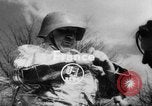
French fire fighters demonstrate new aluminum foil fire suits in France.
French firemen demonstrate new aluminum foil fire suits in France. Fire fighters wear the fire suits which are only three thousandths of an inch thick. They plunge into a 3000 degree inferno. People watch the fire fighters. The fire fighters emerge unsigned from the fire. One fireman takes off his helmet and smiles.

Soldiers fire railroad guns in France.
16 inch guns mounted on a train in France during World War I. Soldiers stand near the railroad guns. Railroad guns are loaded and fired.
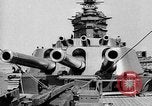
King George VI Coronation Fleet Review. HMS Nelson. HMY Victoria and Albert
Scenes associated with the British Coronation Spithead Fleet Review of King George VI. View from the bow of the forward 2x3 gun turrets of the HMS Nelson, with their 16 inch guns. Aerial views of the British Fleet assembled with the Royal Yacht, HMY Victoria and Albert, in the center of the array.
CRITICALPAST.COM: About Us | Contact Us | FAQs - How to Order | License Agreement | My Account | My Lightboxes | Shopping Cart | Advanced Search | Featured Collections | Website Terms & Conditions | Privacy Policy ©2026 CriticalPast LLC.
License Agreement |
Terms & Conditions |
Privacy Policy
©2026 CriticalPast LLC.