


 Francais
 Deutsch
 Italiano
Refine Your Search
Adak Alaska USA 1943 stock footage and images
- Showing 6133 to 6138 of 27425 results more
more Hide
Hide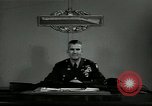
Colonel William Wilson Quinn talks about importance of the blue badge infantry soldiers of the United States Army
Colonel William Wilson Quinn on the show 'The Big Picture' in United States. Blue badge model framed on the wall in the background. He speaks about the importance of the blue badge of the rifleman or infantry man and the soldiers who wear the blue badge. He speaks about the great work of the infantrymen during the Korean War. He also speaks about the war at Sicily, the battle of the Bulge and the great work of various divisions. He says that the program 'The Big Picture' is the result of the great work of the Signal Corps combat cameramen who took the pictures and films of the Infantrymen.
American women work as part of the National Defense Program, United States (WW2)
Wartime activities of women in United States during World War II, narrated by Hollywood actress Katharine Hepburn. A statue of a historic “Pioneer” American woman. American women work to save and help the nation. Women work at a laboratory as scientists. A woman looks under a microscope. Test tubes and other equipment on tables. Women handling chemicals in various flasks without protective gear. They work for the National Defense Program. A woman works near a machine that tests rubber or cloth for parachutes. Woman conducts abrasion test on clothing using a Wyzenbeek machine. She feeds guinea pigs and records their weights. Another woman works in the field of science. A woman gives a lecture on nutrition. A nutrition chart on wall. Other women attend the lecture. Women design working clothes for women. A woman wears a factory jumpsuit uniform.
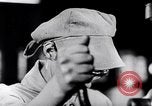
American women actively participate in the National Defense Program as war production workers in United States.
Wartime activities of women in the United States during World War 2. American women wearing uniforms work at machines in factories, assisting with the war production effort. They perform work in operating machines including drill presses, sewing, and fine detail work with precision instruments. They sew airplane wing fabric and parachutes. They assemble and inspect precision instruments employing tiny bearings. The women war workers operate drill presses and lathes in a machine shop.
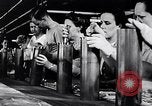
American women actively working and participating in the National Defense Program of the United States in World War II.
Wartime activities of women in United States during World War 2. American women war production workers busy in an ammunition factory helping men with war production. They check the shells at the munitions plant. A woman gives a lecture. A chart on wall. Other women attend the lecture. They wrap surgical dressings for the Red Cross. A woman gives blood to blood bank. Doctor and nurses take the blood in a glass container and put it in a box. The women participate in the defense program and war effort, filling many roles previously occupied by men fighting in World War 2.
Dramatization: The German view about the American women in United States.
Dramatization of the Nazi concept of American women as decadent playgirls unfit for working. Newspapers headline about end of the World War II. A man comes downstairs. He comes near a man in prison. The man in prison writes a book on the participation of the American women in the war. Men discuss among themselves. Photographs framed on the wall. They discuss a map and about the army of the United States. A man says that the American women army has done a lot for the victory of the United States. The other man states that there was no Women Army of America. He discusses with him the records and statistics of the expenditure of the American women. He says that they were all playgirls and not interested in working.
American women work at factories to help the army in United States (WW2)
Opening scene shows German leader Adolf Hitler in a planning session looking at a map during World War II. Brief dramatization depicts a Nazi German official learning the role of women in war materiel production in the United States. Scenes of the United States Capitol building, factories, and shipyards in America. A tractor clearing a road. War production workers streaming through the gates of the Alabama Dry dock and Shipbuilding Company. American war factories being quickly built and staffed. Wide views of many war workers arriving for work. War ships being launched. A Nazi German official reading a report. A drinks menu from “Blue Moon Café”. Women at work in factories. Women reading sign “GIRLS WANTED”. The women war workers using various machines and tools for war production. African American women working in an armament factory. Women in a munitions factory. They use tiny equipment with skill that is needed for war purposes and sew the plane wings fabric and parachute fabric.
CRITICALPAST.COM: About Us | Contact Us | FAQs - How to Order | License Agreement | My Account | My Lightboxes | Shopping Cart | Advanced Search | Featured Collections | Website Terms & Conditions | Privacy Policy ©2026 CriticalPast LLC.
License Agreement |
Terms & Conditions |
Privacy Policy
©2026 CriticalPast LLC.