


 Francais
 Deutsch
 Italiano
Refine Your Search
Adak Alaska USA 1943 stock footage and images
- Showing 6271 to 6276 of 27425 results more
more Hide
Hide
Children crowd the White House lawn for the annual Easter- egg rolling competition.
Thousands of children crowd the White House lawn for the annual Easter- egg rolling competition. Children wave at the camera. Faces of several children.
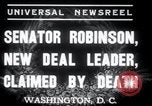
American flag lowered to half mast in Washington DC on the death of Senator Robinson.
Shows Senator Joseph T Robinson of Arkansas making a speech. American flag lowered to half mast in Washington DC on the death of Senator Robinson. The Capitol Building can be seen in the background.

U.S. aviatrix Amelia Earhart arriving in Oakland California after solo flight from Honolulu, Hawaii
Scenes of Amelia Earhart taxiing her Lockheed Vega 5B airplane to the ramp, at Oakland Airport, on January 12, 1935, having left Wheeler Field, Honolulu the day before. This completed her solo flight from Honolulu, Hawaii (the first person to successfully accomplish such a transpacific flight). Crowds her airplane as she taxis in, and parks near a hangar of the U.S. Naval Air Station. Amelia stands in the cockpit of her airplane, holding a bouquet of flowers, as crowds mill about on the ramp beneath. Change of scene shows Amelia standing on a steel platform, of the airport tower, with her husband, George Putnam. Closeups of Amelia.
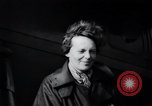
U.S. aviatrix Amelia Earhart Putnam gives an interview at an airfield in United States.
Surrounded by press, public and photographers U.S. aviatrix Amelia Earhart Putnam gives an interview at an airfield in United States. She leaves with some officials.
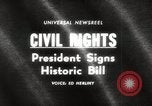
President Lyndon B. Johnson signs the Civil Rights Act at the White House in Washington DC.
United States Congress passes the Civil Rights Bill. After the House votes on the measure, President Lyndon B. Johnson signs the Civil Rights Act of 1964 into law before an audience of Legislators and Civil Rights Leaders at the White House in Washington DC. He calls it 'a turning point in history' and uses one hundred pens to affix his signature. Many civil rights and government leaders seen behind the President, including Everett Dirksen and Hubert Humphrey, Marting Luther King Jr., and J. Edgar Hoover, all of who receive signing pens. President Johnson hands several signing pens to Attorney General Robert Kennedy, for members of the Kennedy family.

Golfer Dave Marr wins the Professional Golfers' Association (PGA) tournament.
Golfer Dave Marr wins the Professional Golfers' Association (PGA) Tour Championship in Pennsylvania, United States. South African golfer Gary Player swings his club during the competition. Spectators watch in the golf course. American Arnold Palmer competing in the tournament. Top money winner Jack Nicklaus, nicknamed The Golden Bear, swings his club. Dave Marr competes and wins the PGA tournament. Billy Casper finishes with a 282. Crowds rush to find the golf ball landing a few feet from the hole. Dave Marr voted the PGA Player of the Year, with his PGA Championship trophy.
CRITICALPAST.COM: About Us | Contact Us | FAQs - How to Order | License Agreement | My Account | My Lightboxes | Shopping Cart | Advanced Search | Featured Collections | Website Terms & Conditions | Privacy Policy ©2026 CriticalPast LLC.
License Agreement |
Terms & Conditions |
Privacy Policy
©2026 CriticalPast LLC.