


 Francais
 Deutsch
 Italiano
Refine Your Search
Adak Alaska USA 1943 stock footage and images
- Showing 667 to 672 of 27381 results more
more Hide
Hide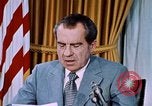
President Richard Nixon gives an energy crisis statement from the Oval Office of the White House in Washington DC.
U.S. President Richard Nixon addresses the nation from the Oval Office of the White House in Washington DC, United States. President Nixon says that lack of energy supplies would bring temporary shortages in fuel supplies and some increase in fuel prices. He says that if energy resources were properly developed they could fulfill American energy requirements for centuries. He says that his administration was going to end quantitative controls on oil imports and establish a national energy office in the United States. He talks about increasing the ability of the United States to prevent oil spills. The President proposes that the Congress should remove government regulations which discouraged the growth of domestic natural gas industry. Secondly, the Congress should help to establish research and ground work for developing new forms of energy for a long range future (alternate sources of energy). Thirdly, the Congress should permit the licensing of new deep water ports to open the way for long delayed Alaska oil pipeline.
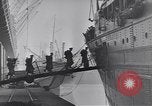
U.S. Army Service Forces transporting troops and supplies worldwide during World War II.
U.S. troops board a large troop transport ship via a gangplank. Troops on an intermediate deck of the ship. Some are sprawled out relaxing. View from above of more troops boarding a ship. Men and equipment on the pier below. American forces at various far flung places where the U.S. Army Services Forces facilitated their transport and logistic support. Fleeting glimpses of troops in: Ireland; Alaska; Trinidad; and South America. Troops jam the upper deck of a transport ship. Army Service Forces officers in a planning meeting. Naval officers on deck of a ship look through binoculars as U.S. Naval ships bombard the coast of Solomon Islands and landing craft carry marines in an amphibious assault. Next, a man is seen annotating a map of North Africa. Secret maps pertaining to Allied landings in Tunisia and Algeria. Animated map illustrates amphibious landings on North African coast, highlighting Casablanca, Oran, and Algeria. Landing craft carry troops and supplies that are piled up in the sand beach. Soldiers moving military supplies ashore, in fire brigade fashion. Soldiers working at desks in Offices of the Army Service Forces. Filing cabinet in background. Trucks on the move in remote locations. Supply ship being loaded at a terminal. Fuel drums and army vehicles a being loaded aboard ships. Officers seated at a conference table. Ordinary American enlisted soldiers in a griping session at an Army post in the United States. Camera pans over large formation of soldiers. Animated chart shows more than half of servicemen who are part of Army Service Forces (ASF), are unaware of that. Troops marching in review at a tropical location, where reviewing officers wear pith helmets. Chart illustrates lack of unit pride in ASF. Images of various ASF logos. Chart shows results of polling data from soldiers and service members. Signal Corps and Engineers elements of ASF have the greatest unit pride. But most think better of other branches of the Army. More troops marching, in steel helmets and carrying rifles with bayonets affixed. Troops marching overlaid by "50%" indicating that half don't believe their contributions to the war effort are significant. Troops lined up (for pay?). More charts expressing concern about low morale. A heavy gun firing. German paratroopers jumping from a formation of Junkers Ju 52 aircraft. Charts expressing prevailing U.S. troops view that Germany wouldn't be too hard to defeat. Chart showing lack of understanding about why the U.S. is fighting Germany. Image of President Franklin D. Roosevelt and Prime Minister Churchill seated in front of their key military officers at Casablanca Conference in World War 2. Chart shows U.S. soldiers believe that the greatest war effort is expended by the U.S. followed by Russia, with China and Britain providing little. Chart illustrates that only half U.S. troops want to get overseas and fight. Chart shows U.S. War Department films can correct this problem.
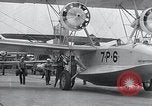
U.S. patrol squadrons (PN-1 type) take off from San Diego, California to make Alaskan trip and gather aeronautical data.
Officers and men of two U.S. patrol squadrons go through final tests in preparation for their expedition to Alaska in San Diego, California. PN-1 type flying boat or sea plane patrol aircraft take from water to make Alaskan trip to gather valuable aeronautical data.

News reporters and scientists tour site of an atomic blast in a tunnel in Nevada
An atomic blast in a tunnel in Nevada. Men enter a tunnel. A sign reads 'Danger, Do not enter without proper authorization'. The atomic bomb blast makes news with the disclosure that the shock was detected in Alaska over 2000 miles away. Men wearing helmets and shoe coverings inspect and make observations in the tunnel. A man passes a geiger counter near a tunnel wall spray painted with writing, "Seismometer site."
U.S. Air Force film report about the Strategic Air Command (made in January 1960.)
Film opens with still portrait of U.S. Strategic Air (SAC) Commander in Chief, General Thomas S. Power., who is heard saying "Peace is Our Profession." Signs outside SAC headquarters, bearing the same message. Glimpse of entry gate to the headquarters. View of Atlas missile displayed on the headquarters grounds. Closeups of the missile, at top and bottom. Air Force personnel manning phones in SAC Control Center, underground,at Offutt Air Force Base, Nebraska. Others are seen walking near extremely large wall displays. View of the main Control Center with officers at their respective stations. View of person entering past guards into the underground facility. A briefing officer climbs onto a moving platform that elevates him so he can brief the center personnel, while referring to one of the large wall displays. View of teletype machines receiving messages in the Center. Digital clocks show times in places like Guam and Alaska. The famous "Red Telephone" from which it is possible to launch the entire SAC strike force, all over the world, within seconds after warning of an enemy attack has been received at SAC Headquarters. B-47 bombers taxiing on a base. Closeups of some taxiing. A B-47 bomber taking off and flying high above the camera. Extreme closeup from outside of crew members in cockpit of B-47 in flight. Flight of three B-47s flying in formation.
U.S. Air Force Strategic Air Command aircraft stationed in various parts of the world.
Klaxon horns sound alert signals and U.S. Air Force Strategic Air Command (SAC) flight crews, on alert, stop what they are doing and rush from their quarters to jeeps, that take them to their aircraft. They are seen clambering aboard their bomber aircraft. Closeup of a B-47E-30-LM Stratojet bomber, tail number 52-264, taxiing. Closeup of its wheels. The B-47 taking off from a base in the continental United States. In Alaska, a B-52 bomber taxis on a plowed taxiway in a snowy airfield. Local people watch as two B-52 bombers take off from a SAC base in Africa. Formations of B-52 bomber in flight. View of Air Force personnel inside the SAC headquarters Command and Control Center at Offutt Air Force Base, Nebraska. Scene shifts to a B-47 bomber flying directly overhead and an Atlas missile being launched. Glimpse of pilot and copilot inside the cockpit of a SAC bomber in flight. A nuclear bomb dropping from an open bomb bay viewed from inside the aircraft. An atomic explosion during one of the tests conducted by the United States, in the Pacific, from 1946 to 1958.
CRITICALPAST.COM: About Us | Contact Us | FAQs - How to Order | License Agreement | My Account | My Lightboxes | Shopping Cart | Advanced Search | Featured Collections | Website Terms & Conditions | Privacy Policy ©2026 CriticalPast LLC.
License Agreement |
Terms & Conditions |
Privacy Policy
©2026 CriticalPast LLC.