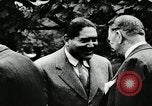
'Retrospect' about the events that led to the present pattern of life in the United States. Host Douglas Edwards, an American television anchor speaks about the past events in America. Crowd of unemployed men gathering in bread lines after the 1929 crash and subsequent Great Depression. A man near a box of apples. The U.S. President Franklin Delano Roosevelt addresses a gathering. The kidnapping of Charles Augustus Lindbergh, Jr., the son of the aviator Charles Lindbergh in 1932. Bruno Richard Hauptmann, a German carpenter who abducted the child during the trial. The congressmen at the formation of the Lindbergh Law. Newspapers describe the apprehension or death of notorious mafia gangster criminals, such as Dutch Schultz and Baby Face Nelson. Huey Pierce Long, Jr. a American politician addresses people. Emperor Haile Selassie of Ethiopia appeals to the League of Nations, after his country is attacked by Italy under Mussolini. Adolf Hitler stands. Troops of the German army parade. Scenes from the Spanish Civil War in 1936-1937 as Spanish national forces battle against fascist rebel forces. Spanish Troops fire 75mm field artillery pieces. Bombs being dropped on the buildings. Spanish soldiers marching during the civil war. The Hindenburg disaster takes place on May 6th 1937: The German airship LZ 129 Hindenburg catches fire over the Lakehurst Naval Air Station in Manchester, New Jersey. Amelia Earhart the first woman aviator to fly solo holds flowers and is surrounded by people. She went missing in 1937. Cowboy philosopher Will Rogers, alone and with U.S. Vice President John Nance Garner and with aviator Wiley Post (who had patch over one eye). King Edward VIII of Great Britain, abdicating the throne for "the woman I love." People at the German-American Bund Nazi sympathizing gathering including the subduing of objectors on stage, in Madison Square Garden, New York. British Prime Minister Neville Chamberlain, returning from meeting with Adolf Hitler in Munich in 1938. View of Adolf Hitler. German tanks on parade in World War II. an array of artillery guns on display. Railway guns being fired in WW2.
Douglas Edwards interviews William Donner in the United States. Douglas Edwards, an American television anchor speaks about shelter and evacuation for nuclear fallout. Fallout shelter sign (for atomic or nuclear attack) in front of a family fallout shelter bunker with beds, furnishings, and supplies. He interviews William Donner from the Office of civil defense and mobilization. William Donner speaks about the situations in which to evacuate and to seek shelter. He speaks about the factors that govern the evacuate or shelter policies during an emergency.
A 1959 production featuring footage of personalities visiting the United States circa 1920s. Douglas Edwards, an American television anchor speaks about the people who visited America. The French actress Sarah Bernhardt visits America. She is greeted by the people. In 1914 she is honored by the French government. Madam Ernestine Schumann-Heink, famous contralto, on board ship with friends. Modern interpretive dancer Ruth St. Denis, with a troupe of women dancers. Russian composer, conductor, and pianist Sergei Rachmaninoff, onboard ship. Polish pianist and statesman, Ignacy Jan Paderewski, arriving in America. Famous Irish tenor, John McCormack, arriving in America. Italian tenor, Enrico Caruso, seen with friends, as he visits America. George Bernard Shaw, the Irish playwright visits America. Arthur Ignatius Conan Doyle, creator of the Sherlock Holmes stands with his family. Maurice Maetterlinck, Belgian playwright and Nobel laureate on deck with companion. Michael Arlen, best-selling author, arrives in America. Joseph Conrad, Polish-born English novelist, is seen with ship's officers. British writer, H.G.Wells, tips his hat as he arrives on a ship to America. Douglas Edwards then presents a public interest announcement about civil defense planning, for the U.S. Office of Civil and Defense Mobilization, sponsor of the show (during the Cold War). This is followed by voice-over from unidentified speaker urging citizens to take part in civil defense. Shown is a cutaway view illustrating emergency supplies of canned foods, and other supplies stored in a home basement for emergencies. A sign describes it as part of a "Family Fallout Shelter." Narrator states that civil defense is an American tradition.
Scenes inside U.S. Army hospital in Japan. Surgeons scrub hand and arms at sinks before surgery. Surgeons prepare for operation on patient. Patients are moved about and treated. Nurse tending bedridden patient. Several soldiers seen leaving to return to duty in Korea. Others are transported to Haneda Air Base, near Tokyo, where the Military Air Transport Command operates long range aircraft in the so-called "Pacific Air Shuttle." A wounded soldier is taken from an ambulance and placed aboard a transport aircraft. Interior of aircraft is shown, with stretchers, medical workers and nurses. Aerial view of Honolulu, Hawaii from aircraft. The aircraft lands at Hawaii where wounded are cared for at Tripler Army Hospital until ready to continue journey to Travis Air Force Base in California. View from cockpit of aircraft landing at Travis Air Force Base. Wounded patients being moved through rear cargo doors of C-97 aircraft. Exterior view of fountains and main entrance at Walter Reed U.S. Army General Hospital in Washington, DC. Captain Zimmerman introduces Lt. Col. S.J. Newsome, who was a surgeon in Korea with the 7th Division. Dr. Newsome emphasizes "speed" as the most important factor in recovery of wounded soldiers. He also mentions the problem of disease affecting soldiers in foreign places like Korea, saying that, "Korea is a disease ridden country" with cases of pnemonia, smallpox, and "orgental diseases we had never seen before." Scenes of Army doctors performing medical examinations on soldier patients. Wounded being placed aboard jeep in Korean War. Soldier firing rifle. Soldiers slogging through mud and water. Soldiers firing artillery in the snow, and evacuating wounded on inflated litter in snow. Combat in jungle. View of civilian people wasing at side of river in India. Civilian dead in streets.
U.S. Army Medical Service research in collaboration with scientists around the world. Tropical Disease Research Center in Puerto Rico. Building with jeep parked in front. View of scientists in the laboratory. Scientists at table gather data on tropical diseases. Germany: scientists studying epidemic jaundice observe through a microscope. Another scientist pours a liquid in a flask. Madagascar: Street scene with veiled women and turbaned men in market place. Washington: Laboratory of Army Medical Research Center. Technicians and scientists work in laboratory. Chemicals kept in the shelves. A doctors collects the blood sample of a person. A team of doctors perform surgery. A soldier on bed wearing an oxygen mask and then on a tread mill, in experiments at Fort Knox, Kentucky . Aerial view of atomic bomb explosion. A person entering Headquarters Building of Walter Reed U.S. Army Medical Center, Washington, DC . A soldier in a whirlpool tub of water as a nurse helps with physical therapy. Soldier patients receiving physical therapy under supervision of nurse. A soldier prone on an examination table as he receives an x-ray or other imaging scan under supervision of a nurse. Soldiers in beds in a hospital ward. A soldier drinks purified water from a mug and soldiers purify water in the field. A scientist pours a liquid from one flask to another in developing pasteurization methods. Chefs cook. Scientists wearing mask as they work in the laboratory. Microscopic view of disease-causing bacteria. DDT is sprayed into a woman's clothing. DDT spray and powder fumigates plants. A blood sample taken from finger and put on slide. Candling of eggs preparing penicillin.
TV program, 'The big picture, ' depicts the role of women in the U.S. Army. U.S. Army Captain Carl Zimmerman speaks on the role of women in the American army. U.S. army soldiers marching. U.S. women soldiers in uniform marching. United States army General Matthew Bunker Ridgway speaks about the services provided by women in the U.S. army.
CRITICALPAST.COM: About Us | Contact Us | FAQs - How to Order | License Agreement | My Account | My Lightboxes | Shopping Cart | Advanced Search | Featured Collections | Website Terms & Conditions | Privacy Policy ©2026 CriticalPast LLC.
License Agreement |
Terms & Conditions |
Privacy Policy
©2026 CriticalPast LLC.