


 Francais
 Deutsch
 Italiano

Refine Your Search
Adak Alaska USA 1943 stock footage and images
- Showing 67 to 72 of 27411 results more
 Hide
Color Sound
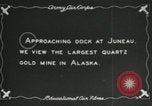
Alaska Steamship liner, SS Aleutian, docks at Juneau, Alaska
View from SS Aleutian ocean liner, of the Alaskan Steamship Line, as it approaches dock at Juneau, Alaska. Sheer mountain face overlooks the docks. Large buildings of the largest Quartz Gold mine in Alaska, are stepped down the steep slope. The ship passes a building labeled "Juneau Cold Storage."After docking, the camera pans across many people on the wharf and a building labeled The Alaska Line. Various sorts of buildings line the waterfront area.
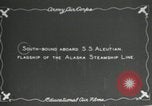
Tourists aboard the Alaska Steamship, SS Aleutian. The processing of fresh caught salmon at a cannery in Alaska
The SS Aleutian, flagship of the Alaska Steamship Line. Passengers appear small as they walk on the deck of this large ship. Some travelers sit under umbrellas. Others enjoy the sun. But all are dressed fairly warmly. A large smoke stack protrudes through the center of the deck. Masts and other timbers seem suited for loading and unloading freightl. A fishing boat makes way across a mirror-like bay. A powered fishing boat tows a line of 17 dinghies each having a mast for sail. View from high point on a wharf, of large fishing boats tied up at a cannery dock. Fishermen unloading a catch of salmon into a hole in the dock, where the fish enter a conveyer that moves them into the cannery processing area. There men use pikes to move and sort them. Next men are seen cleaning and fileting the fish by hand at work stations equipped with water supplies. They place the filets on trays above their work stations. Women are seen canning smaller pieces of fish and placing them into boxes. The fish are then processed by belt-driven machinery that packs and seals the finished cans that then pass by a quality control inspector. Final scene shows a building standing on many tall stilts, in the water. Several men stand on the nearby shore.
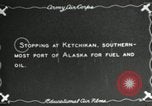
The Army Air Corps Alaska Flight support ship, "El Aquario," stops to refuel at Ketchikan, Alaska
Views of harbor at Ketchikan, Alaska, from deck of the "El Aquario," supply ship supporting the U.S. Army Air Corps Alaska flight project in 1934. Camera pans across the harbor showing a steamship at dock and the settlement town of Ketchikan. A passenger steamship is seen with smoke from her stack, underway. A smaller steam ship underway. Crew members of the El Aquario, fish from her bow. One pulls in a small fish. Another one poses with a large fish. views of glassy calm waters from the El Aquario, underway after refueling at Ketchikan, followed by scenes as she moves into more open waters. Hills with snow on their tops.
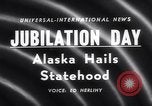
Jubilation Day as Alaska hails Statehood
Alaska hails approval of its Statehood. Alaska wins approval to become the nation's 49th State. Cars seen on the street in Anchorage. A sign reads 'Anchorage-All-America city'. Newspaper headlines read 'We're in'. Children sit with a banner reading '49th State'. A huge star placed on the U.S. flag by a woman who is helped by a fireman. Young women in a convertible celebrate as they pass by Stolt Electric at 1000 East Forth Avenue as wells as Hub Clothing in Anchorage. A man with a stuffed moose with a sign on it that reads, 'Hey Texas, now I'm the biggest bull.' Crowd gathers to watch a bonfire built by Boy Scouts. Sign reads, 'State of Alaska'

Will Rogers and Wiley Post take off in their floatplane from Fairbanks, Alaska. The plane later crashed, killing both.
Will Rogers and Wiley Post pose for pictures taken just before boarding Post's self-modified float plane that crashed en route to Point Barrow, Alaska, killing both Rogers and Post. The floatplane takes off from water. Map shows route: Juneau to Dawson, Fairbanks, Alaska; to Anchorage, Alaska and then back to Fairbanks. The words, "Point Barrow" animate on map - line running to Point Barrow, where the plane crashed after an engine failure, while taking off from a lagoon just outside of Point Barrow. Aerial views of the Arctic areas.
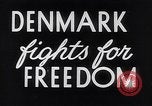
German occupation, martial law, and Danish resistance in Denmark during World War II
Film about Denmark after the Nazi German occupying force declared martial law and state of war with Denmark, in 1943-44 during World War 2. It was made by Danes and smuggled out of Denmark during that period. Opens with view of a church building and flocks of birds. Views of German army troops marching into Copenhagen, Denmark on April 9, 1940. SS troops dressed in black, marching. German soldiers carrying rifles with fixed bayonets, goosestepping. A fire burning at site sabotaged by Danish resistance elements in 1943. Derailed trains carrying goods to Germany. Fire at a German factory. Danish workers with bicycles staging a strike in protest German measures in response to resistance actions. Danes gathered in outdoor observance memorializing those killed by the Germans. A shop owned by German sympathizers (Quislings) destroyed by other Danes. People gathered on street on 29 August 1943, when the occupying German forces attacked the remaining Danish garrison and declared martial law. Announcement posted in Danish on a wall. View of Danish Naval vessels ordered scuttled by the Danish Admiralty, including the coastal defense ship,Peder-Skram, seen in front of a large building, the submarine, Havfruen (not seen) and others seen sunk at docks in Copenhagen harbor. Bullet hole through a glass window. A week later, on Sunday, 5 September, 1943, a German Panzer light tank is seen moving on a street, as pedestrians go about their business in Copenhagen. German soldiers patrolling on a motorcycle with sidecar. A man holding his hands up as he is hustled through a crowd under arrest by a German in black uniform (possibly Gestapo or SS). Motorcycle driving through pedestrians on the sidewalk. Spectators line a fence by an open field near a building labeled "Badstue Badminton." One, a woman, speaks through the fence to a Danish soldier interned there. View of the quarters of the Royal Guard at Rosenborg, occupied by German soldiers and with Nazi flag flying above it. Civilian relatives of interned men wait outside army headquarters for news about them. A courtyard, during a mass funeral, is filled with memorial flower wreaths covering the coffins of Danish soldiers and civilians killed by the Germans. Camera focuses on a wreath from King Christian of Denmark, among the many others. Two German soldiers march up a path at the Royal Residence Amalienborg, where King Christian is arrested. Views from moving camera as Danish flags are seen flying all over the city of Copenhagen, on 26 September, 1943, to celebrate the King's 73rd Birthday. The major exception is the Nazi Gestapo headquarters in the "Shellhus" (the prewar Shell Oil offices) shown in isolation. Views of people moving their belongings on hand carts after their homes were taken over by Germans. The slogan in English, "Do it well and do it now,"is seen left by Danish resistance fighters where they sabotaged a German military installation.
CRITICALPAST.COM: About Us | Contact Us | FAQs - How to Order | License Agreement | My Account | My Lightboxes | Shopping Cart | Advanced Search | Featured Collections | Website Terms & Conditions | Privacy Policy ©2026 CriticalPast LLC.
License Agreement |
Terms & Conditions |
Privacy Policy
©2026 CriticalPast LLC.